
This study investigates the evolution of typographic style in Switzerland, France, and Germany across the 20th century through the geometric analysis of over 12,000 printed letterforms. The authors measure proportion, weight, slant, and serifs, and combine this with a network analysis of designers. The research challenges the myth of a unified “Swiss Style,” showing diverse regional approaches (e.g., Basel vs. Zurich) shaped by educational and cultural factors. Swiss typography emerges as a plural field influenced by local contexts and transnational exchanges.

This study analyzes 76 American cookbooks (1803–1922) to understand how immigrant cuisines (French, Asian, African American, Italian) adapted to American culture. Using ingredient co-occurrence networks and topic modeling (LDA), the authors identify distinctive adaptation paths. French cuisine introduced refined dining customs, Asian cuisines emphasized combinations of common ingredients, African American recipes reflected constrained social roles, and Italian cuisine shifted after WWI. Cookbooks are seen as cultural mediators, expressing both ethnic identity and integration into American norms.

Using a dataset of 1,238 silk artifact images, this study analyzes the evolution of color schemes and motifs in Chinese silk design from the Sui-Tang to Qing dynasties. Combining computer vision (HSV analysis) and image recognition (Gemini API), the authors find shifts linked to political and cultural trends. Tang and Ming silks favor vibrant reds and auspicious symbols; Song silks adopt elegant, subdued plant-based motifs; Qing silks use a wider palette, reflecting court preferences and social hierarchy. Motif clustering reveals both symbolic continuity and stylistic diversification.

This study compares Olympic media coverage in People’s Daily (China) and The New York Times (USA) to explore how nationalism is expressed. Using over 100,000 articles from 1980–2015, the authors analyze language, sentiment, and framing. Chinese media emphasizes collective national pride, while American media highlights individual achievement. Both prioritize gold medals, but differ in emotional tone and political framing—especially during events like the 2008 Beijing Olympics. The findings reveal how global sports are used to construct national identity through distinct cultural and ideological lenses.

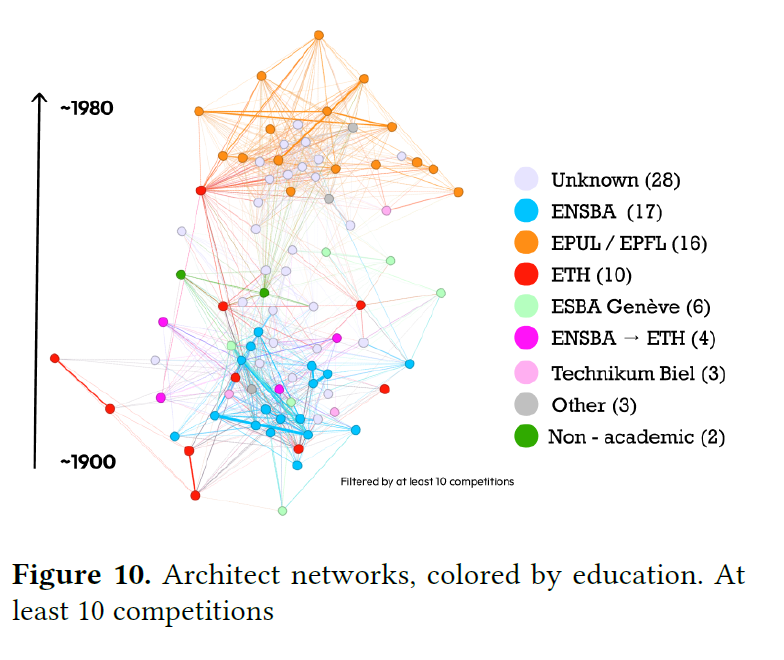
This project analyzes a large-scale corpus of architecture competitions in French-speaking Switzerland (1870–1990) using data compiled by historian Pierre Frey. By building two weighted graphs (competitions and architects), it identifies central actors (e.g., Fonso Boschetti, Laverrière), domain trends (public buildings, education), and spatial patterns by canton. Shannon entropy metrics show that most architects remain active in a single region, while educational background (ENSBA, EPFL, etc.) influences network clustering. The study reveals a mostly anonymous field structured by institutional networks and regional dynamics, extending beyond canonical figures.
This project applies computational methods to analyze how trauma is portrayed in the works of Chu Tien-hsin, a second-generation Taiwanese writer. Drawing on trauma theory, the authors operationalize four traits (indirection, fragmentation, repetition, absence) through close/distant reading of 17 short stories. Using lexical networks, time-shift detection, and visual metaphors, they reveal how fractured identity and marginalization of mainlanders are embedded in narrative structure. The study aims at demonstrating the value of digital tools in exploring psychological and historical trauma in literature.

This study examines the representation of women in 109 manga volumes (1970s–2010s) across various genres. Using statistical analysis (visual/narrative presence, network centrality) and linguistic features, it reveals significant gender imbalances shaped by genre and target audience. Women appear more frequently and speak more in shōjo and josei manga (aimed at female readers), but remain secondary in shōnen and seinen manga (aimed at male readers). Persistent visual stereotypes—such as schoolgirls, traditional roles, and sexualized portrayals—are common, though some seinen titles feature more complex female protagonists. A gradual shift toward more neutral or masculine speech styles among female characters is also observed over recent decades.
