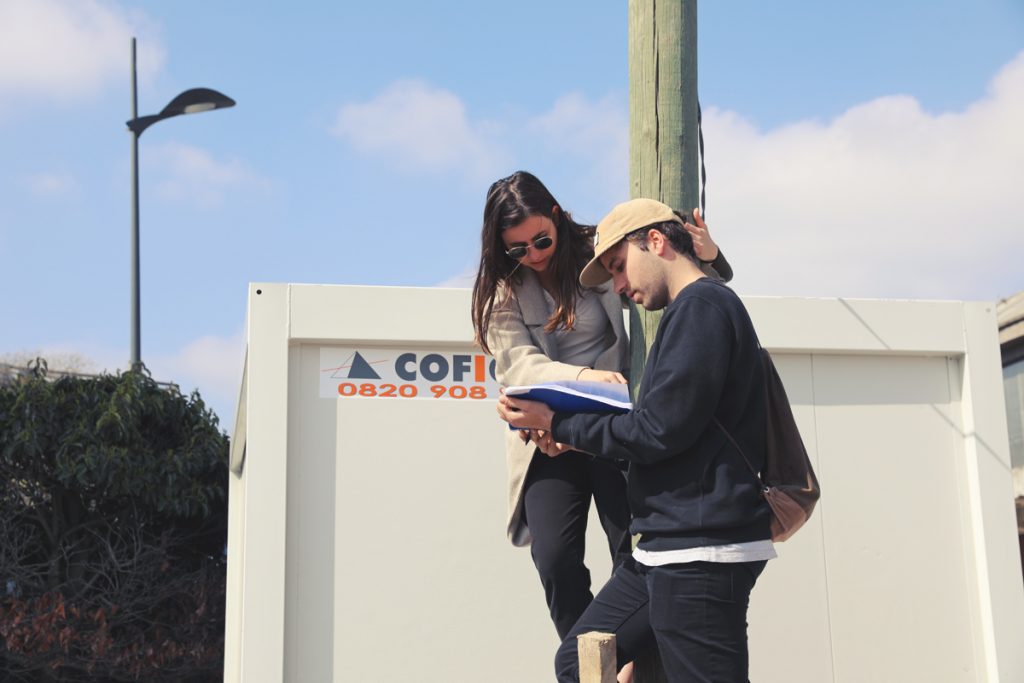
Teaching © Alexandre Gonzalez, 2019 The list below lists all the courses given at EPFL in which the Urban Sociology Laboratory is involved.City and mobility (FR)The City and Mobility course focuses on the basic knowledge of mobility, starting from lifestyles to inform architecture and engineering. In particular, it explores how cities and mobility are co-constructed. Urban habitat and developement (FR)Focusing on how the poorest are housed in both the Global South and North and in crisis settings, particularly emergency architecture, the course offers a critical analysis of 21st-century urbanisation worldwide.UE D : Urban planning and territory (FR)The UED aims to familiarize itself with diagnostic methods that incorporate social practices and customs, since “living” encompasses not only the physical space of one’s home, but also the entire range of life experiences and familiar places that people use, experience, and grow attached to.Urban sociology (FR)This course aims to familiarize students with urban sociology through the lens of housing. It enables them to navigate the concepts, tools, and methods the discipline offers to understand the simultaneous evolution of lifestyles and the spatial and political organization of territory. DemanSpatial and Regional Economy (FR)An introductory course designed to provide a historical perspective on the spatial distribution of people and activities.UE C : Habitat and society (FR)By articulating theoretical and architectural knowledge with socio-political knowledge, the UE aims to explore the possibility of a renewed contemporary imagination around productive housing.Horizontality and its project (EN)This seminar proposes to revisit horizontality as a mode of critical engagement with the socio- political, ecological, and economic processes of urbanization. Participant will be asked to develop a critical perspective on each of the three seminar session.Diversity and Sustainability in Human Mobility (EN)Human and freight mobility in large cities is a complex process with dense population and many transport modes to compete for limited space. New emerging modes of transport, such as on-demand services, and new technologies, such as autonomous vehicles, create additional opportunities and challenges.Digital urban history: Lausanne Time Machine I (FR)This course is part of a series of interdisciplinary and collaborative courses open to students from UNIL and EPFL. It focuses on urban history through the application of computational methods and the development of a digital project in group. Digital urban history: Lausanne Time Machine II (FR)This course is part of a series of interdisciplinary and collaborative courses open to students from UNIL and EPFL. It focuses on urban history through the application of computer methods and the development of a digital project.Chantier urbain : perception, gouvernance, usages (FR)This week ENAC aims to apprehend urban construction sites as key moments in the territorial fabric, in the articulation between urban planning and the effective implementation of a vision for the territory. Night in Lausanne (FR)This course will take an interdisciplinary approach to night in Lausanne. Through a nocturnal journey, we will take stock of the city as it exists at night time. During the week, we’ll collectively reflect on the future of nights in Lausanne, and present our initial ideas. The city-tree (FR)This ENAC week is an invitation to question how cities are reinventing their relationship with living and natural entities, focusing in particular on the question of trees. International Geneva: An urban system in crisis (FR)This course explores the challenges facing Geneva’s international ecosystem in the context of declining multilateralism and reduced U.S. support. Using the concept of the urban system, students analyze how political shifts impact institutions, real estate, and territorial structures.Urban governance (EN)This course equips students with the tools for influence within institutional systems, drawing on the fields of sociology, political science, and social psychology. It explores how to better convince decision-makers, shift behaviors, and design more effective and impactful public policies.Social justice and transition in the urban context (EN)This course explores the connections between spatial justice, social equity, and the socio-ecological transition. Through theoretical insights and empirical case studies, it provides tools to critically assess urban transformations and imagine fairer and more hospitable cities.Computational methods in urban studies (EN)CMUS will focus on acquiring insights into, engaging with, and modeling the processes of spatial transformation in contemporary societies. It will integrate statistical techniques and critical urban theory to promote socially and environmentally fair policies against the climate crisis.AI for urban history (EN)This course explores how AI and LLMs can be used to analyze historical urban data. Students study city evolution (1700-now) through hands-on projects, producing a web interface and a visual booklet based on sources like maps, directories, and cadastral records.Core project: Urban Systems studio (EN)Interdisciplinary urban design studio addressing site and territory through multiple urban systems. Combines architectural, infrastructural, and social approaches to develop critical, experimental, and context-responsive urban interventions.