
Partner: École Polytechnique Fédérale de Lausanne
PI: Prof. Nenes Athanasios ([email protected])
Operator: Dr. Ghislain Motos, LAPI/EPFL
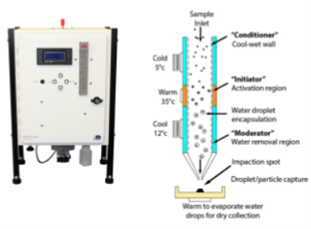
Virus sampling is performed using a viable virus aerosol sampler (BioSpot-VIVAS model BSS310, Aerosol Devices Inc., Fort Collins, CO, USA; see Lednicky et al., 2016), which, before sampling, grows aerosol particles from as little as a few nm to micron-sized droplets via water vapor condensation. This ensures that the particles are collected gently on a Petri dish filled with 2.5 mL of PBSi. The supersaturation within the instrument column is produced by the injection of liquid water and the heating or cooling of different stages: the conditioner, initiator, moderator, nozzle, and sample are respectively set to 5, 45, 13, 25 and 13°C. Samples are collected with a flow rate of 8 L/min. To ensure efficient condensation of water vapor onto virus-containing aerosol particles in the BioSpot-VIVAS column during sampling, the aerosol concentration is kept below 50,000 cm–3 in the aerosol chamber. A higher particle concentration could cause excessive competition for water vapor within the column, which would lead to a degrading collection efficiency. After collection, the samples are poured into conical 50-mL centrifuge tubes and placed in an ice bucket until the end of the experiment, and subsequently aliquoted and frozen at −20°C.