Partner: National Technical University of Athens, FORTH, EPFL
PI: Prof. Alex Papayannis, NTUA/EPFL; Prof. Athanasios Nenes, EPFL/FORTH
Operator: Marilena GIDARAKOU, PhD candidate NTUA; Romanos FOSKINIS, EPFL
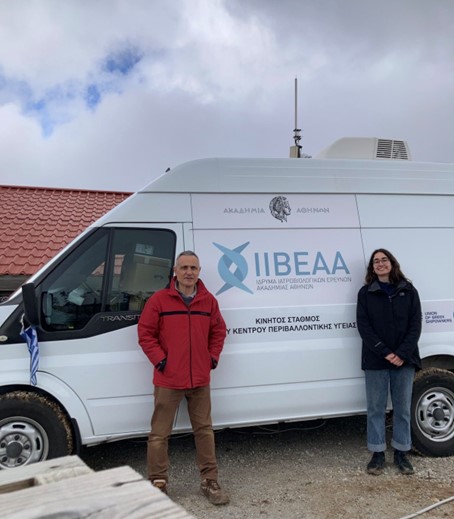
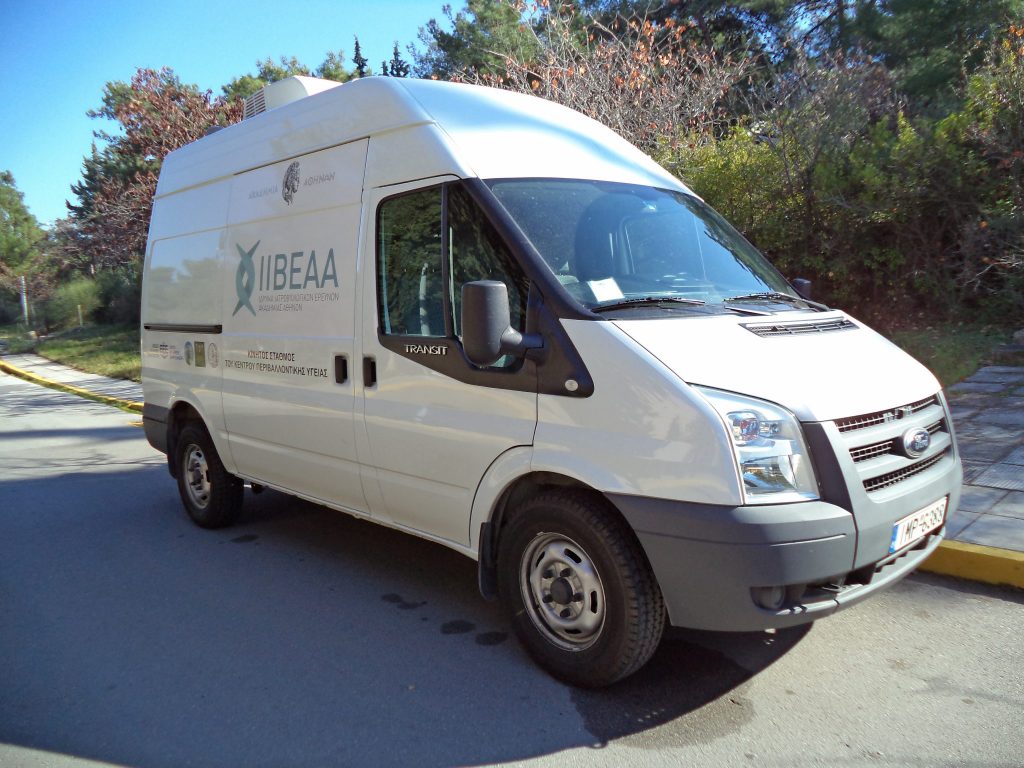
AIAS/NTUA is a mobile elastic-depolarization lidar employed for detecting the polarized and cross polarized backscattered lidar signals at 532 and 1064 nm, to further characterize the shape of the sampled particles and cloud properties (water- or mixed-phase clouds). AIAS provides the vertical profiles of the aerosol backscatter coefficients at 532 and 1064 nm and the linear particle depolarization ratio (LPDR) at 532 nm, as well as the cloud height and geometrical properties, from 0.3 up to 8-10 km asl., with a high temporal (1.5 min) and spatial (down to 7.5 m) resolution. The calibration technique applied in this system is the ±45o calibration method as performed in the frame of the European Aerosol Lidar Network (EARLINET).
The EPFL/NTUA/FORTH UV elastic-fluorescence-Raman lidar (ARIS) is a world-class mobile multi-wavelength (36 channels) lidar (the first of its kind) with detection channels at 355 nm (elastic), 387 nm (Raman N2), 407 nm (water vapor) and 420-520 nm (fluorescence). ARIS is also equipped with a 32-channel lidar spectrometer to detect highly detailed fluorescence spectra from atmospheric bioaerosols (pollen, fungal spores, bacteria), from 0.3 up to 2 km asl. ARIS uses a UV laser emitting at 355 nm to provide the vertical profiles of the aerosol backscatter coefficients and lidar ratio at 355 nm, water vapor mixing ratio, fluorescence capacity and fluorescence backscatter coefficients at 470 nm from bioaerosols. Using Machine Learning (ML) algorithms ARIS is also able to provide bioaerosol typing at various atmospheric layers in the planetary boundary layer. ARIS participated at the PERICLES and Chopin Helmos CleanCloud campaigns.