
Rich, Poor and, Mechanism of Sharing’s in Space Hyderabad City, India
Keywords: Hyderabad, Paris, Porous City, Urbanism, Metropolis, Social injustice, Spatial injustice, Spaces of encounters, Spatial proximity, & Public space
Shyam Sunder Sirimalla
Prof. Paola Viganò (Thesis Director),
Prof. Vincent Kaufmann (Thesis Co-Director)
Thesis accepted on 19th May 2026 under the jury’s recommendation of
Dr. Vandana Shiva
Satish Kumar
Rahul Srivastava
Prof. Milica Topalović &
Prof. Nicola Braghieri.
EPFL Switzerland 2026
Grant: EPFLglobaLeaders
PhD thesis Abstract
This PhD research gazes into spaces of encounters in Hyderabad City within the conceptual and methodological framework of ‘spatial proximity’ and ‘street vendors as agents of change’ to affirm : Can a street vendor act as an agent to produce social and spatial porosity in a city?
Space encourages and discourages certain forms of interaction and gives form to social structures and ideologies (Lefebvre, 1991) ¹. What are those spaces that encourage interaction, and those that do not? While public spaces invite and encourage a form of interaction, is it true interaction? Are there other
unexpected or invisible spaces of interactions? Do all the known to be public spaces welcome interactions? And above all, What forms of interactions and between whom? It is that ideology, to identify the space that encourages interaction, central to spaces of encounter this thesis unfold.
The positionality of street vendors as a subjects of spatial rationality—as agents to reveal and produce social porosity—identifies the spaces of encounters, interpret the proximity, overlap, crossings and juxtapositions in public space between the urban elite and urban poor in Hyderabad city. Street vendors are invisibilised, though they can be considered as a crucial articulation between rich and poor and their divided territories in Hyderabad city. If one wants to make a more inclusive city, one needs to better understand socio-economic encounters between the urban elite and urban poor in public spaces. Street vendors move fluidly between social classes, interacting daily with the affluent and the poor, aware of their movements and their potential encounters in public spaces, which remained largely unstructured and underexplored in public space. Recognizing and embracing the spatial and social informality of street vendors, and to develop from there a renewed – spatial and social – urbanity is crucial.
The fundamental observation of this research came from the socio-spatial phenomenon of “the existing close physical proximity between the urban elite and urban poor in space in the city of Hyderabad India, transformed by the informal, trust-based socio-economic interactions, in other words the spatial proximity, translated into the unique mosaic urban fabric of the wealthy neighbourhoods and pockets of slums in juxtaposition to most western megacities, whereas seclusion between these two parties is rather explicit. It is apparent that, despite the colossal indifferences between the affluent and poor, there is no ghettoization, at least spatially. This spatial relation of proximity is generating incentives for the poor to locate in close physical proximity to affluent as sources of labour and services (Sirimalla 2017, 2023)2,3.
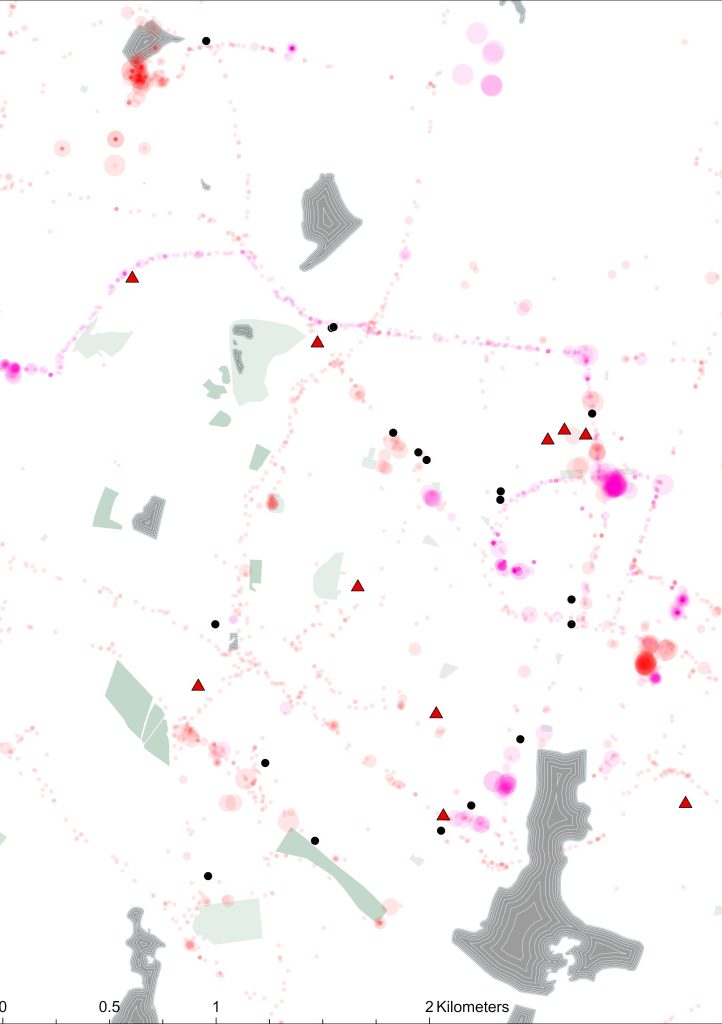
Prerogative to support my assertion, based on life experience as a burgess of Hyderabad city, and field research, methods are constructed to reveal the actual spaces of encounters between the rich and the poor in public spaces through empirical investigation, through the voices subaltern vendors and subaltern drivers as agents, by investigating their spatial practices in micro studies—including behavioral observations, GPS tracking, interviews, census and palimpsest strategies, territorial and ethnographic mapping—references of “Porous City” project of Greater Paris (Secchi and Viganò, 2011)4 as a mapping guide.
The resulted Spaces of Encounters are analyzed and interpreted through three tales (storytelling through maps, folklore and anecdote inspired by the work of Mahasweta Devi): The street vendor pterodactyl, The porosity producer, and the porous city. The street vendor pterodactyl narrates the lost roots and dispossessed territories of Subaltern (a Dalit, a tribe) in Telangana. The Porosity Producer narrates the tale of the capacity of spaces of encounters in creation and production of social porosity across the boundaries and segregations of socio-cultural, socio-economic and socio-ecological dimensions. And finally, The Porous City narrates the spatial policy and design of the Hyderabad metropolis, envisioning the extension of spaces of encounters to the metropolitan scale, as the starting point of an integrated system of public, green, water, and economic spaces.
Thesis remarks
Dr Shyam sunder has done a good combination of social and architectural design, and he also done a very deep analysis. And I loved the quotation by Kabir in every chapter. I think he has made a very, very creative effort of intermingling the social strata, street vendors and the drivers as well as town planning and architecture, and of course, Hyderabad is a fascinating city to study, to analyze both for its diversity as well as its plurality, and for its long history.
Vandana Shiva, 19th May 2026