
Predict Lab Student Projects
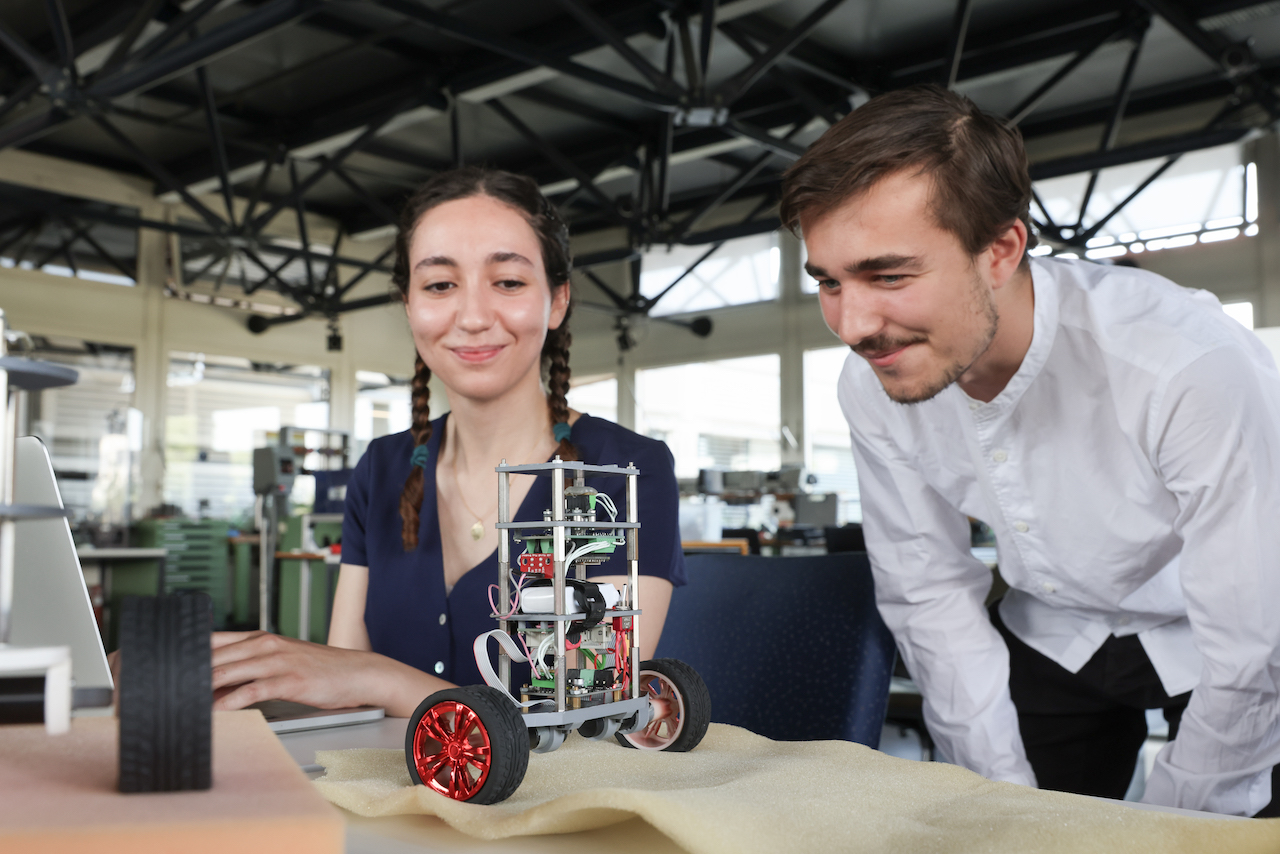
Bachelor project : Mini-segway racing
We regularly run student projects at the bachelor and master levels. We update the list of offered projects below before each term.
If you’re an EPFL team that would benefit from better control, please do contact us, as we do regularly run projects with a number of teams.
If you have a project in control or robotics that you’re excited about, please get in touch and we can try and make it work!
Design, Modeling, and Control of a Centrifugally-stiffened Multi-kite Airborne Wind Energy System
- ID: 14279
- Type(s): Projet de semestre MA GM, Projet de Master (PDM) GM
- Section(s): GM
- Status: Validé
- Professor: Colin Neil Jones, Johannes Christian Karl Waibel
Airborne Wind Energy systems harvest renewable energy from high-altitude winds with a fraction of the costs of conventional wind turbines.
We explore a multi-kite system with two or three kites constrained by tethers, which is supposed to increase efficiency significantly.
Semester or master projects may push boundaries in system (hardware) design, modeling, identification, and simulation, and/or control with classical (PID) or optimal control methods (LQR/MPC).
There is a possibility to get involved in a consequent startup company founded in summer 2026 after the project.
- Comment
- If interested, please directly email [email protected].
- Professor(s)
- Colin Neil Jones (Laboratoire d’automatique 3), Johannes Christian Karl Waibel
- Administration
- Barbara Marie-Louise Frédérique Schenkel
Heterogeneous Monitoring of of Industrial Processes with Graph Neural Networks
- ID: 13958
- Type(s): Projet de semestre MA EL, Projet de Master (PDM) EL
- Section(s): EL
- Status: Complet
- Professor: Mengjie Zhao, Colin Neil Jones
Heterogeneous Monitoring of of Industrial Processes with Graph Neural Networks
The Industrial Internet of Things (IIoT) generates vast quantities of data from interconnected sensors and actuators operating within complex industrial systems. While conventional data-driven methods analyze these signals with temporal context, they often fail to exploit the relational structure of industrial processes, such as physical connections, control interaction and functional dependencies between process variables and equipment.
In industrial plants, sensor data can be broadly categorized into process state variables (e.g., temperature, pressure, flow), actuation or load variables (e.g., motor current, valve position), and equipment health indicators (e.g., vibration, acoustic emission). These variables are tightly coupled: process conditions influence equipment load, which in turn affects mechanical degradation. However, in current industrial practice, process monitoring and equipment condition monitoring are typically treated as separate problems, obscuring these interactions and delaying fault detection.
As a result, many equipment faults are only detected once mechanical damage has already progressed. For example, pumps, among the most failure-prone components in process manufacturing, often experience clogging due to suboptimal process operation, such as inappropriate temperature changes that induce crystallization or solidification. While vibration-based monitoring may detect the issue at a late stage, it often cannot distinguish whether the root cause lies in process conditions or intrinsic equipment failure. Capturing the relationships between process variables, load indicators, and equipment health is therefore essential for early fault detection and meaningful root cause analysis.
Graph Neural Networks (GNNs) provide a powerful framework to model such systems by explicitly representing sensors and actuators as nodes in a graph, with edges encoding their interactions. By leveraging sensor relationship graphs inferred from IIoT data and guided by physical priors and known process dependencies, GNNs can capture structured, directional dependencies that are typically lost in traditional machine learning approaches.
Thesis Goal
This thesis aims to develop a framework for heterogeneous monitoring that jointly models process behavior and equipment health. By combining data-driven graph inference with physics- and process-informed constraints, the proposed approach seeks to enable early fault detection, unsupervised fault diagnosis, and interpretable insights into how process operation affects equipment degradation.
You will work with real industrial IIoT data and addresses a practical and pressing challenge in process manufacturing, conducted as part of an early stage startup project. Ultimately, the goal is to support operators with actionable insights that enables timely and informed interventions to ensure process reliability.
Requirements
– Good knowledge of Python programming.
– Good understanding of fundamental machine learning concepts.
– Experience with GNNs is advantageous.
- Professor(s)
- Mengjie Zhao (Laboratoire d’automatique 3), Colin Neil Jones
- Administration
- Barbara Marie-Louise Frédérique Schenkel
- External
- KIIO
- Site
- https://sirop.org/app/99ca7413-9292-4f65-bf8e-bdf54bd0ffe3?_k=E7s1t-HKBHHssTRV
Hierarchical Graph-Based Root Cause Analysis for Large-Scale Process Systems
- ID: 14274
- Type(s): Projet de Master (PDM) MT, Projet de semestre MA MT
- Section(s): MT
- Status: Complet
- Professor: Mengjie Zhao, Colin Neil Jones
The Industrial Internet of Things (IIoT) generates vast quantities of data from interconnected sensors and actuators operating within large-scale industrial systems. While conventional data-driven methods analyze these signals with temporal context, they often treat the plant as a flat collection of variables and doesn’t account for the process structure, delayed propagation, and feedback loops. This makes it difficult to identify the root cause of faults in large-scale systems, particularly when disturbances evolve and propagate across interacting process units.
Large process manufacturing plants, such as refineries or chemical production facilities, often consist of tens of sub-processes and thousands of sensors monitoring process states, actuation. These sub-processes are tightly coupled through material, energy, and control interactions, such that disturbances rarely remain local and may propagate across the plant over time. To ensure reliable and stable operation, it is therefore important not only to detect when abnormal behavior occurs, but also to trace deviations that appear across multiple parts of the plant and over extended time horizons back to their point of origin. Analyzing how faults propagate across interacting sub-processes supports root cause localization and enables a physically meaningful interpretation of observed process deviation/fault.
Graph Neural Networks (GNNs) provide a powerful framework for modeling industrial systems by representing sensors and actuators as nodes and their interactions as edges. Beyond modeling individual signals, GNNs naturally support hierarchical representations, in which groups of signals associated with a subprocess are modeled as subgraphs. This structure enables modular modeling of large systems, allowing sub-process models to be integrated into a plant-level graph without retraining the entire model from scratch. By operating at multiple levels of abstraction, higher-level connectivity supports efficient information propagation and faster fault localization.
Thesis Goal
This thesis aims to develop a framework for hierarchical, propagation aware framework with modularized subprocesses that allows extension of the monitoring scope so that we can monitor and diagnose large sale systems. You will work with a recently released high-fidelity Fluid Catalytic Cracking (FCC) – Fractionator processes simulator, which includes realistic fault scenarios such as condenser efficiency degradation and valve leakage. This thesis addresses a practical and pressing challenge in process manufacturing, and will be studied in the context of an early stage startup project. Ultimately, the goal is to support operators with actionable insights that enables timely and informed interventions to ensure process reliability.
Requirements
– Good knowledge of Python programming.
– Good understanding of fundamental machine learning concepts.
– Experience with GNNs is advantageous.
- Professor(s)
- Mengjie Zhao (Laboratoire d’automatique 3), Colin Neil Jones
- Administration
- Barbara Marie-Louise Frédérique Schenkel
- Site
- https://sirop.org/app/aebdeb9c-e3b5-4cab-83a5-5780db41d49b?_k=6w1MnPKomApCSvyi