
General information
Type: Semester project
Period: Spring 2021
Project directors: Prof. François Maréchal (IPESE-EPFL)
Assistants: Rafael de Castro Amoedo (IPESE-EPFL)
Related project: Waste integration and valorization
Introduction
The world is facing a dual challenge with regard to sustainable energy supply and greenhouse gas emissions reduction. The complexity consists in supplying more abundant and clean energy, consuming fewer fossil resources and finding appropriate solutions to reduce emissions while satisfying the energy requirements. Between the first oil crisis and 2010, global CO2 emissions doubled and until 2035 an additional increase of 23% is predicted due to the growing population and energy consumption.
To meet the CO2 reduction targets and to ensure a reliable energy supply, the development and wide scale deployment of cost-competitive innovative low-carbon energy technologies is essential. Switching to renewable resources and CO2 capture, utilization and storage (CCUS), are regarded as promising alternatives. To design and evaluate the competitiveness of such complex integrated energy conversion systems, a systematic comparison including thermodynamic, economic and environmental considerations is required.
Waste generation, an often sub-valorized resource, is in clear growth. Rapid urbanization and increasing population are pressuring the use of resources and the growth of waste generation in the near future. Depending on the composition, average municipal solid waste (MSW) energy content is close to 12 MJ/kg, part of which can be retrieved as heat and electricity in thermovalorisation units. Nevertheless, these units emit a considerable amount of CO2 – a carbon source that could be used if CCUS technologies are deployed.
Technologies for CO2 capture are relatively well understood today with cases of industrial success. However, capture and storage are not enough; an utilisation phase is seen as fundamental to replace processes in which fossil fuels, or fossil-based resources are used. The current conviction is that CCUS technologies have to be pursued. To understand entirely the role the different CCUS schemes could play in reducing greenhouse gas emissions, a number of issues need to be addressed simultaneously – like the assessment of all resulting emissions, the energy requirement and the costs of implementation.
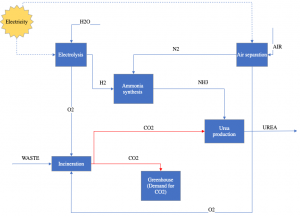
Among the uses of CO2, Urea (CO(NH2)2) production is one of them. Close to 90% of the world industrial production of Urea is used as a nitrogen-release fertilizer. NH3 is obtained using the Haber-Bosh process, with H2 originated by electrolysis (with renewable sources, e.g.) and N2 from air separation (cryogenic, e.g.). The demand for fertilizers is expected to increase in the future, due to an increasing population and food production requirements.
GOAL
A systematic thermo-environomic optimisation strategy for the consistent modelling, comparison and optimisation of waste treatment options is being developed. Based on the application of a consistent evaluation and optimisation methodology, this work intends to study and understand Urea production as greenhouse gas mitigation strategy and fertilizer supplier in actual and future energy systems. CO2 is captured and sourced from municipal solid waste thermovalorisation.
The choice of the optimal configuration is defined by the production scope and the priorities given to the different thermo-environomic criteria. The environmental benefit and the energetic and economic costs of carbon use should be assessed for several process options and energy systems, for different CO2 capture technologies. The process performance is systematically compared and the trade-offs are assessed to support decision-making and identify optimal process configurations understanding the trade-offs between efficiency, investment and emissions.
Taking into account the thermodynamic efficiencies based on process integration techniques, the economic performance and the environmental impacts from LCA results will be beneficial from a sustainability and process engineering point of view to identify possibilities to enhance the competitiveness of waste thermovalorisation units with CCUS.
This work aims to contribute to the following questions:
- What is the cost of treating waste, if Urea production is comprised?
- What is the cost and impact of incorporating Urea production?
- What causes the trade-off between the different objectives and what are the consequences on decision-making?
- What is the influence of technology choice and the economic scenario?
- What are the bottlenecks of these technologies to penetrate the market?
TOOLS
A library of models is available comprising different conversion routes for waste. In particular, thermovalorisation models (incineration, gasification, pyrolysis, etc.), district heating models, CO2 capture units and use of CO2 to produce C1-chemicals (methanol, methane, formic acid, carbon monoxide) are available. In addition, utility/combustion models (steam network, heat pumps, SOFC, Gas turbines, SOEC, etc.) are available.
Key points:
- Literature review on Urea production and use of CO2 as carbon source
- Development of Urea production models from CO2 and NH3, including ammonia synthesis from H2 and N2.
- Model incorporation in waste superstructure with CO2
- Results generation using different approaches
- Possibility of industrial collaboration with current partners.
Workflow:
- Modelling approach: Flowsheet (Aspen/Vali) and/or black-box/surrogate models for process modelling to represent the chemical and physical Urea and NH3 Literature review is needed to retrieve relevant values.
- Energy integration: by making use of pinch analysis, it will be shown how the process integration impacts the process configuration, with opportunities for maximizing and valorizing waste heat.
- Economic and environmental analysis – addresses how a carbon tax could be implemented and its value, as well as the impact of adding Urea production.
- Multi-objective optimization – to assess trade-offs between conflicting objectives, including efficiency metrics, capture and utilization costs, etc.
- Results analysis and conclusions, answering the main questions.
You should bring…
- Experience in working with flowsheeting software is a plus (Belsim Vali, Aspen) or motivation to improve your skills
- Experience in programming languages (e.g. Matlab, Lua, python, etc.) is a plus
- Good knowledge of energy systems (Some EPFL classes like: Thermo I/II, Energy conversion, advanced energetics, MOES, etc.)
- A high level of motivation to work independently in a structured and organized way
- Good communication skills
We also offer…
- Scientifically rich environment with researchers from different areas
- Dynamic research group
- EPFL-Valais promotes sports and language classes to its members.
- Financial compensation to travels from Lausanne to Sion.
How to apply?
If you are interested or want to know more please make contact with Rafael Amoedo attaching your CV, Cover letter and transcript of records (Bachelor and Master).