
1. (MS thesis) Stability of Gravity Jets
Gravity or buoyant jets play a key role in many environmental and engineering flows. Typical examples include river plumes entering the ocean, fresh-salt water interfaces in estuaries, or the striking patterns where two rivers of different density and sediment load meet. Similar horizontal dense jets also occur in industrial outfalls, cooling-water releases from power stations into stratified lakes and coastal waters. Understanding how such a horizontal gravity jet evolves, mixes, and spreads is essential for predicting pollutant dispersion, assessing environmental impact, and designing safe and efficient discharge systems.
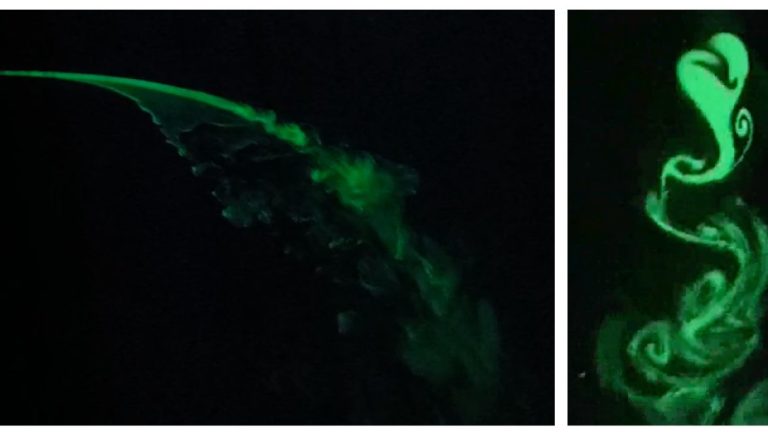
In this project, we will investigate the dynamics of a heavy fluid (salt water) injected horizontally into a lighter fluid (fresh water) as shown in Figure 1 of the experimental study. Looking from the side (left, Figure 1), the injected jet falls at certain distance with the secondary jet which falls at a shorter distance. From the frontal view (right, Figure 1), a complex three-dimensional structure is developed showing instability patterns. These gravity jet behaviours can be characterized by a non-dimensional number, called Richardson number, Ri which is defined as the ratio between velocity of the jet at the inlet and the gravity difference between the two fluids [1].
The project combines theoretical analysis and numerical simulations using OpenFOAM to clarify the fundamental physics that control its trajectory, dilution, and mixing behaviour over the range of Ri. The project will be with Prof. E. Yim at HEAD-Lab. EPFL and will be in collaboration with Prof. P. G. Ledda of Univ. Cagliari.
References:
[1] G. Querzoli and A. Cenedese, “On the structure of a laminar buoyant jet released horizontally,” Journal of Hydraulic Research, vol. 43, no. 1, pp. 71–85, 2005.
Figure 1 (above): (Left) side view, (right) front view from the injection nozzle (Credit: G. Querzoli & P. G. Ledda, Univ. Cagliari)
2. (MS thesis) Wind driven rotating sloshing waves in hydro turbine draft tube
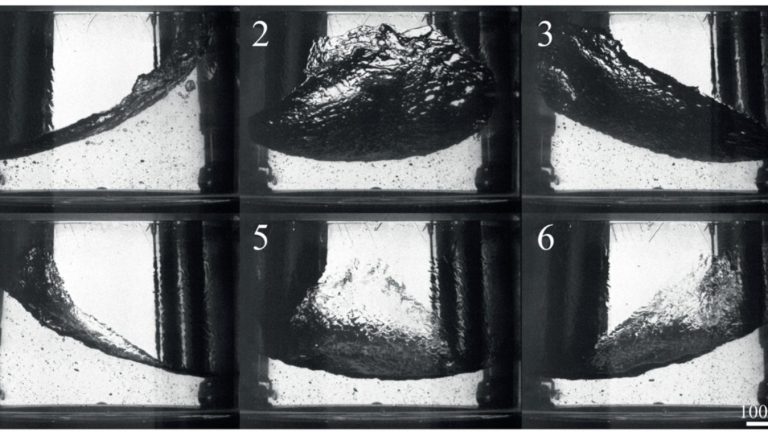
Hydropower units may be required to operate in condenser mode to supply reactive power. In this operating mode, the water level in the turbine or pump-turbine is lowered below the runner by closing the guide vanes and injecting pressurised air, so that the runner rotates in air while the draft tube cone is only partially filled with water. The resulting rotation of the air drives a shear flow above the water surface, which in turn excites a free-surface motion in the draft tube. The experimental study [1] has shown that this motion is dominated by an azimuthal wavenumber 𝑚 = 1 rotating wave, often described as a sloshing mode.
The objective of the present work is to develop an in-depth theoretical description of this wind-driven free surface wave. As a first step, we analyse the generation and wavelength selection of gravity waves on a flat water surface subject to a parallel air flow, using simplified hydrodynamic models and linear stability analysis [2]. Building on this understanding, we then extend the theory to a cylindrical geometry representative of the draft tube, and investigate the structure, frequency and growth of azimuthal modes of the rotating wave. The goal is to clarify the physical mechanisms controlling this resonant air-water interaction in condenser mode operation and to provide a framework for interpreting existing experiments and guiding future design choices. The project will be with Prof. E. Yim at HEADLab.
and in collaboration with Dr. E. Vagnoni at PTMH, EPFL.
References:
[1] E. Vagnoni, A. Favrel, L. Andolfatto, F. Avellan, 2018, “Experimental investigation of the sloshing motion of the water free-surface in the draft tube of a Francis turbine operating in synchronous condenser mode”, Experiments in Fluids 59(6):95.
[2] Branger, H., Manna, M. A., Luneau, C., Abid, M., and Kharif, C., 2022, “Growth of surface windwaves in water of finite depth: A laboratory experiment,” Coastal Eng., 177, 104174.
Figure 1 (above): Sloshing waves in a partially filled hydro turbine draft tube induced by the turbine’s rotating motion [1].
Semester projects (MS)
1. Bubble vortex breakdown in a cylindrical cavity
Description:
This project will investigate the possible flow configurations of a swirling flow inside a cylindrical cavity. In the case of a single-phase flow, the base flow and its stability characteristics to axisymmetric and helical modes are well understood. It is furthermore known that the flow can exhibit pronounced recirculation regions at the cavity axis, some of which could sustain a small portion of a second phase. In this project a small bubble of a second phase will be inserted at the axis of the cavity, and its corresponding base flow and its stability in the axisymmetric setting will be investigated with a numerical code (either COMSOL or Basilisk, depending on the student preference). The possible base flow will be determined as a function of nondimensional Reynolds (viscous interactions), Froude (effective gravity) and Weber (surface tension) numbers, the cavity aspect ratio and the boundary conditions imposed on the cavity walls. The expected outcome of the project is a description of the ranges of the governing parameters that yield a configuration that can sustain a stable second phase bubble as a function of the bubble size and its initial placement. These parameter ranges will be determined using a time integration procedure with a selected numerical code.
Requirements/Methods:
The student is expected to have a good background in fluid mechanics and numerical methods for the Navier-Stokes equations. The candidate should have a certain level of confidence and experience in either using the COMSOL solver or in the C/Linux environment in the case of Basilisk code.
Related course: Fluid mechanics (ME-280), Instability (ME-466), Numerical flow simulation (ME-474)
Other Projects (taken):
2. Effect of channel confinement on bluff-body wake dynamics (Taken)
Description:This project investigates the flow around a bluff body placed in a confined channel. Using two-dimensional numerical simulations, the student will study how the blockage ratio affects wake structure, drag, and vortex shedding. A circular or square cylinder will be placed at the center of a channel, and the Reynolds number will be chosen in the laminar vortex-shedding regime. The student will quantify the drag coefficient, lift fluctuations, recirculation length, and Strouhal number, and compare these quantities for different blockage ratios. The objective is to understand how wall confinement modifies canonical bluff-body wake dynamics.
Requirements/Methods: The student is expected to have a good background in fluid mechanics, including the Navier-Stokes equations. We will solve the laminar Navier–Stokes equations using an open-source finite-element method, and post-processing will be performed in MATLAB.
Related course: Fluids mechanics (ME-280), Instability (ME-466)
3. Pressure losses and secondary flows in a 90° pipe bend (Taken)
Description:This project investigates the flow through a 90° pipe bend and the origin of the minimum in the bend loss coefficient as a function of bend radius. Using CFD simulations, the student will study how the curvature ratio R/D affects pressure loss, separation, secondary flow, and downstream flow recovery. The student will simulate several bend radii and compute the bend loss coefficient, The results will be compared with classical engineering trends, where K_L decreases for sharp bends but can increase again for very large bend radii due to accumulated wall-friction losses. The objective is to understand the balance between turning-induced separation losses in sharp bends and wall-friction losses in long-radius bends.
Requirements/Methods:The student is expected to have a good background in fluid mechanics, including internal flows, Bernoulli’s equation, and the Navier–Stokes equations. The project will use CFD software to simulate incompressible flow through a 90° pipe bend, with post-processing performed with the CFD or MATLAB.
Related course: Fluids mechanics (ME-280), Introduction to Turbomechinery (ME-342)