
Florence Graezer Bideau supervised students’ semester projects, focusing on the main research areas of the Heritage, Anthropology and Technologies research group.
A selection of the last projects is listed below:
Exploration des opportunités digitales dans l’événementiel
Juliette Le Béchec

This Master’s research project is part of an effort to improve the digital work tools of the Montreux Jazz Festival’s Permanent Bureau team, drawing in particular on the needs of the Operations Department.
It is grounded in a comprehensive understanding of the logistical, operational, and urban challenges of the festival and its preparation, drawing on data from both the previous and upcoming editions. This approach makes it possible to identify the limitations of the tools currently used to conceptualize and plan the setup of the various spaces and projects, in terms of technical practicality, collaborative use, and the risks associated with data preservation. The work culminates in a concrete UX/UI-focused reflection on the development of a centralized digital platform designed to facilitate internal and external collaboration, and to support teams in the design and management of interdependent projects.
Résumé des interviews Montreux Jazz Memories
Mathieu Mognol

This bachelor’s project focused on processing over 800 interviews from the Montreux Jazz Festival, collected within the Montreux Jazz Memories program. The dataset, originating from automatic transcriptions, contained numerous errors and lacked organization. The project had two main goals:
Develop an automated pipeline for cleaning and correcting transcripts (language detection, dictionary and proper noun list checks, phonetic corrections, and Levenshtein distance adjustments) to produce reliable text.
Design an AI-based summarization tool, using models such as GPT-3, to generate concise summaries (<1000 characters) and extract relevant keywords.
The final outcome includes a Python application (MJM_App) enabling keyword-based search, summary browsing, and on-demand generation of new summaries. This tool significantly improves access to key information for researchers, supports the preservation of the festival’s cultural heritage, and serves as a replicable framework for managing large qualitative datasets.
Hop on the train! – Interactive platform to explore the collection of Montreux Jazz Memories interviews and synthesize interconnected stories
Daniele Belfiore
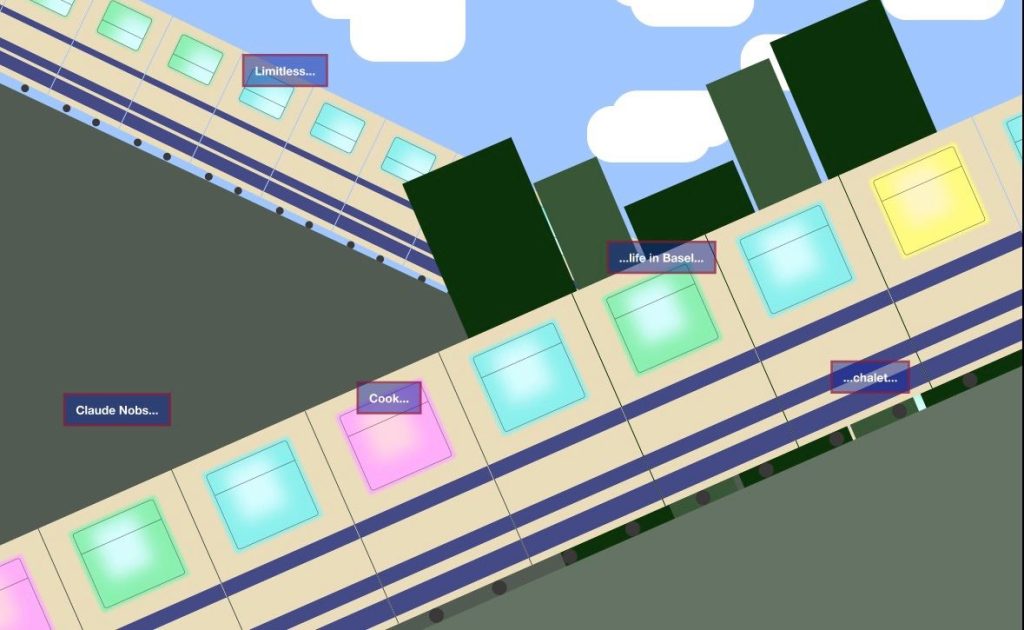
“Hop on the train!” is a semester project from the Digital Humanities master, conceived to explore the interviews archive of the Montreux Jazz Memories project in an interactive fashion, by interconnecting all the different interviews to synthesise new stories. An AI pipeline leverages Large Language Model to process over 400 transcriptions – to clean the texts and classify them into 6 different themes – and then synthesises 6 original stories (one per topic) to unveil new points of view from the people who experienced the festival. The prototype is deployed as an interactive exhibition which is based on a set of train journeys: each train line is a story, and each wagon represents an interviewee and their information. In this way, the full train ride tells a story that is data driven and that has never been read before. In this report, you’ll see the experiments that lead to the final AI pipeline to process the texts and all the inspiration and concepts that lead to the final design.