
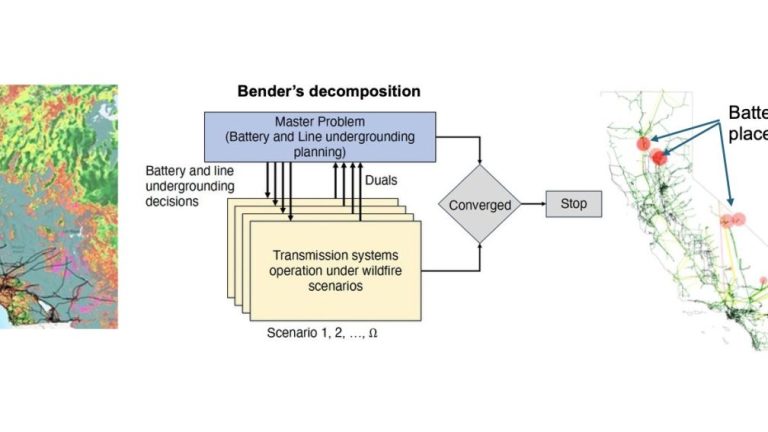
Grid-Integrated Energy Storage Operation and Planning
We investigate the integration of energy storage systems in power networks, addressing both operational and planning aspects. Our work focuses on optimal sizing, siting, and control of storage to enhance grid flexibility, facilitate renewable integration, mitigate congestion, and improve overall system reliability under uncertainty.
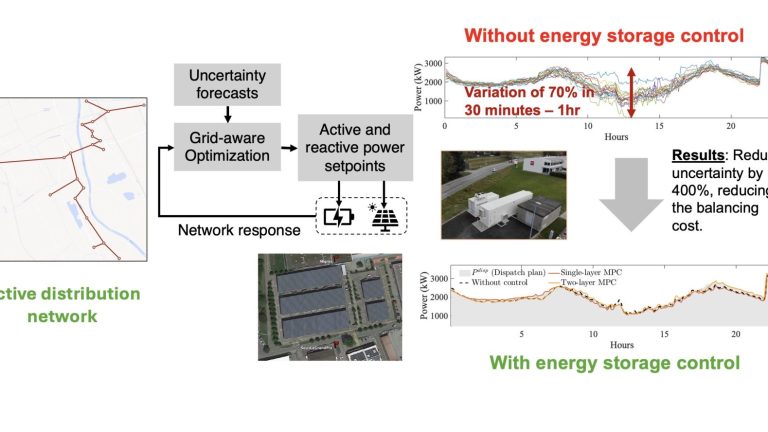
Intelligent Grid-Aware Control of Active Distribution Networks
We develop control and optimization methods for active distribution networks with high penetration of distributed energy resources (DERs). Both centralized and distributed schemes are designed to coordinate heterogeneous resources, such as photovoltaics, storage, and flexible demand, to provide ancillary services while ensuring secure network operation. The proposed approaches explicitly account for uncertainty in generation, demand, and system conditions. They have been validated on real-world distribution networks in collaboration with distribution system operators (DSOs), demonstrating scalability and practical relevance, and opening pathways toward commercial deployment.
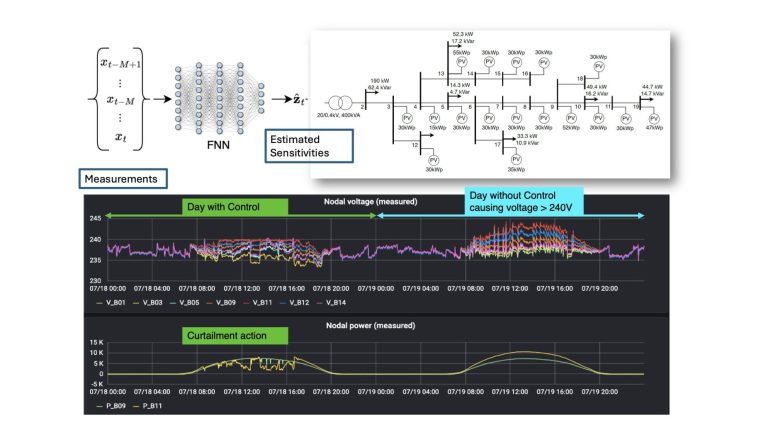
AI/ML-assisted Data-Driven and Model-Free Control in Data-Limited Settings
We propose data-driven and model-free control methodologies tailored to power systems with limited observability. Leveraging measurements from smart meters and phasor measurement units, our methods enable control and optimization without requiring fully specified network models. These approaches combine system identification and control, allowing reliable operation even with incomplete or noisy data. Experimental validation on real-world systems demonstrates their effectiveness and robustness in practical settings.
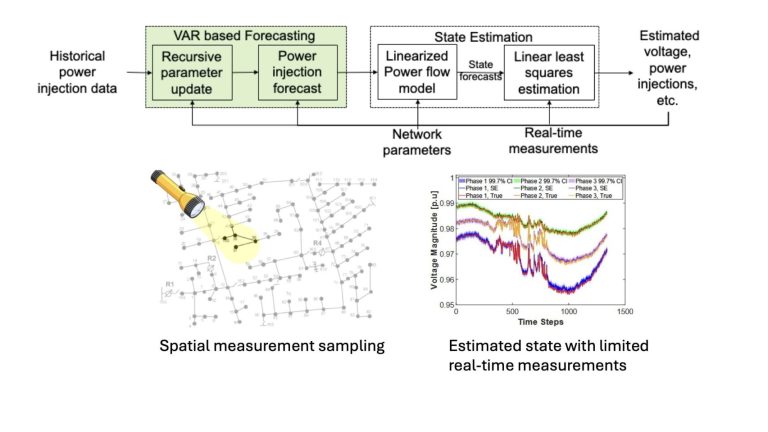
Network and State Estimation Under Limited Observability
We address the problem of monitoring distribution systems in the presence of sparse measurements and limited communication infrastructure. Our research focuses on advanced distribution system state estimation (DSSE) and parameter identification techniques. The developed methods improve network visibility by reconstructing system states and estimating unknown parameters, thereby enabling more reliable grid operation and supporting advanced control applications in modern distribution systems.
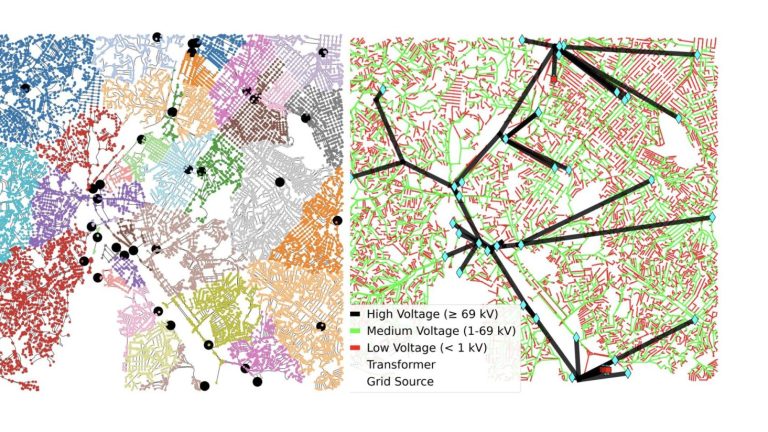
Synthetic Power Network Generation
We develop methodologies for generating realistic synthetic power networks to overcome the limited availability of real-world data. Our work includes the first publicly available synthetic representation of Swiss distribution systems. This framework enables large-scale, reproducible studies, including nationwide analyses of solar hosting capacity and optimal planning of energy storage.
LLM-powered Autonomous Grid Agents
We develop agentic AI frameworks that can autonomously perform power-system studies using a combination of large language models (LLMs), retrieval-augmented generation (RAG), power-system simulation tools, and physics-based validation. The system allows a user to ask natural-language questions such as:
- “Run optimal power flow on a particular network and identify constraint violations.”
- “Perform N-1 contingency analysis and rank the most critical outages.”
- “Explain why bus voltages are below limits and suggest corrective actions.” and so on…
The agent interprets the request, selects the appropriate analysis workflow, executes the required simulation, validates the results using deterministic engineering rules, and generates a technically grounded explanation.
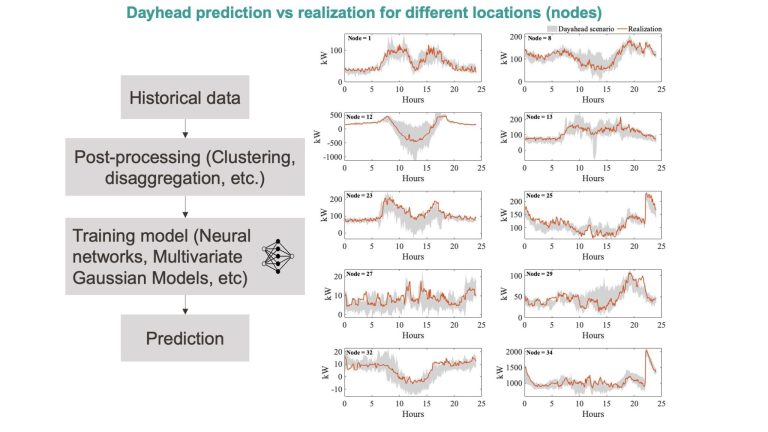
Day-ahead and Real-time Forecasting of Solar, Demand and Electric Vehicle Demand
We develop novel forecasting techniques for the uncertain power injections such as solar, wind, hydro generations, residential, commerical and industrial demand, and electric vehicle charging behaviour. The techniques utilize historical dataset at various spatial and temporal resolutions and apply new machine learning and statistical techniques to reduce the error between realization and forecasts. The forecasts can be obtained for multi-day ahead to minutes ahead of the realizations.
The current research is on developing decision-focussed forecasting of the stochastic resources by learning to perform better at task for which the forecast are going to be used compared to the root mean square error.