
Contacts: Elisabetta De Giovanni, Prof. David Atienza
Our system
Physical inactivity is the fourth leading risk factor for global mortality. Therefore, it is important to develop a healthy lifestyle performing regular physical exercises, which improves aerobic capacity and cardiovascular system. Nonetheless, engaging in physical training requires an optimal fitness and performance monitoring to prevent overtraining or undertraining. Furthermore, a feedback in real-time can help to improve the performance and the physiological adaptation of the body to cope with the training. In this research field, different works designed models of the performance of athletes, although they do not consider the acute immediate response of the body to training to assess underperformance. Then, in the commercial field, wearable sensors are frequently used to extract simple physiological data. However, these sensors are not highly accurate and often rely on anthropometric data and activity-related features.
This project aims to design a smart autonomous multi-parametric system which accurately monitors training performance and fitness level of an athlete in real-time, using wearable sensors. The system can be divided in 4 phases shown in the figure below.
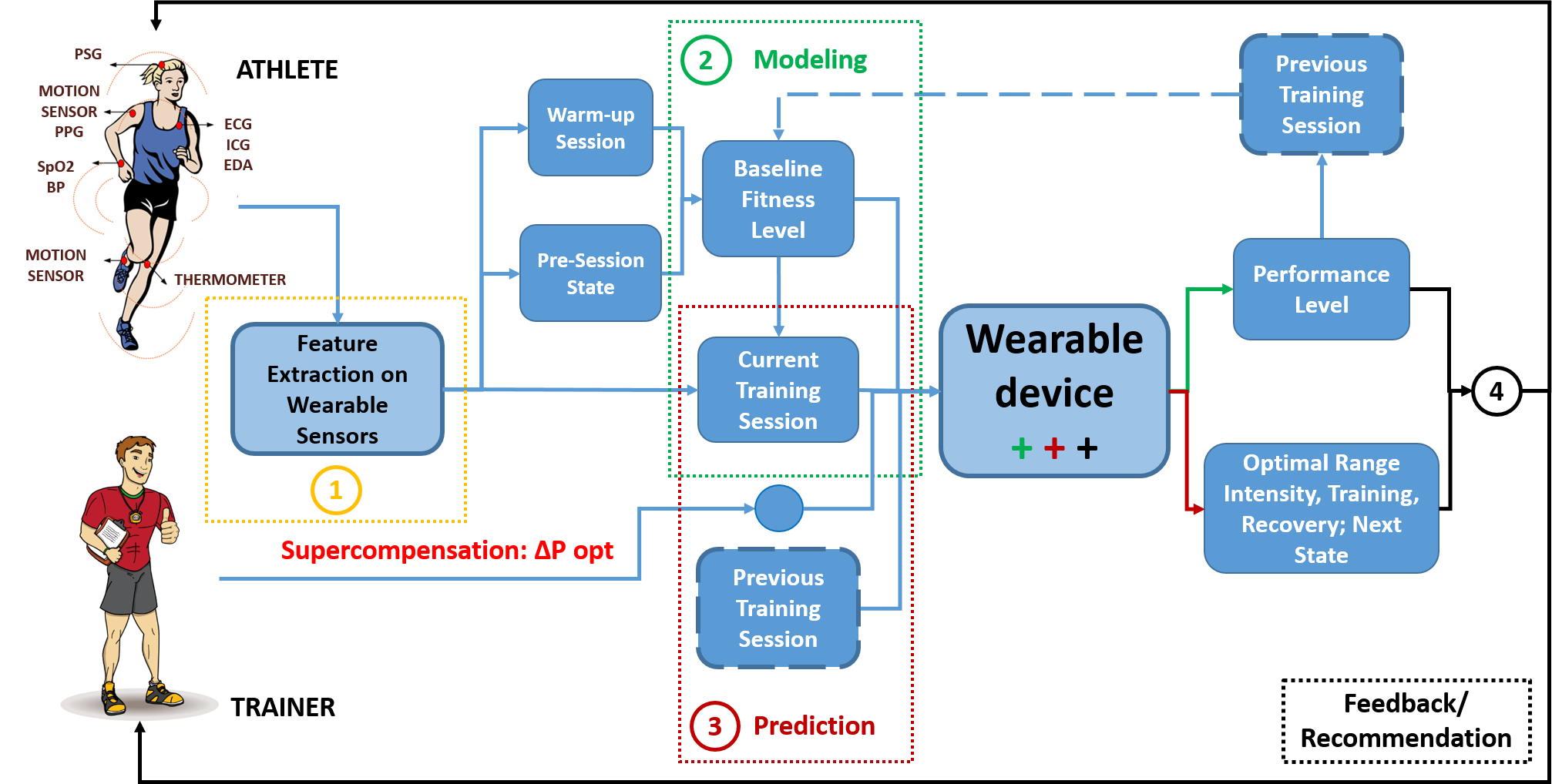
The first phase focuses on highly accurate and energy efficient methodologies for feature extraction from multiple non-invasive biosignals on wearable sensors, such as ECG, pulse, motion, etc.


The first contribution of this phase is a highly accurate heart rate estimation during physical activity optimized for a wearable armband device, developed by SmartCardia, a spin-off start-up of ESL. This device is accurately comparable to a chest belt, such as Polar heart rate monitor.
The second contribution is a patient-specific approach to predict a paroxysmal atrial fibrillation onset. The next step is the implementation of the method on a wearable device for single-lead ecg monitoring to be used in this system as additional functionality, since elite athletes may suffer from atrial fibrillation.
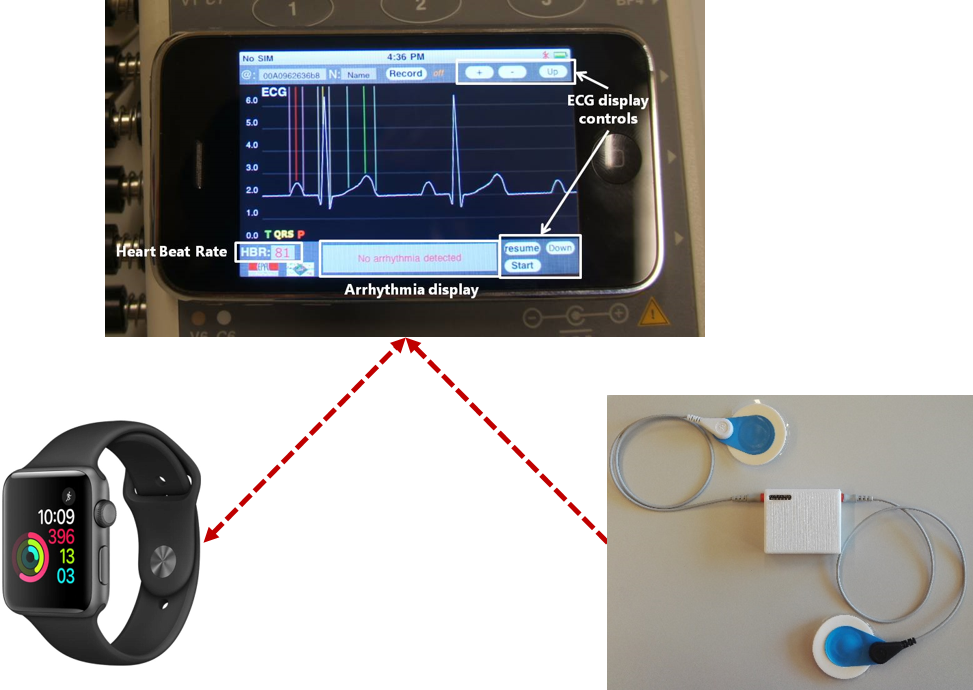
The second phase involves the design of the performance and fitness level model to describe the single training segment. The model is based on the subject’s baseline fitness level, the subject’s state before the training, a warm-up session and the history of previous sessions. The validation of the model considers a specific sport, and it involves a collaboration with the Institut des Sciences du Sport de l’Université de Lausanne (UNIL ISSUL) using the Biopac® System.


The third phase has aimed to develop a methodology for predicting significant parameters for an optimal performance and to describe the possible future state of the subject during a single training segment. Optimal performance is described with three main parameters: intensity, training duration and recovery time. Moreover, the project includes designing a model for the description of long-term underperformance prevention based on the previous methodologies.
Finally, the fourth phase aims to design the feedback to help the athlete (and the trainer) to improve performance considering the output of the previous phases. The system is able to suggest a time interval to stop the training or start again, as well as indicating if the train is too hard or too easy. Moreover, the system prescribes the next exercise to improve the performance in the long-tem.
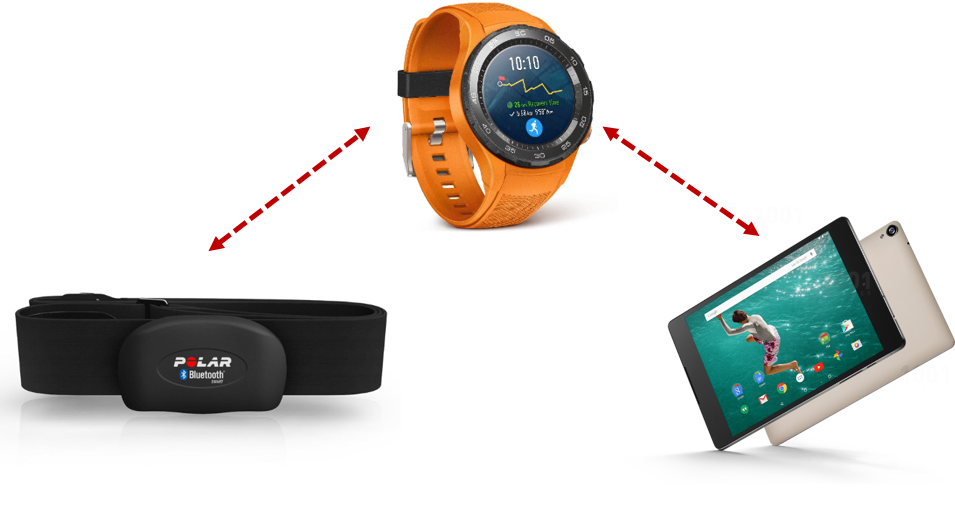
Part of this recommendation engine is done using the Huawei Watch 2, a Polar H7 heart rate monitor and a smartphone/tablet.
Publications
- A Patient-Specific Methodology for Prediction of Paroxysmal Atrial Fibrillation Onset. Computing in Cardiology, Rennes, France, September 24-27, 2017.
- Ultra-Low Power Estimation of Heart Rate Under Physical Activity Using a Wearable Photoplethysmographic System. 19th IEEE/Euromicro Conference On Digital System Design (DSD 2016), Limassol, Cyprus, August 31 – September 2, 2016.