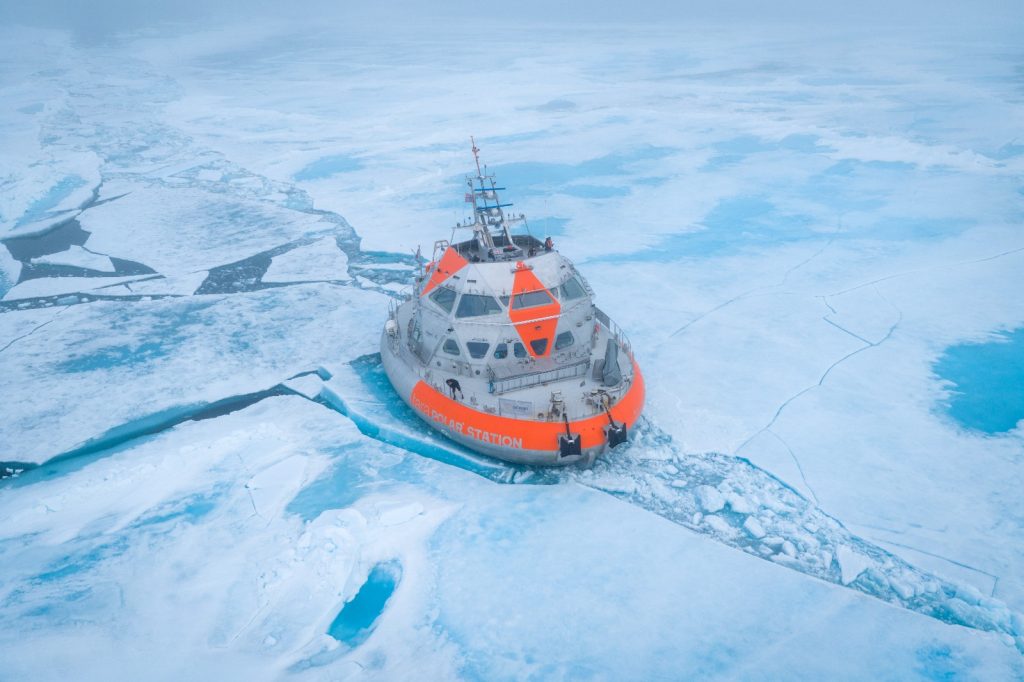
Tara Polar Station (TPS) is a new French research vessel that will drift for the next 20 years in the Central Arctic Ocean to investigate the decline of sea ice and the transformation of this particular ecosystem. The first drift mission was launched on 19 July 2026 and it will last about 15-18 months.
Find out more about TPS and the international consortium here.
EERL is co-leading the atmospheric program on board. Read our vision paper Schmale et al. (2025) here.
Our research focuses on the following main areas:
- vertical structure of the central Arctic lower atmosphere with a focus on thermodynamics and aerosol cloud interactions,
- the seasonal cycle of aerosol chemical chemical composition, and
- the seasonal cycle of ice-nucleating particles and their relation to biological signatures.
The vertical structure of the lower atmosphere is hardly known in the in central Arctic due to the scarcity of observations. Typically, we expect temperature inversions which means that observations of aerosol chemical composition at the surface are not necessarily representative of what we find at cloud level. Hence, we deploy our tethered balloon system (AVATAR) to fly regular profiles, twice each week during the drifts, to measure basic thermodynamic variables (T, RH, winds) and aerosol and cloud properties. We observe aerosol number size distributions and cloud droplet size distributions.
The seasonal cycle of aerosol chemical composition in the central Arctic is hardly observed. The MOSAiC expedition provided a leap forward in the understanding, however data is missing for the winter. Using a robust new technology based on Nano-Electromechanical-Membrane-Systems paired with Fourier-Transform Infrared spectroscopy (NEMS-FTIR), we will obtain daily samples. Find the description of the NEMS-FTIR technique developed by EERL in collaboration here. The aerosol chemical composition will shed light on the origin of particles, as well as their primary and secondary nature.
Finally, little is still known about ice-nucleating particles (INP) in the central Arctic. While MOSAiC has brought important new insights, that mission is one snapshot. With our daily samples of INP in conjunction with vast biological analyses of aerosol particles conducted by collaborators, we aim to understand their provenance. INP and the temperatures they start nucleating ice at are critical for the Arctic mixed-phase cloud regime that is predominant. Mixed-phase clouds have a strong impact on the surface energy budget as well as precipitation.
EERL’s participation in TPS occurs via several projects.
Swiss National Science Foundation ICAARUS bilateral project with Japan, BNP Parisbas Micro-Arctic project in collaboration with partners in France and Spain, and the Swiss Polar Institute Flagship ARKTIS.
Within ICAARUS, we collaborate with the National Institute for Polar Research (NIPR) in Japan to conduct simultaneous airborne atmospheric observations from TPS and the new Japanese Arctic Research Vessel Mirai II.