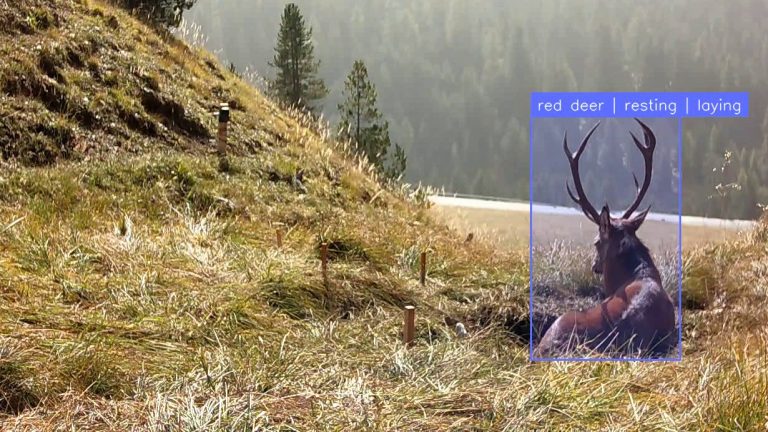

Managing wildlife populations and understanding animal behavior are important topics in conservation and, more broadly, in animal ecology. The usage of digital technologies (from camera traps to drones) can help rangers and scientists to accelerate surveys and scale findings beyond a localized small region.
At ECEO, we are actively involved in several projects aiming at digitalizing animal conservation with image processing and machine learning. We are active in the Swiss National Park to improve the understanding of wild mammals’ behavior, as well as in Namibia (Kuzikus reserve) and Kenya (Ol Pejeta Conservancy), where we develop algorithms for interactive censuses of wild animals.
Papers
- Gabeff, Qi, Flaherty, Sumbul, Mathis, & Tuia (2025). MammAlps: A multi-view video behavior monitoring dataset of wild mammals in the Swiss Alps. Proceedings of the Computer Vision and Pattern Recognition Conference. (paper, github).
- May, Dalsasso, Delplanque, Kellenberger, & Tuia (2025). How to minimize the annotation effort in aerial wildlife surveys. Ecological Informatics. (paper, github).
- Gabeff, Rußwurm, Tuia, & Mathis (2024). Wildclip: Scene and animal attribute retrieval from camera trap data with domain-adapted vision-language models. International Journal of Computer Vision. (paper, code).
- May, Dalsasso, Kellenberger, & Tuia (2024). Polo–point-based, multi-class animal detection. European Conference on Computer Vision. (paper).
- Tuia, Kellenberger, Beery, Costelloe et al. (2022). Perspectives in machine learning for wildlife conservation. Nature Communications. (paper).
- Kellenberger, Veen, Folmer, Tuia (2021). 21 000 birds in 4.5 h: efficient large‐scale seabird detection with machine learning. Remote Sensing in Ecology and Conservation. (infoscience).
- Kellenberger, Marcos, Lobry, Tuia (2019). Half a percent of labels is enough: efficient animal detection in UAV imagery using deep CNN and active learning, IEEE Transactions on Geoscience and Remote Sensing, 57: 9524-9533 (arxiv).
- Kellenberger, Marcos, Tuia (2018). Detecting mammals in UAV images: Best practices to address a substantially unbalanced dataset with deep learning, Remote Sensing of Environment, 216: 139-153 (arxiv).