
Research
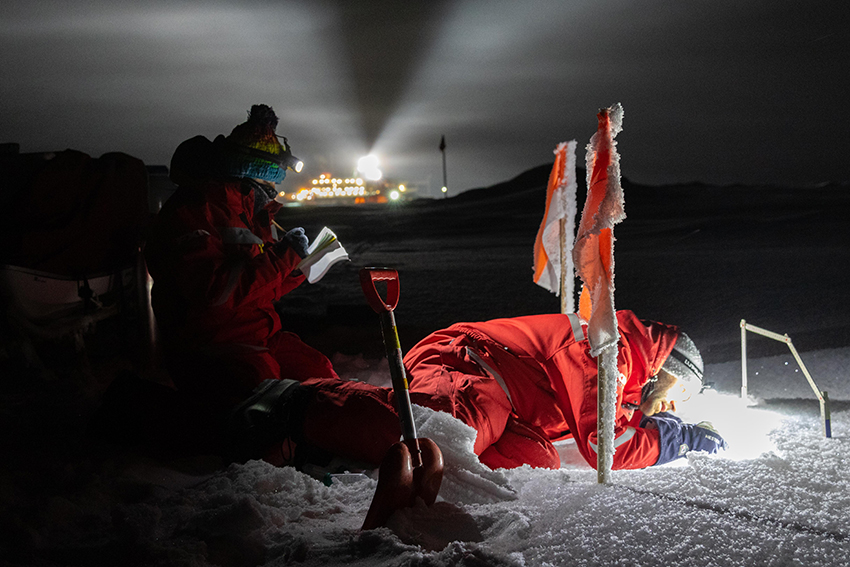
Snow measurements on the Arctic ice sheet during the MOSAIC Expedition. Very low to no wind conditions were very rare but made the snowpit work much easier in this case. (Photo: Alfred-Wegener-Institut / Marcel Nicolaus)

What will our research areas be in the near future ?
Discover our future avenues of snow and energy research of the ‘CRYOS’ (EPFL) and ‘Snow Processes’ (SLF) groups
Mountain snow cover and precipitation
The spatial and temporal dynamics of the mountain snow cover are only incompletely understood, due to a lack of knowledge on deposition phenomena (total amount of precipitation and wind transport dynamics) as well as the spatial and temporal variation in melt.
Snow and mountain hydrology
The overarching objective of this research is to better understand the dominant processes controlling the spatial features of snow accumulation and melt influencing water cycle in alpine environments in the Swiss Alps.

CRYOS stations around the world !
Over the years, the interest of CRYOS in understanding the cryosphere has lead to the installation of several stations all over the world. Check out this webpage for more information !

The Mountains as a Source of Renewable Energy
The (superior) potential of mountain regions for new renewables such as wind and solar (PV) is less explored. CRYOS has spearheaded research into mountain renewable energy and has shown for example that the snow cover adds significantly to PV potential at high elevation.

Numerical Modeling of the Alps and Polar regions
At CRYOS we are actively working in the improvement of numerical weather prediction models by developing new physics-based modules, parametrization and coupling high-resolution models to have advanced numerical results to investigate cryospheric physics.