We develop new theory and methods that can be used to answer real-life questions. In practice, researchers and decision makers are often interested in causal effects: they want to learn what works. For example, will a new medication lead to better survival? Can a new teaching strategy lead to better exam scores? Should we implement a new policy to improve the economy?
However, making valid (causal) inference from data is rarely trivial. Indeed, we strongly believe that a formal framework is crucial to avoid sloppy reasoning and pitfalls. Thus, one of our main goals is to create new theory and methods for causal inference. Crucially, we strive to develop methods that rely on assumptions that are (i) transparent, (ii) scientifically testable and (iii) as weak as possible.
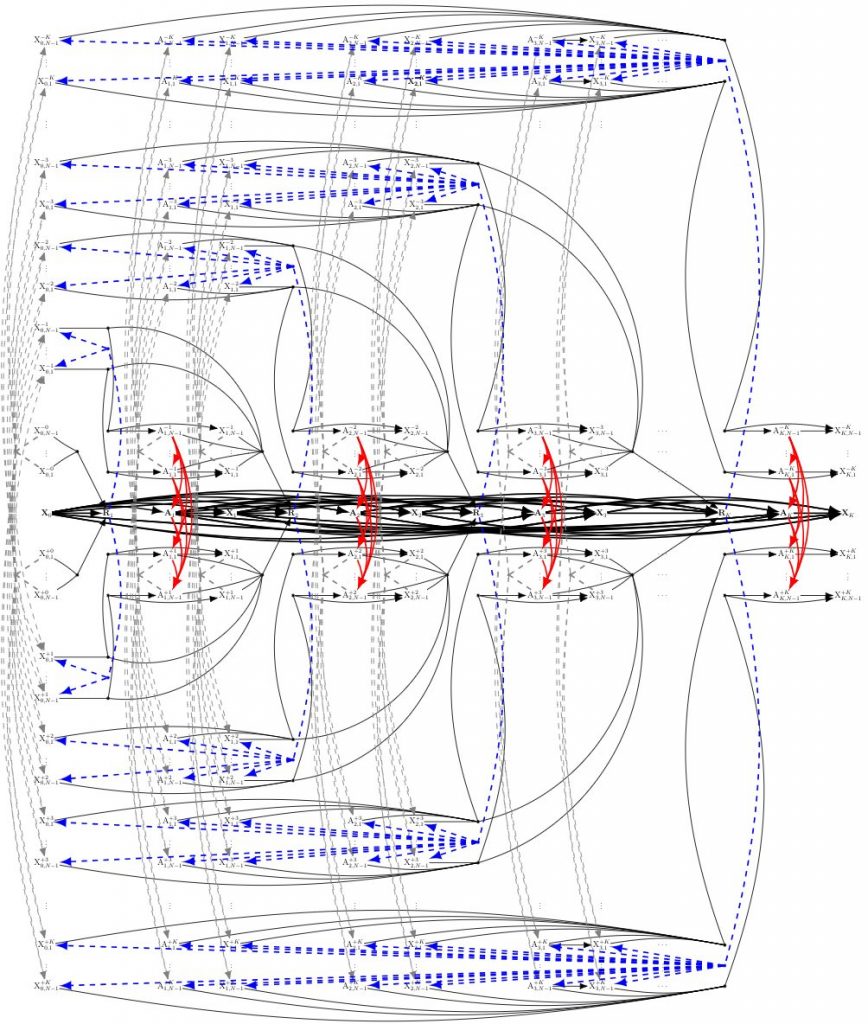
More specifically, several of our projects concern non-parametric identification of causal parameters in interventionist frameworks for causal inference. We are particularly interested in longitudinal data structures, where exposures, effects and outcomes are functions of time. For example, we derive results on time-to-event outcomes, such as survival, which are ubiquitous in practice. We are also developing generic estimators, where we use theory for ordinary and stochastic differential equations to obtain asymptotic guarantees. These estimators can be used to study a wide-range of causal and non-causal parameters.
Besides our methodological work, we are interested in applying new methods to available data. While most of our current applications concern clinical medicine and epidemiology, we are also interested in problems arising in biology, psychology, economics and engineering.