
Are you excited about working at the crossroads of nanotechnology, biology, and photonics? Our group offers a range of Master’s and semester projects in Microtechnique and Bioengineering, focused on the development of lab-on-a-chip nano-biosensors. These hands-on projects provide exposure to nanophotonics, nanofabrication, microfluidics, and cellular/molecular biology.
We regularly update a selection of example projects on this page – these illustrate the type of work you could get involved in during the summer or academic semesters.
Don’t see a perfect match? We often have additional or upcoming projects that may not yet be listed – so don’t hesitate to reach out.
To apply or learn more, please contact the relevant supervisor with your CV, a brief motivation, and your availability.
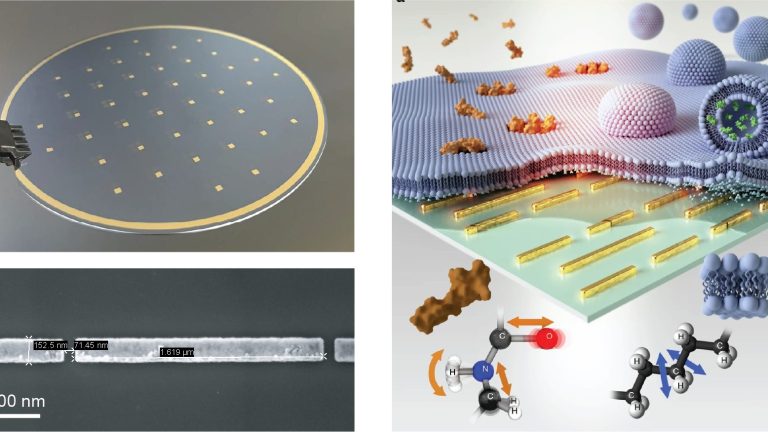
Metasurface-enhanced infrared spectroscopy for biochemical sensing applications
Description:
Infrared (IR) spectroscopy is a gold-standard bioanalytical technique for label-free, non-destructive and chemical-specific detection of biomolecules such as proteins, lipids, and nucleic acids by studying the vibrations of their molecular bonds. Recently, engineered nanophotonic metasurfaces have emerged as a powerful approach to significantly enhance the performance of IR spectroscopy for extreme sensitivity, faster response time, miniaturization and lab-on-a-chip integration. As a result, this new method, which is called Surface-Enhanced Infrared Absorption (SEIRA) spectroscopy is promising for a wide range of applications including disease diagnostics, environmental monitoring and safety. In this project , we will apply IR metasurfaces and SEIRA to enable highly sensitive multiplexed detection of bioanalytes in aqueous conditions and high-resolution mid-IR tissue imaging. We will additionally focus on large-scale manufacturability of the designs to ensure that they are readily applicable in lab-on-chip and point-of-care device architectures.
Who we are looking for:
A motivated student curious to explore the limits of SEIRA for biosensing application in an experimental laboratory and/or interested in developing new fabrication protocols on the state-of-the-art CMi tools.
Prior experience in photonics/infrared spectroscopy would be a plus, but is not required as we offer you a chance to learn the basics and applications of infrared spectroscopy as well as cutting-edge nanophotonics with hands-on experience.
Proficiency and experience in Python are preferred for spectral data analysis. Previous experience in fabrication at CMi will be a major advantage.
The project is available as an internship/thesis with at least a minimum duration of 4-6 months. Students able to start in early 2026 will be given preference. The project can be tailored for EPFL students as a Bachelor or Master project.
Contact persons at BIOS:
Ivan Sinev: [email protected]
Nikita Glebov: [email protected]
Relevant publications:
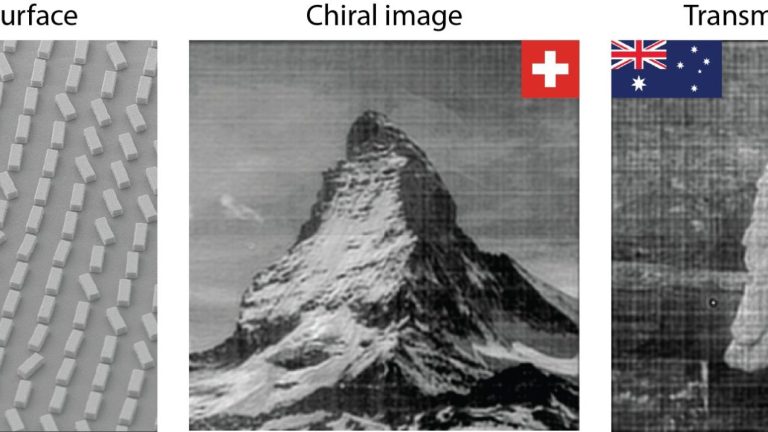
Chiral metasurfaces and chiral sensing
Description:
Chirality, defined as the non-identity of an object with its mirror image, is ubiquitous in science and life. It appears across scales: in electronic transitions of semiconductor crystals, in the handedness of molecules like amino acids or DNA, and even in familiar macroscopic structures (be it snail shells or galaxies). Understanding and controlling chirality is crucial: reversing a molecule’s handedness can make a nutrient ineffective or turn a therapeutic compound into something inactive—or even harmful.
Light is an ideal non-invasive probe for chirality. Left- and right-circularly polarized waves interact differently with chiral matter, producing measurable effects such as circular dichroism and circular birefringence. These effects are widely exploited in molecular sensing, drug design, and solid-state quantum physics. However, natural chiral responses are typically extremely weak, which makes their amplification a central challenge.
Recently, engineered nanophotonic metasurfaces have emerged as a powerful approach to manipulate light in unprecedented ways, enabling enhanced electromagnetic field localization, strong light-matter interaction, exotic polarization states and many more.
In this project, you will design, implement and test advanced metasurfaces to control chiral light and achieve ultra-sensitive detection of chiral molecules.
We focus on two spectral windows:
- Mid-infrared, where molecular vibrational resonances naturally strengthen chiral signatures.
- Visible, where residual chirality from deep-UV electronic transitions can be enhanced using state-of-the-art metasurface concepts.
Who we are looking for:
A motivated student curious about photonics design, advanced nanofabrication, and experimental nanophotonics.
Prior experience in nanophotonics and nanofabrication are a plus, but not required, as we will offer you a chance to learn the basics as well as cutting-edge techniques with hands-on experience. Proficiency in Python or Matlab are preferred for spectral data analysis.
The project is available as an internship/thesis with at least a minimum duration of 4-6 months. Students able to start in Spring 2026 will be given preference. The project can be tailored for EPFL students as a Bachelor or Master project.
Contact persons at BIOS:
Nikita Glebov: [email protected]
Berkay Dagli: [email protected]
Relevant publications:
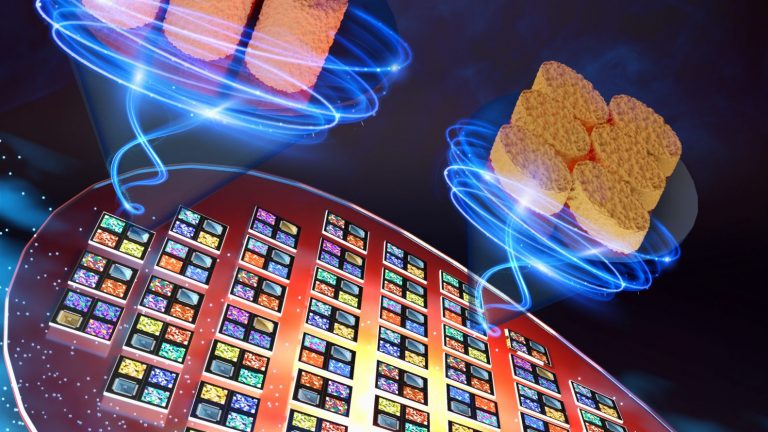
Advanced Nanofabrication for Nanophotonics-Enhanced Biosensing
Project Description:
This project focuses on developing the advanced fabrication technique for nanophotonic structures using Deep-UV lithography. As a master Student, you’ll work at the renowned CMi facility, developing and optimizing a process for fabricating nanoplasmonic structures in the cleanroom. Using cutting-edge techniques like DUVL lithography, ion beam etching, and advanced characterization tools, you’ll process wafers with precision, contributing to groundbreaking nanotechnology research and gaining hands-on experience.
Who we are looking for:
We are looking for students interested in gaining practical experience in nanophotonic structure fabrication and optical characterization. The project is available as a Master thesis study with at least 4-6 months minimum. If you have a background in engineering or physics and are interested in developing low-cost fabrication techniques, please get in touch with us to learn more.
Contact persons at BIOS:
Or apply here:
https://forms.gle/SSkK5hA9p2EUYo856

Label-free nanophotonic biosensing for spatiotemporal analysis of live-cell and tumoroid dynamics
Description:
Deciphering how single cells and tumoroids communicate—through cytokine secretion and other signalling molecules—is central to advancing precision medicine, from understanding therapy resistance to optimizing cell therapies. However, these biological processes are highly dynamic, heterogeneous, and often invisible to conventional biochemical assays.
At BIOS, we have developed next-generation, label-free nanophotonic biosensing platforms—including plasmonic nanohole arrays and dielectric metasurfaces—that enable real-time and highly sensitive detection of biomolecules secreted by living systems. These sensors seamlessly integrate with microfluidics to interrogate single-cell and single-tumoroid behaviour with spatiotemporal resolution, revealing signalling dynamics that are inaccessible to traditional endpoint assays.
In this project, you will contribute to building a platform that aims to push nanophotonic biosensing towards impactful biomedical applications such as precision diagnostics, therapy monitoring, and mechanistic studies of disease progression.
What You Will Gain
- Hands-on experience in surface functionalization, microfluidic integration, and live-cell/tumoroid assays.
- Direct exposure to real-time nanophotonic sensing and hyperspectral imaging technologies.
- Experience in signal processing and multidimensional data analysis to extract biologically meaningful dynamic signatures from complex datasets.
- An opportunity to work in a highly multidisciplinary environment at the interface of nanophotonics, biotechnology, and precision medicine research.
Who We Are Looking For
We are expecting a strongly motivated student passionate about applying advanced nanophotonic tools to solve real biological and clinical challenges.
Preferred background:
Experimental & Lab Skills
- Strong interest in hands-on experiments, including optical setups, biosensor surface chemistry, and microfluidics.
- Basic understanding of cell biology; prior experience in biochemical assays or cell culture is a plus (not required).
Data & Computational Skills
- Proficiency in Python or MATLAB.
- Interest or experience in signal processing, spectral analysis, image analysis, or machine-learning–based feature extraction.
The project is available as an internship/thesis with at least a minimum duration of 4-6 months. Students able to start in early 2026 will be given preference. The project can be tailored for EPFL students as a Bachelor or Master project.
Contact persons at BIOS:
Jiayi Tan: [email protected]
Relevant publications:
- https://advanced.onlinelibrary.wiley.com/doi/10.1002/advs.202415808
- https://advanced.onlinelibrary.wiley.com/doi/10.1002/advs.202401539
- https://www.nature.com/articles/s41551-023-01017-1
Photo Credit: Yen-Cheng Liu