
With the LinoSPAD camera system we explore different pixel architectures through the combination of a simplified SPAD detector with an FPGA. The sensor has a line of 256 pixels and each pixel is connected to an output pad, which in turn connects to an FPGA input. Inside the FPGA we have to possibility to experiment with different pixel and array architectures choosing elements from counters, TDCs, histogram generation, timestamp processing, correlation analysis and more.
A default firmware has been developed and tested implementing an array of 64 TDCs, each capable of timestamping photons at a rate of up to 133 MHz. Due to the sensor deadtime in our passively quenched detector the maximum rate is never reached, but provides a margin to process detections from multiple pixels concurrently in a single TDCs. The sensor is in use by multiple research groups around the globe using it for different time-resolved applications like 3D sensing, coincidence detection or random number generation.
| Parameter | Value |
| Chip size | 6.8 × 1.68 mm2 |
| Technology | AMS HV 0.35 µm 4M |
| Resolution | 256 × 1 (+8) |
| Pixel pitch | 24 µm |
| Fill factor | 40% |
| Dead time (VQ = 0.9 V) | <100 ns |
| Median DCR at 20°C | 2.5 kHz |
| Spectral range (Vex = 3 V, PDP > 5%) | 400-850 nm |
| Light incidence | 45° from normal |
| Number of TDCs | 64 |
| Maximum TDC event rate | 133 MHz/TDC |
| Average TDC resolution (LSB) | < 25 ps |
| TDC range | 28 bit (4.5 ms) |
| TDC DNL range, uncorrected | 4 LSB |
| TDC DNL range, corrected | 0.2 LSB |
| TDC INL range, uncorrected | 7 LSB |
| TDC INL range, corrected | 0.5 LSB |
| Data transfer rate | 200 MB/s |
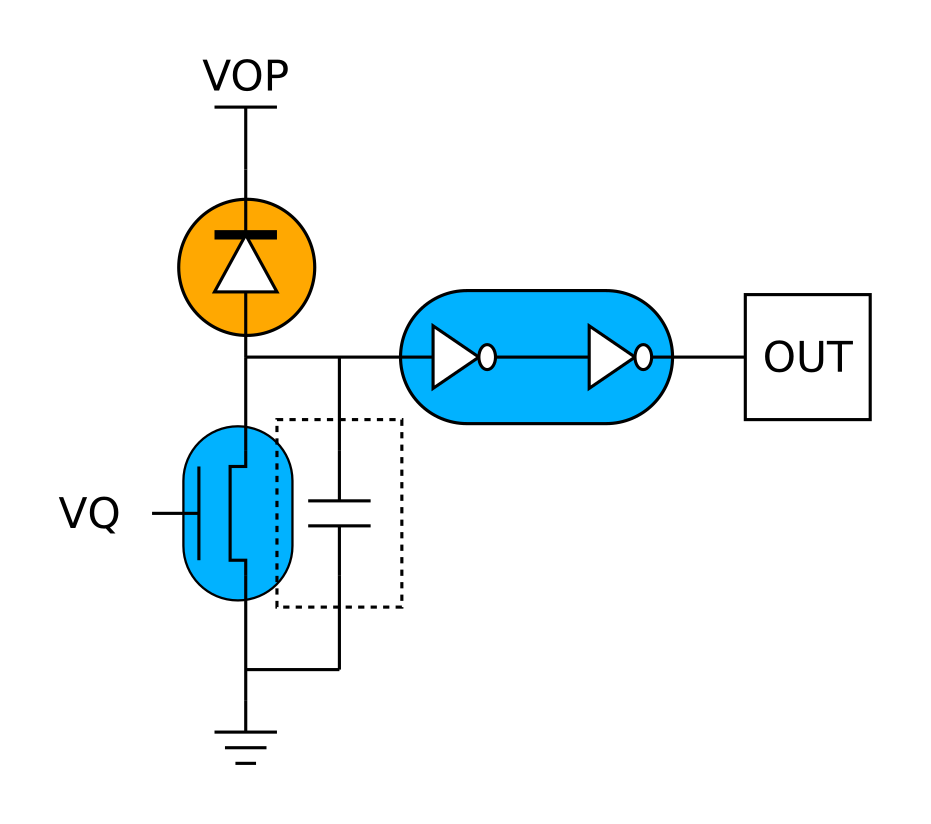 |

LinoSPAD pixel schematic (x256 on a chip)LinoSPAD micrograph
 Spartan 6 motherboard for LinoSPAD (shared with SwissSPAD1)Example of FPGA architecture
Applications
- Time-resolved imaging
- Architecture exploration
- Scientific imaging
Contact
Relevant publications
David B. Lindell, Matthew O’Toole, and Gordon Wetzstein, „Single-Photon 3D Imaging with Deep Sensor Fusion“, ACM Trans. Graph. 37, 4, Article 113 (August 2018). https://doi.org/10.1145/3197517.3201316
D. Lindell, M. O’Toole, G. Wetzstein, “Towards Transient Imaging at Interactive Rates with Single-photon Detectors”, IEEE Int. Conference on Computational Photography (ICCP), 2018. http://www.computationalimaging.org/publications/reconstructing-transient-images-from-single-photon-sensors-cvpr-2017/
S. Burri, C. Bruschini, and E. Charbon: “Applications of a reconfigurable SPAD line imager (Conference Presentation)“, Proc. SPIE, Photonic Instrumentation Engineering V, vol. 10539, 2018. https://doi.org/10.1117/12.2289620
M. O’Toole, F. Heide, D. Lindell, K. Zang, S. Diamond, G. Wetzstein, “Reconstructing Transient Images from Single-Photon Sensors”, IEEE Int. Conference on Computer Vision and Pattern Recognition (CVPR), 2017. http://www.computationalimaging.org/publications/reconstructing-transient-images-from-single-photon-sensors-cvpr-2017/
S. Burri, C. Bruschini, and E. Charbon, “LinoSPAD: A Compact Linear SPAD Camera System with 64 FPGA-Based TDC Modules for Versatile 50 ps Resolution Time-Resolved Imaging,” Instruments 2017, 1(1), 6; doi:10.3390/instruments1010006. http://www.mdpi.com/2410-390X/1/1/6
S. Burri, H. Homulle, C. Bruschini, and E. Charbon: “LinoSPAD: a time-resolved 256 x 1 CMOS SPAD line sensor system featuring 64 FPGA-based TDC channels running at up to 8.5 giga-events per second”, Proc. SPIE, Optical Sensing and Detection IV, vol. 9899, 2016. https://documents.epfl.ch/groups/l/li/linospad/www/LinoSPAD_SPIE_PE_98990D.pdf