
Project completed
In this project we are studying a new concept to the design of fully digital image sensor with a digital 1-T pixel or a digital optical switch. The digital pixel is designed for use in a digital film concept known as Gigavision camera. Each digital pixel has 1 or 0 binary output due to light intensity and threshold of the pixel. The digitized pixel output is reading out very fast by an optimized digital column readout circuitry.
By measuring the density of digital pixel output with the readout counterparts, a grayscale image is achieved and the image is reconstructed through an external software algorithm. The external imaging reconstruction allows anti-aliased grayscale images thus increasing image quality and achieving a reproducible and high dynamic range imager.
Achievements through the project
– Fundamentals of the optical devices (see Fig.1)
– Designing analog and digital mixed signal circuits (see Fig.1)
– Programing hardware description languages (see Fig.2)
– Designing PCB (Printed Circuit Board) (see Fig.2)
– Understanding optical measurement systems (see Fig.3)
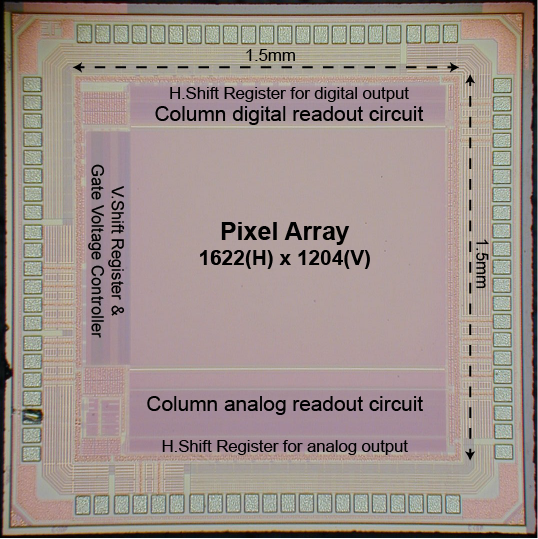
Fig.1 A designed and fabricated the fully digital image sensor with a digital 1-T pixel with a 90nm CMOS standard process. A device simulation and circuit simulation has been done for the chip design and an integrated circuit (IC) layout editor has been used for the chip fabrication.
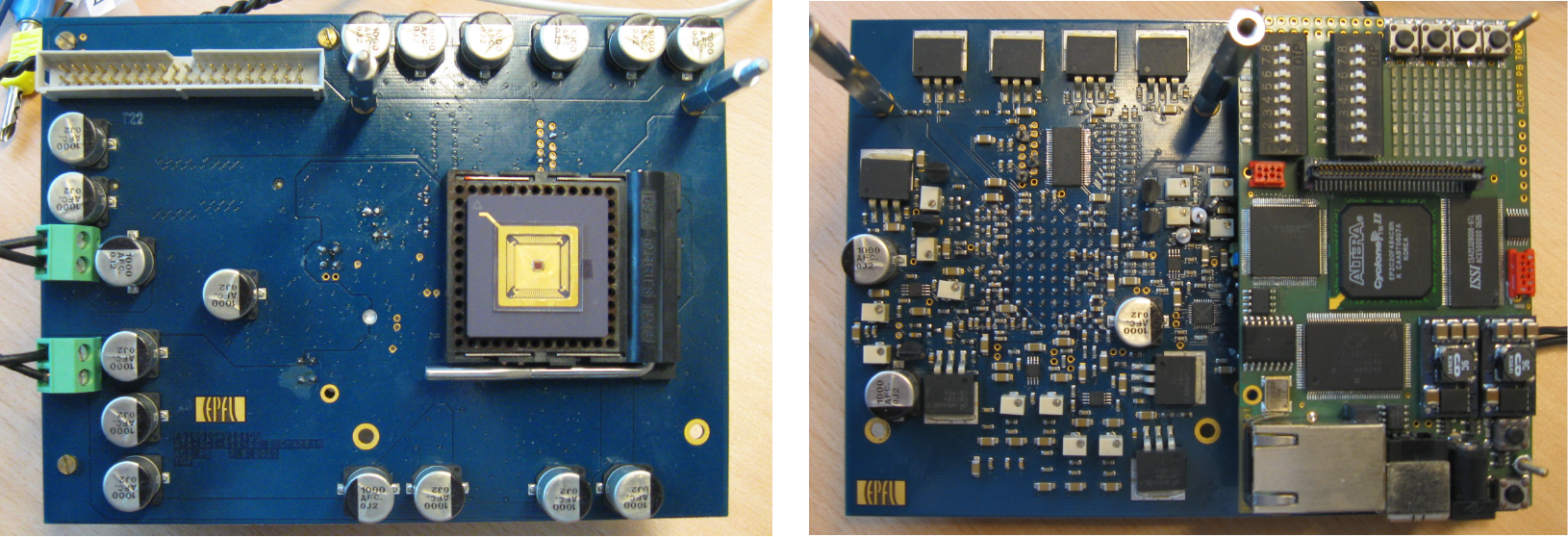
Fig. 2 A printed circuit board (PCB) is designed and fabricated to test the fully digital image sensor. A hardware description language has been employed to work the PCB.

Fig. 3 Binary images and a reconstructed sample image are shown in this figure. These images are taken by a SPAD camera which is the main work of the AQUA group and then reconstructed by an external software algorithm.
(figure source: F. Yang, Y. M. Lu, L. Sbaiz, and M. Vetterli, “Bits From Photons: Oversampled Image Acquisition Using Binary Poisson Statistics”, IEEE TRANSACTIONS ON IMAGE PROCESSING, VOL. 21, NO. 4, APRIL 2012)
Contacts
Hyungjune Yoon