
Since 2001, EPFL and the University of Lausanne have been working hand in hand to offer outstanding education, the diversity of which would be impossible for a single institution to achieve on its own. This cooperation gave rise to EPFL’s Social Science and Humanities (SHS) Program.

The SHS Program contributes to an essential part of EPFL students’ education. Engineering professions do not only require technical skills; they also demand an understanding of the historical, economic, political, philosophical, and psychological issues surrounding the contexts in which engineers and scientists are called upon to work.
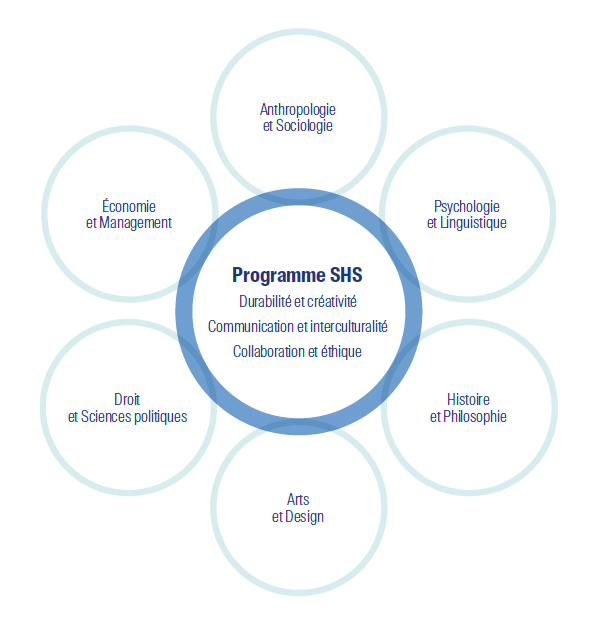
Today and tomorrow, everyone needs what are known as “transversal” skills: a sense of collaboration; sensitivity to ethical issues and interculturality; communication skills (both oral and written); and the ability to develop creative solutions, particularly in response to the sustainability challenges posed by technological development.
By broadening disciplinary horizons, bringing together students from all sections of EPFL, and varying teaching approaches (lectures, seminars, projects, etc.), the SHS Program places these skills at the heart of its educational objectives.
The program’s courses are selected each year because they meet the needs of future engineers and scientists. They are taught by faculty from all UNIL faculties, as well as from EPFL and our two partners in the field of design, ECAL and HEAD.
The highly diverse program is organized into six disciplinary groups, from which each EPFL student is free to choose their own path:
- Anthropology and Sociology
- Psychology and Linguistics
- History and Philosophy
- Arts and Design
- Law and Political Science
- Economics and Management
The SHS Program was launched in 2001, thanks to close cooperation between EPFL and the University of Lausanne. The two institutions worked hand in hand to offer an excellent education, the diversity of which would be impossible for a single institution to achieve on its own.