
By Marie Jones, 11.08.2026
Dear SPAN-blog reader,
Since my last post, I closed two major chapters of my life: I became a Doctor on June 12th and completed my traineeship at the European Commission on July 31st!! In this article, I’ll look back on some of the most exciting activities of my traineeship and reflect more widely on the role of science in policy making and where this intertwined with my PhD and SPAN.
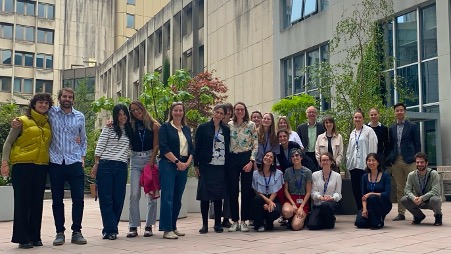
But before I start, I would like to thank all the members of the ENV.B.1 unit for their warm welcome and constant support. I was very lucky to join a team which trusted me, valued my existing knowledge and encouraged me to learn and grow. I am also very grateful to the other ENV trainees, it was an honour to share this experience with such talented young professionals and engaged individuals: “la relève est assurée”!
Voting a law is a milestone but implementing it is the real work
As outsiders to policy making, when we read in the news that a new EU law was passed, we might be tempted to think that the hard work has been done: 27 countries and over 700 elected members of the European Parliament, coming from the whole political spectrum, have agreed on a single text, a common course of action. While it is more than fair to shout “Hooray!” for the accomplishment so far, it is only one stage of the “Policy Cycle”.
Before explaining the Policy Cycle and diving into what I did during it, I need to explain that not all laws are the same (pretty obvious if you are a lawyer, much less if you are an engineer!):
- The treaties which set how the EU should work and offer the legal framework for all the other laws. They set out the big principles but don’t tell you anything about how to put them into practice.
- The primary legislation (aka the big laws we hear about in the news) can be of two types: a Regulation that applies directly to all the EU Member States or a Directive which needs to be transposed in each country individually. The trade-offs between the two are harmonised rules or adaptability to national specificities. These laws undergo negotiations called “Trilogues” between the Commission, the Member States (represented by the Council) and the Parliament.
- The secondary legislation is there to specify in incredible details every technical aspects that were left opened in the primary legislation. Because the method to determine the boiling point curve of a steam cracker for recycled content calculation isn’t really within the expertise, nor the best use of their time, the Parliament and Council empower the Commission to figure out these types of technical details and to pass what are called Implementing and Delegated Acts. The two procedures are a bit different but essentially the Commission just needs to consult a subset of stakeholders instead of the Trilogue to speed up the process.
Little explanation of the “Policy Cycle” in 5 steps and where science can influence it
- It all starts by identifying a problem and adding its resolution to the political agenda (referred to as “agenda setting”). To make a parallel with research, it’s like the identification of knowledge gaps but here as “regulatory gaps”. That’s a first entry point for scientific findings: researchers can shed light on a topic requiring attention from policy makers. The consensus of the community and the urgency of the problem will probably influence how quickly the matter is taken up in the agenda, but scientists also have to time their intervention with the electoral calendar. In the EU, the bulk of the agenda is indeed decided at the appointment of the President of the Commission every 5 years, and more granular schedules are published annually.
- Once a topic is on the agenda, the Commission machinery goes into action to formulate a policy. The EU needs to respect its own “Better Regulation Principles” which call for evidence-based policies. This means that for every new law, there must be an impact assessment to understand the implications of different policy options. The Commission will work closely with the Joint Research Centre (JRC) or external consultancies that support the assessment of existing literature and often model scenarios with several policy options. That’s when scientists are needed to propose solutions! It’s also the most straightforward career entry point at the science-policy interface: the EU Commission needs qualified staff to coordinate the impact assessments, the JRC and private consultancies need trained researchers who can interpret academic work. Moreover, this stage requires a public consultation which means that any citizen around the world can contribute to the formulation of the policy. Academics may also choose to provide their independent expert opinion in this way. Following the completion of the impact assessment, the legal team takes over and drafts a legislative proposal which then needs to be approved by all the Commissioners (equivalent to national ministers) and all the DGs (ministries). This usually takes several rounds of revisions already, not so dissimilar to peer-reviewing in academic publishing!
- A legal proposal for primary legislation has been approved by the Commission, it then makes its ways into the famous Trilogues. The text will be modified during the negotiations until its Scientists may be called up at this stage, but the bulk of the work has already been done so their expertise tends to be mostly used to confirm or refute the proposal, not bring new perspectives or solutions. The vote is usually what is reported in the media, and then the general public, and most researchers, don’t hear much more about the law…
- Actually, the implementation phase is where a lot of technical scientific expertise is required to set thresholds, methodologies, calculation rules, etc. Through secondary legislation and guideline documents, the Commission tries to translate political orientations, aims and targets into practical rules and guidelines to be followed by economic actors and civil society. At this stage, interactions with stakeholders on the field, like academics but also mostly with industries and NGOs, are key to ensure that technical rules are feasible in practice and that they can be effectively reported to monitor progress. It’s a stage of which scientists are not always aware, but where their domain-specific expertise is instrumental for legislation to be impactful.
- Finally, all legislations are constantly monitored and must regularly be In the EU, this implies gathering evidence on the effectiveness, efficiency, coherence, relevance and EU added value of a Directive or Regulation. Like for the impact assessment in phase 2, scientific data and their analysis are needed, providing another entry point for researchers wanting to engage at the science-policy interface. Based on the evaluation outcome, the problem to be tackled might be added back onto the agenda et c’est reparti pour un tour!
Although I already understood the concept of the policy cycle before starting my traineeship, it’s only after meeting with the Director of the DG Environment, Eric Mamer, that I truly understood the importance of implementation. While it’s really the adoption which receives media attention and therefore provides the most short-term ‘political credits’ for any politician looking to be re-elected or for any civil servant looking for a promotion, it’s the implementation which will impact the lives of citizens and our environment. In his speech at our Summer Party, Mr Mamer insisted that success for him meant the effective implementation of the measures which he inherited from the Green New Deal rather than seeking the spotlight with completely new legislations. Although sometimes disruptive legislations that make headlines are needed, I appreciate his pragmatic approach, which opened my eyes on what it means to have an impact.
What I personally experienced of the policy cycle
While I didn’t get the chance to witness Trilogues as none of the files in my Unit was at the third phase of “Adoption”, I got to contribute to all other steps. Let’s start backwards!
My main responsibility was on the evaluation of the Single-Use Plastics Directive (SUPD), a widely known legislation for the public as it enforced tethered caps (when the lid of a bottle stays attached to it) and banned plastics from many items like cotton buds. Understanding what worked well and what didn’t is thus key to continue and improve the EU action to fight marine litter. By coordinating the support study with a contractor, I learnt how to interpret litter count data, to prepare a questionnaire for targeted stakeholder consultations and to analyse the results, the summary of which you can read online. I’m grateful to my supervisor who let me present these preliminary findings during an inter-service group consultation, where we informed the other thematic DGs (read ministries) of the evaluation progress and received their feedback. While the evaluation is only due in July 2027, the option to add the revision of the Directive to the political agenda had to be discussed now, attesting how hard it may be for an external researcher to time their input for agenda setting… Nonetheless, this gave me the opportunity to draft a note for the hierarchy on the risks and opportunities of a revision.
On the implementation of the SUPD, I joined a few weeks after the committee vote on an Implementing Act on calculation rules for chemical recycling. Given the complexity of the methodology (that’s where my example of boiling point curves comes from!), the Commission proposed to prepare a manual to guide economic operators and verification bodies. In this context, I drafted the contract with an academic partner, describing the project tasks and deliverables, basically shaping how the manual will look and what it will contain. It was a bit like writing a reverse grant application, so it was very useful to have followed the grant writing course at EPFL!
My time in the Unit also corresponded to the last months before the entry into force of the first measures under the Packaging and Packaging Waste Regulation (PPWR) on Aug 12th. It was thus crunch time for the team, managing several Implementing and Delegated Acts. Keeping track of all that was going on was not easy internally, let alone for external stakeholders, Member States and industries alike. I was therefore tasked with preparing timelines for the PPWR implementation to be presented during Expert Group meetings.
The PPWR also mandates the assessment of biobased plastics in view of formulating policies to promote them. In this context, I interacted with the JRC on their market review for biobased plastics and on biogenic carbon accounting, a methodological question in life cycle analysis that I also encountered during my PhD. While the legal scope only covers materials legally defined as plastics, industry players producing non-plastics biobased materials are seizing the opportunity to also be included in future legislation. They already captured the interest of the European Economic and Social Committee (consultative body of the EU representing the civil society), where an opinion was debated, a sequence that I could attend and report on. And this is how I also got involved in providing scientific support to the agenda setting. I indeed contributed to the drafting of the first explanatory briefing for the hierarchy on novel biobased materials, clarifying definitions and the industrial state-of-play, and analysing the barriers and potential scope of amendment in the PPWR.
Seizing opportunities for PhD knowledge brokering
One of the most exciting aspects of my traineeship was the opportunity to directly inform policy makers of my PhD findings by presenting my thesis to my whole unit. It was fantastic to see how I was able to make them think about the most efficient use of biomass into chemicals and plastics. Even better was that this reflection fully went both ways with their feedback changing the perspectives of my thesis. While I showed that, from a production point of view, it makes most sense economically to make dedicated materials with a molecular structure closer to biomass, I was confronted with the challenges of dealing with completely new plastics in the current recycling infrastructure. During a visit to the Leuven composting plant, I could see first-hand the challenges for waste stream cross-contamination: the difficult separation of plastics from organic waste and its incineration instead of recycling if properly sorted…
The timeliness of my thesis with the political discussion on biobased plastics also enabled me to meet the representatives of the company Avantium, whose publicly available data I used as a comparative case study in one of my papers. I was happily reassured by the validity of my findings when their economic and environmental impact assessments aligned perfectly with my modelling work! It was thanks to this interaction that I actually got to enter the Parliament not as a tourist when they invited me to a working group organised by them and a Dutch Member of the European Parliament.
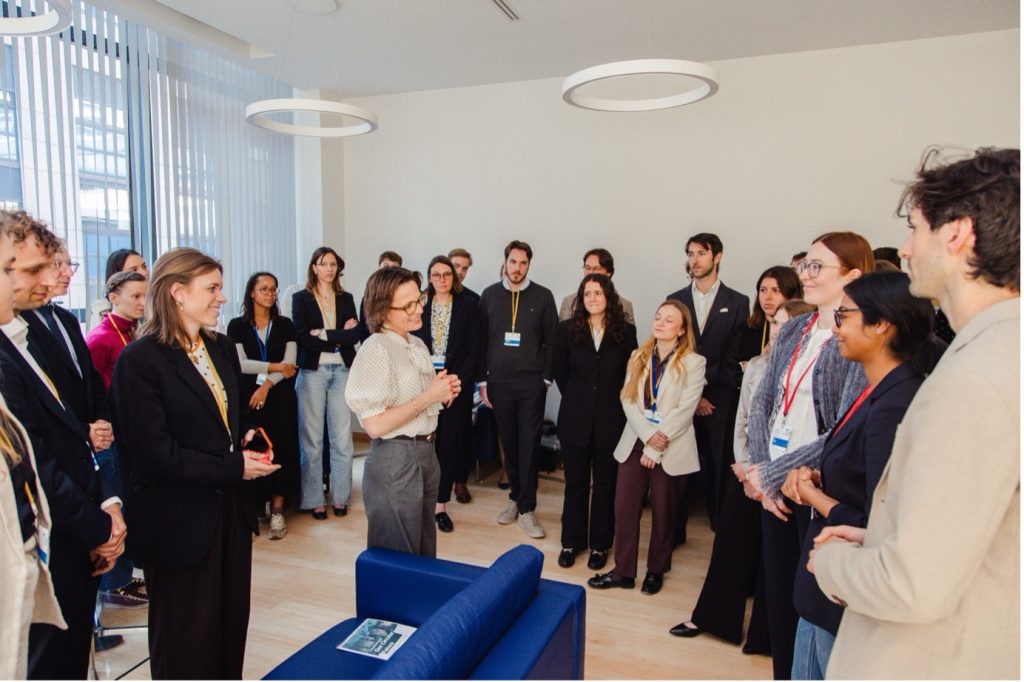
Finally, the proudest moment of my traineeship was to make a statement during the Youth section of the European Circular Economy Stakeholder Platform, organised by my colleagues in April. I could directly address Commissioner Roswall with my vision for a circular economy where “circularity cannot be separated from sufficiency”, a sentence later picked up in the press release! This event reminded me that beyond being a scientist wanting to contribute to evidence-based policy making, I also remain a citizen with a voice. While I need to be careful to not create confusion between these two roles, I can only look back at this experience at the EU and be immensely grateful to live in a place where I can express my opinions freely and without fear.
Thank you for reading all the way this very (too) long account. Feel free to reach out to me should you want to discuss further the opportunities for young researchers to work at the science-policy interface. Being part of SPAN is already a first step to get you there!
Disclaimer: This blog post only reflects the personal views of the author, not the positions of the European Commission.