
Mission & Strategy

EPFL logo on Place Cosandey © 2025 EPFL / Adrien Buttier
Strategic Planning Environment
EPFL has developed a dedicated strategic planning framework to support the fulfilment of its mission and the achievement of its objectives. This reflects EPFL’s distinctive position as a publicly funded academic institution competing to attract best talent, while remaining firmly committed to serving Swiss society. It also provides a structured and transparent way to communicate EPFL’s strategic priorities, both internally and externally.
The strategic planning environment contains the four-year Strategic Plan of the ETH Board for the ETH Domain which provides guidance for the EPFL’s four-year Development Plan for the respective Education, Research, and Innovation (ERI) periods and contains Schools and Colleges individual strategies which has been summarised in the EPFL Mission & Outlook 2025-2028.

Development Plan 2025-2028
EPFL creates value for society and contributes to addressing major global challenges through its core missions of high-quality education, innovative research, and the effective transfer of knowledge and expertise. It is committed to the highest standards of quality in delivering these missions, combining fundamental and applied research, fostering lifelong learning, and strengthening its impact across Switzerland and beyond. EPFL also relies on its ability to attract and nurture diverse talent and to cultivate a dynamic, trusted community, while clearly articulating and communicating its strategic priorities.
Since its inception in 1969, EPFL fosters a strong quality culture, grounded in continuous improvement and responsiveness to the evolving expectations of society, students, faculty, and staff and a broad participation in decision making processes. Its strategic planning framework, including the Development Plan and the Target Agreement signed with the ETH Board serve as central pillars of its quality assurance system.
The effective implementation of this framework relies on the principles of subsidiarity and individual responsibility, which are at the core of EPFL’s governance and quality culture. The details are presented in the EPFL’s Quality Policy.
Strategic areas
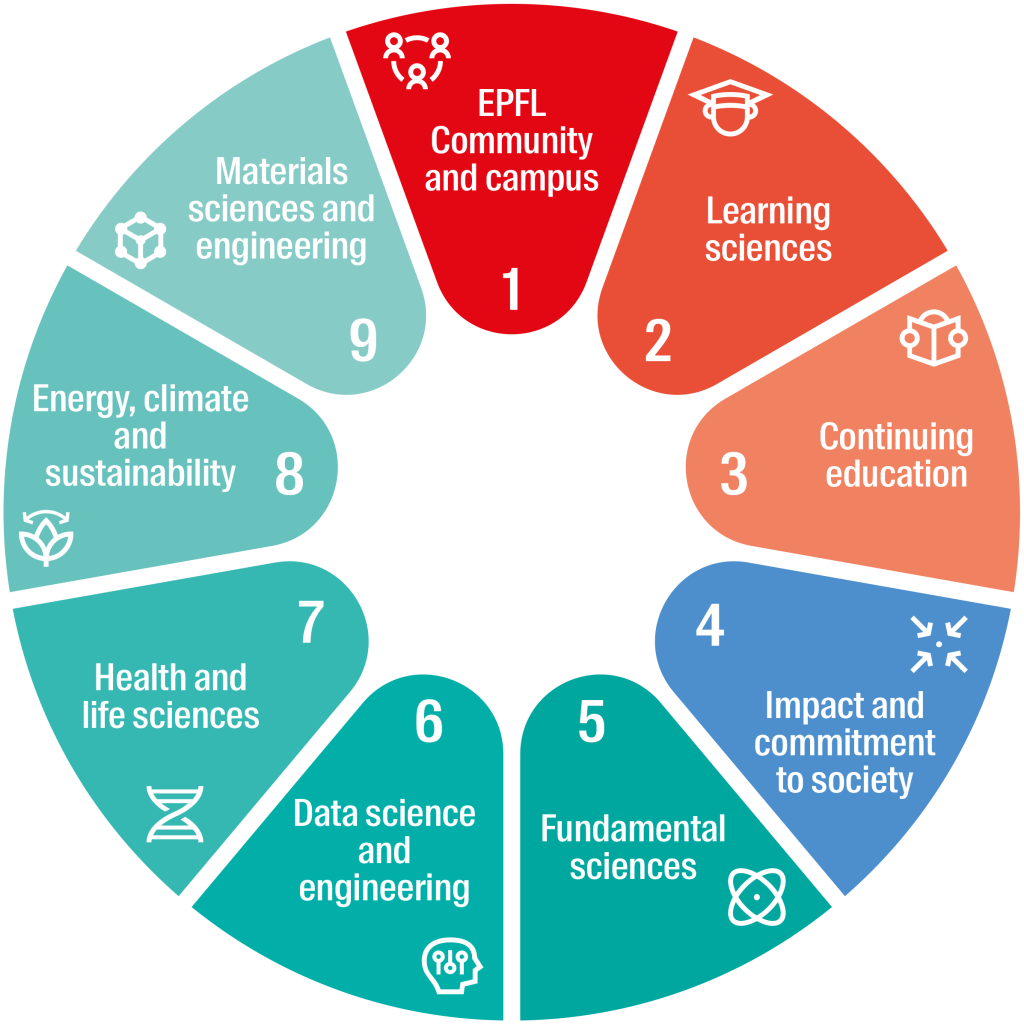
To take EPFL to a new stage of development in the 2025-2028 period, particular attention must be paid to key strategic areas alined with the strategic areas of the ETH Domain (Human health, Energy, climate and environmental sustainability, Responsible digital transformation, Advanced materials and key technologies, Engagement and dialogue with society).
EPFL has therefore identified nine major transversal and academic axes. The strategic orientations related to these areas serve as a guide for the entire EPFL community and will be translated into concrete actions within the Schools and Colleges.

Ongoing efforts in recent years have strengthened diversity and harmony within the community, with initiatives around the themes of respect and mental health, as well as mentoring programs. This work will continue and training programs in collaboration and leadership will be expanded, while strengthening links with campuses outside the canton of Vaud and reinforcing the communication strategy at all levels.
Detailed overview available in the 2025–2028 Development Plan

EPFL aims to strengthen its capabilities in learning sciences and digital education, both for the education of its own student population and as a contribution to the Swiss education system.
Detailed overview available in the 2025–2028 Development Plan

Aware of developments in the professional environment, EPFL is committed to ensuring that learning can take place at the highest level throughout life. To this end, we aim to offer a comprehensive range of MINT disciplines, including top-quality online, on-site and hybrid programs for engineers, managers and decision-makers. Building on its recognized expertise, EPFL will work closely with its partners while focusing on faculty engagement and strategic and business development, to establish itself as one of Europe’s leading institutions for continuing education.
Detailed overview available in the 2025–2028 Development Plan

EPFL plans to develop a global impact strategy to amplify its positive contributions to society and strengthen its links with Swiss citizens. Impact has been added to the missions of the Vice Presidency for Innovation and Impact (VPI) and will be included as a criterion for academic promotions.
Detailed overview available in the 2025–2028 Development Plan

Fundamental research contributes to global knowledge and long-term social and economic prosperity. EPFL is a leader in this field and must strengthen its impact by supporting core disciplines, improving research infrastructure, integrating students at an early stage of research and addressing pressing societal challenges through data-driven approaches and full academic freedom.
Detailed overview available in the 2025–2028 Development Plan

EPFL recognizes the importance of IT and digital transformation, with a focus on responsible digital transformation. It has identified six strategic directions: the expansion of the Swiss Data Science Center (SDSC+), privacy and cybersecurity, the integration of data science into the first-year curriculum, the promotion of AI in engineering and science, the development of the EPFL AI Centre and the impact of social sciences in addressing the disruptive role of AI and its societal consequences. These initiatives will position EPFL as a leader in the field of digital technology and AI.
Detailed overview available in the 2025–2028 Development Plan

EPFL is committed to pushing back the frontiers of health sciences and technologies to make a real impact. Through its interdisciplinary and strategic approaches, it will actively contribute to advances in precision medicine, prevention, diagnostics and therapies. By investing in education, research and innovation, EPFL is helping to shape the medicine of the future for patients and society.
Detailed overview available in the 2025–2028 Development Plan

EPFL plays a key role in Switzerland’s climate and energy strategies, supporting the objectives of sustainability and energy transition. It is helping to strengthen the scientific base, develop essential skills and support Swiss industries in their transformation. To broaden and strengthen its leadership, EPFL will focus on interdisciplinary research, collaboration and international visibility, while transforming its campus into a living laboratory, with the aim of achieving carbon neutrality by 2040.
Detailed overview available in the 2025–2028 Development Plan

EPFL emphasizes the importance of continuous innovation in materials science and technology for sustainability and technological progress. It will focus on existing strengths and expand into new areas relevant to technology and society, such as sustainable building materials, flexible materials and energy-related materials. The institution aims to create hub for the discovery of high-performance materials to support its research objectives and engage with the ‘pipeline’ of young people and society, with a particular focus on the sustainability of materials.
Detailed overview available in the 2025–2028 Development Plan
Schools and college

ENAC is the EPFL School dedicated to the natural and built environment. Bringing together architecture, civil engineering and environmental engineering in a unique way, ENAC aims to develop scientific understanding of the environmental and societal issues facing humanity, such as climate change, increasing urbanization and environment-related health problems. It strives to design innovative and sustainable solutions to anticipate and adapt to tomorrow’s challenges and to equip future generations with the knowledge, skills and tools needed to steer future developments.
Detailed overview available in the 2025–2028 Development Plan

The IC School is a world-leading center for education, research and innovation in computing and communications. We teach the fundamentals of an exciting and disruptive field and conduct research that pushes the boundaries of knowledge. We develop commercial applications for our technology and encourage entrepreneurship among our faculty and student community. We also engage with Swiss society by participating in public debates on technical issues and consulting with the public sector.
Detailed overview available in the 2025–2028 Development Plan

The School of Basic Sciences cultivates intellectual excellence and provides a state-of-the-art infrastructure, creating an exceptional environment for learning and discovery in mathematics, physics, chemistry and chemical engineering. Our mission is to equip students with a solid foundation in these fundamental sciences, preparing them for leadership roles in academia and industry. Through pioneering research and the development of innovative tools, we foster technological advances and encourage knowledge transfer on a global scale. Our collaborative, interdisciplinary approach ensures that cutting-edge solutions are created and implemented.
Detailed overview available in the 2025–2028 Development Plan

The engineering discipline is undergoing transformations in research and teaching. These changes will create new types of jobs for our students and industry, require adjustments to our education and research strategies, and have a major impact on the well-being of our society. In line with these developments, STI’s mission is:
- training students who are well prepared for careers in industry, research or the public sector
- innovating in engineering education, strengthening the foundations and promoting teamwork
- advancing research discoveries in the engineering sciences
- promoting innovation, technology transfer and transposition
- contributing to the development of effective engineering solutions to societal challenges.
Detailed overview available in the 2025–2028 Development Plan

The School of Life Sciences aims to understand the fundamental mechanisms of life and to use this knowledge for the benefit of health, medicine and society in an ethical manner. At SV, research, education and innovation take place at the intersection of biology and medicine with physics, chemistry, engineering, computer science and environmental sciences. As such, SV aims to become the hub of life and health sciences at EPFL. Quantitative, computational and engineering approaches to generating, understanding and exploiting diverse biological data are at the heart of the School.
Detailed overview available in the 2025–2028 Development Plan

We create value for business and society by developing change leaders and advancing management theory and practice. As part of a dynamic international campus that attracts world-class students and faculty in science, technology, engineering and mathematics, the College offers unique teaching programs at the intersection of business and engineering, and fosters internationally renowned, high-impact research. It offers a collaborative and respectful environment that attracts and retains bright minds and enables them to develop their full potential.
Detailed overview available in the 2025–2028 Development Plan
Strategic Initiatives
EPFL is leading several strategic initiatives to strengthen its institutional foundations, promote a culture of simplification, and support continuous improvement across the School. Together, these initiatives aim to reduce administrative complexity, foster collaboration, and create an environment where the EPFL community can focus on education, research, and innovation.
Documents


Institutional accreditation
Institutional accreditation certifies that EPFL meets the minimum requirements defined in the HedA and guarantees the quality of EPFL’s teaching, research and services.
EPFL received institutional accreditation from the Swiss Accreditation Council on 22 June 2022 with one condition. In 2024, EPFL fulfilled this condition and is fully accredited until June 2029.
The external page accreditation decision and procedure report of the Swiss Agency for Accreditation and Quality Assurance (AAQ) were published by the Swiss Accreditation Council on its webpages. The expert report (available in English only, pdf, 2.60 MB) is also available.