
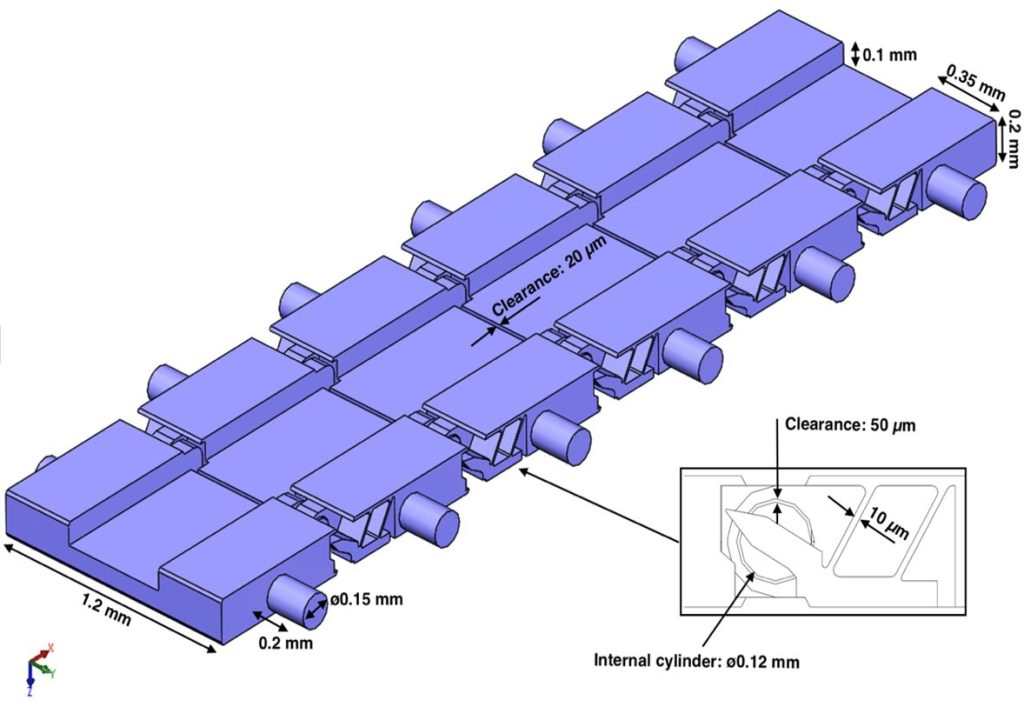
This project aims at developping a scaffold that can be easily transformed from a “flat” state, ideal for depositing cells, to a rolled-up tubular shape. Such a tubular structure offers many advantages for cell growth and organoid development. It provides a lumen that facilitates operations such as nutrient delivery, waste removal, and mechanical deformation. Two-photon deposition technology is currently used to manufacture Biotubes. Among the problems encountered with this manufacturing technique, the autofluorescence of the resins used is a key issue. Even with the least fluorescent resins, this prevents the development of cells from being visualized. The aim of this project is, on the one hand, to assess to which extend the fluorescence of the resins used could be reduced or even completely eliminated (ALCHEMY). On the other hand, it would involve verifying whether the mechanical properties of such resins allow the creation of a Biotube (INSTANT-Lab).
- Field: Advanced manufacturing; materials science
- Laboratories: The Laboratory for the Chemistry of Materials and Manufacturing (STI-ALCHEMY) and the Micromechanical and Horological Design Laboratory (STI-INSTANT-LAB)
- Project leader: Daryl Yee and Charles Baur
- Budget: 36’000.00 CHF