
-
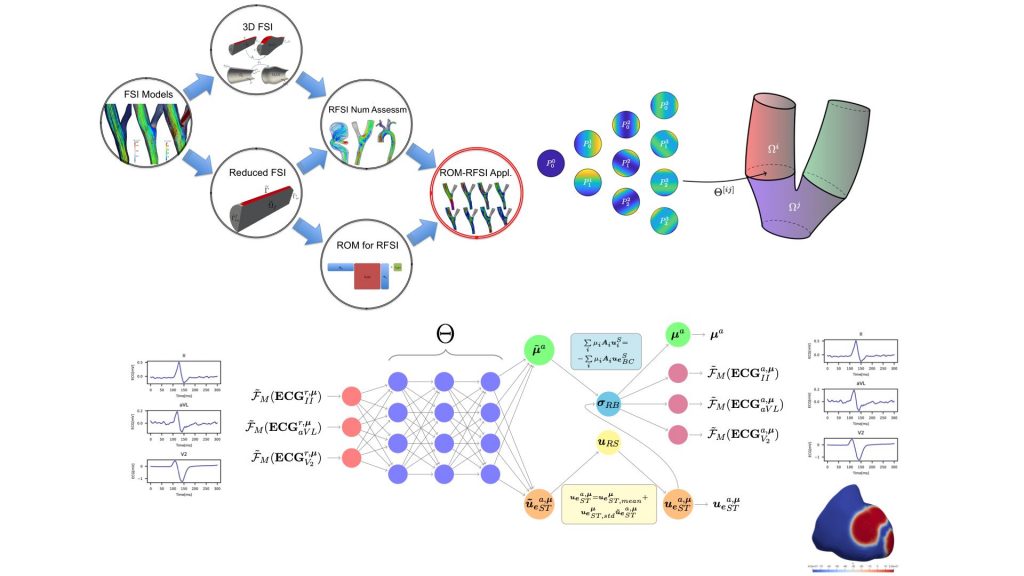
Modeling and simulation of vascular flows
Reduced-order modeling; physics-informed neural networks
We develop advanced numerical methods for cardiovascular flow simulation, emphasizing reduced-order models and physics-informed neural nets to achieve clinically relevant, efficient, and accurate computations. -
Boundary-region plasma physics
Braginskii models; IMEX time integration; finite-difference discretization; boundary-layer stability; HPC scalability
We model edge/boundary-region plasmas using the (drift-reduced) Braginskii equations, discretized with finite differences and advanced IMEX time integrators. The work focuses on robust treatment of strong anisotropy and stiff transport, accuracy and stability in boundary layers (e.g., SOL/divertor), and performance on modern parallel architectures, in close collaboration with the Swiss Plasma Center. -
Learning sciences and mathematics education
First-year mathematics; computational tools; AI-supported assessment; equity & self-efficacy
We study teaching and learning in first-year university mathematics, investigating the role of computational tools, hybrid AI+human assessment and feedback, and interventions that support equity and self-efficacy.