
Research at the Laboratory of Theoretical Physics of Nanosystems (LTPN), led by Prof. Vincenzo Savona, covers the areas of quantum optics, many-body open quantum systems, quantum information and quantum computing, with the overarching goal of exploring the frontiers of modern quantum science and technology.
Highlights
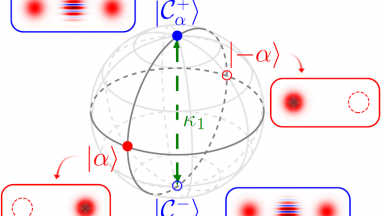
The critical Schrödinger Cat Qubit
Our recent work on Schrödinger cat qubits shows how operating the qubit close to a dissipative phase transition can enhance its noise-bias and make it the best candidate for the realization of a boson-encoded qubit
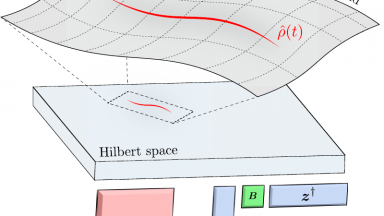
Adaptive variational low-rank dynamics for open quantum systems
An open quantum system is typically in a mixed quantum state. However, its mixedness is often not as large. With this general numerical method, we can integrate the dynamics of a low-entropy open quantum system using only the minimal needed amount of computational resources. The method leads to a significant scaling advantage with respect to exact numerical integration

Neural Projected Quantum Dynamics: a systematic study
Simulating the dynamics of quantum systems is one of the most significant challenges in modern physics because the complexity of these systems grows exponentially with their size. While existing variational Monte Carlo (VMC) methods have shown promise, they often suffer from numerical instabilities and high computational demands. In collaboration with Collège de France, we have introduced a series of powerful improvements to the Neural Projected Quantum Dynamics, which uses neural networks to approximate complex quantum states. We introduce two novel families of integration schemes that achieve high accuracy while remaining computationally efficient for large systems. We also adopt advanced control variates schemes to dramatically improve the stability of the method. These improvements have brought the Neural Quantum Dynamics significantly close to a powerful plug-and-play tool for state-of-the-art simulations, establishing a more stable and scalable path for accurately simulating the dynamics of large, complex quantum materials and circuits.
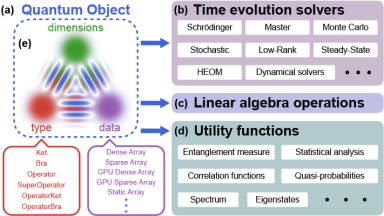
QuantumToolbox.jl: An efficient Julia framework for simulating open quantum systems
Simulating quantum devices is one of the toughest challenges in modern science: the calculations grow so quickly that even powerful computers struggle. Yet these simulations are essential for designing future quantum technologies. QuantumToolbox.jl is a new open-source software package that makes this task much more practical. Built in the Julia programming language, it combines easy-to-use commands with the speed of high-performance computing. It can run on laptops, GPUs, or supercomputers, and it includes tools for everything from modeling noise to optimizing control pulses in quantum experiments. By making large-scale simulations faster and more flexible, QuantumToolbox.jl lowers a major barrier in quantum research, helping scientists explore new ideas and accelerate the path toward real-world quantum technologies.
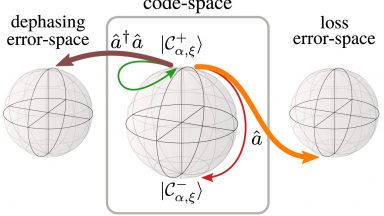
Quantum error correction using squeezed Schrödinger cat states
Check out our last preprint on a novel bosonic quantum code. The squeezed cat code can correct efficiently both photon-loss and dephasing errors, bringing considerable improvement over the conventional Schrödinger cat code, while still preserving ease of implementation
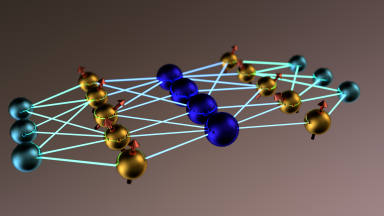
Variational quantum Monte Carlo with neural network ansatz for open quantum systems
A new methodological work combining the predictive power of machine learning tools with the versatility of variational quantum Monte Carlo to simulate open quantum systems. Soon to appear in Physical Review Letters.