
Type: Semester project
Experimental physics / Engineering
Recent investigations showed that when a droplet is placed above a vibrating surface, it can rebound without breaking. The behavior of the droplet can become very complex, and even chaotic [1].
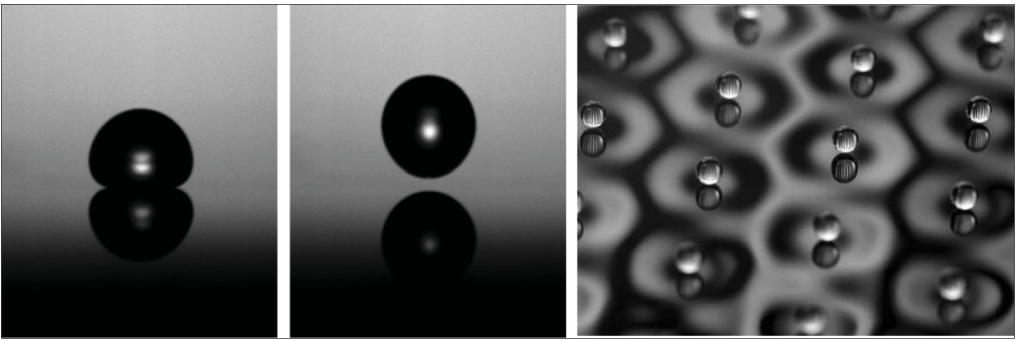
To investigate this behaviour experimentally, one needs to be able to systematically create reproducible droplets of controlled and repeatable size. This is also useful to generate walking droplets, a hydrodynamic quantum analog.
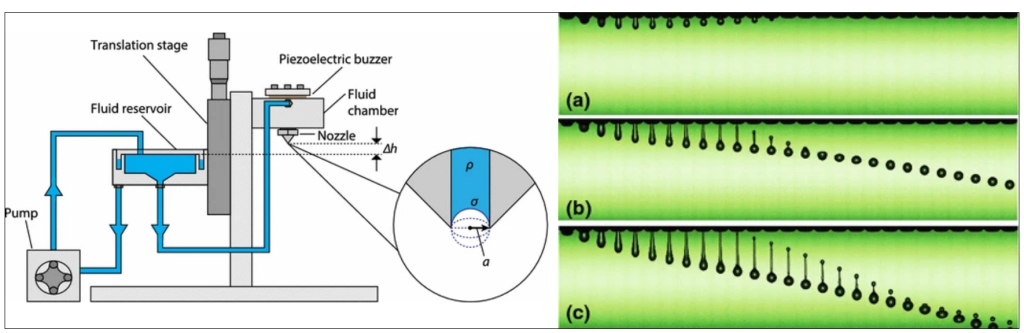
In 2018, D. M. Harris has realeased plans of a simple, low-cost, and precise droplet generator [2, 3]. The goal of this project is to build, assemble and characterize such a droplet generator and, should time allow it, use it to investigate the behavior of droplets over a vibrating surface.
This project couples physics and engineering. The student will learn to integrate mechanical design, electronics, and software into a complete experimental apparatus; and to use it to do scientific experiments.
Desired skills
- Basic electronics
- Basic programming
- Autonomy
Skills that will be acquired/reinforced during the project
- Conception/fabrication: CAD software usage, 3D printing, micro-controller programming;
- Usage of optical and electronic data for instrument control and data analysis;
- Fluid mechanics, chaotic dynamics.
References:
[1] Molefe, Fullana, Gallaire, Kolinski; Drops Can Perpetually Bounce over a Vibrating Wettable Solid. Phys. Rev. Lett. (2025). https://doi.org/10.1103/w3qq-cnj3
[2] Ionkin & Harris; Note: A versatile 3D-printed droplet-on-demand generator. Rev. Sci. Instrum. (2018). https://doi.org/10.1063/1.5054400
[3] Harris, Liu & Bush. A low-cost, precise piezoelectric droplet-on-demand generator. Exp. Fluids (2015). https://doi.org/10.1007/s00348-015-1950-6
Supervisor: Grégoire Le Lay