
Type: Semester project
Faraday instability describes the formation of spatial wave patterns at the surface of a liquid subjected to vertical vibrations [1] (see video [2]). The onset and characteristic wavelength of the instability depend on the forcing frequency and amplitude. In this project, we will investigate how these patterns are modified when the system is subject to an additional spatial modulation. Similar interactions between natural instabilities and spatial forcing have been observed in other systems involving waves, where triadic interactions can generate new spatial and temporal frequencies [3].
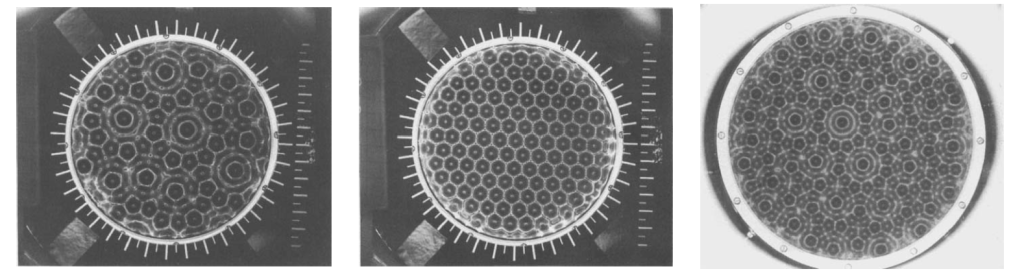
The main objective is to determine theoretically under which conditions such coupling can occur in the Faraday instability, and to identify the corresponding triadic resonance conditions. These predictions will then be tested using direct numerical simulations with the numerical solver Basilisk [5], based on a numerical setup that has already been developed.
The project is suited to a student who enjoys deriving and working with equations and is interested in combining theoretical analysis with numerical simulations. Some coding will be required, but no previous experience with numerical simulations or Basilisk is necessary.
[1] Douady, Stéphane. “Experimental study of the Faraday instability.” Journal of fluid mechanics 221 (1990): 383-409.
[2] www.youtube.com/watch?v=0d_D6yvXAFo
[3] Le Lay, Grégoire, and Adrian Daerr. “Dancing rivulets in an air-filled Hele-Shaw cell.” Journal of Fluid Mechanics 1028 (2026): A13.
[4] Edwards, W. Stuart, and S. Fauve. “Patterns and quasi-patterns in the Faraday experiment.” Journal of Fluid Mechanics 278 (1994): 123-148.
[5] basilisk.fr
Supervisors: Aliénor Rivière & Grégoire Le Lay