
Semester project – Fall 2026
On boats sailing downwind, one of the fastest setups is to use a spinnaker at the fore part of the yacht. This sail is highly cambered and there is evidence that the flow is significantly separated on surface [1].
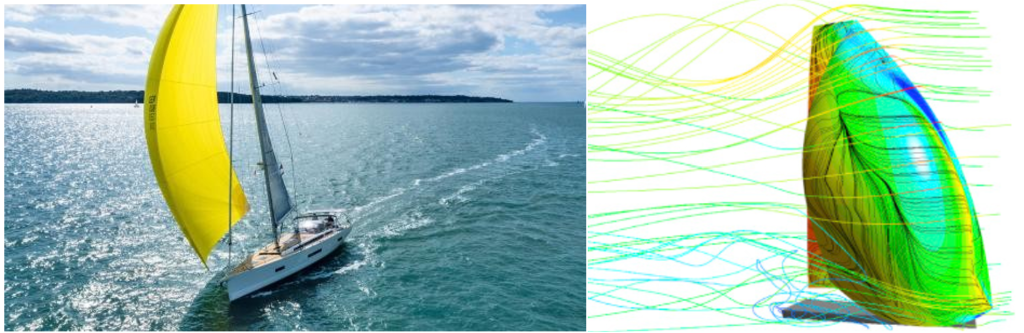
Therefore, understanding the aerodynamics of spinnaker would deliver better performance in these conditions. One aspect is to capture the physics of 2D thin and highly cambered profiles.
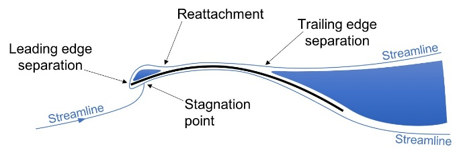
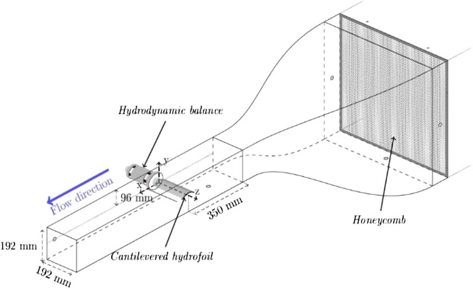
P. Bot [3] studied experimentally a simple thin cambered profile at various angle of attacks for different Re numbers (6.82 104, 2.38 104 and 3.69 105). Results of this work highlighted different behaviours for low and high Re numbers. In order to study further shapes, we would like to build a CFD setup to accurately capture the physics.
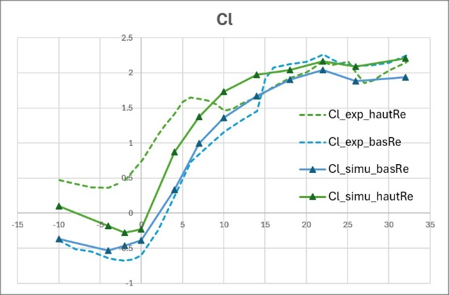
Following up work from an internship [4] that reviewed different meshes and models to build an initial polar, the objective of this project aims at refining the numerical work, focusing on in-depth analysis of the flow for distinct portions of the polar.
Literature work will focus on the experiments of P. Bot as well as on papers dealing with experimental and CFD work to capture the drag crisis for spheres and cylinders.
Numerical work will use the open-source code OpenFoam. Advanced models for capturing turbulence will be reviewed (including non-linear Eddy-viscosity models, DES and possibly LES).

For any information and application, contact Tristan Favre ([email protected])
References:
[1] S. Nava, J.E. Cater, S.E. Norris, Large Eddy Simulation of an asymmetric spinnaker, Ocean Engineering, Volume 169, 2018, Pages 99-109.
[2] Arredondo Galeana, A & Viola, IM 2018, ‘The leading-edge vortex of yacht sails’, Ocean Engineering, vol.159, pp. 552-562. https://doi.org/10.1016/j.oceaneng.2018.02.029
[3] P. Bot, Force Variations Related to Flow Pattern Changes Around a High-Camber Thin Wing, AIAA Journal 2020 58:5, 1906-1912
[4] M. Bihan, Etude numérique des performances aérodynamiques de l’écoulement autour d’un profil fin à grande cambrure, Rapport de stage, EPFL – ENSTA, 2026