
| Type | Master Thesis (preferably) / Visiting Student Project / Semester Project |
| Split | 35% theory, 65% coding and implementation |
| Knowledge | Machine Learning; Python coding; Plus: robotics/control background, constraint or imitation learning |
| Subjects | Robotics, Transfer Learning, Constraint Learning, Simulation |
| Supervision | Max Schmitz Foriest, Baiyu Peng |
| Published | 26.05.2026 |
| Availability | Assigned for Fall 2026. (Please contact us if you are interested in a project for Spring 2027.) |
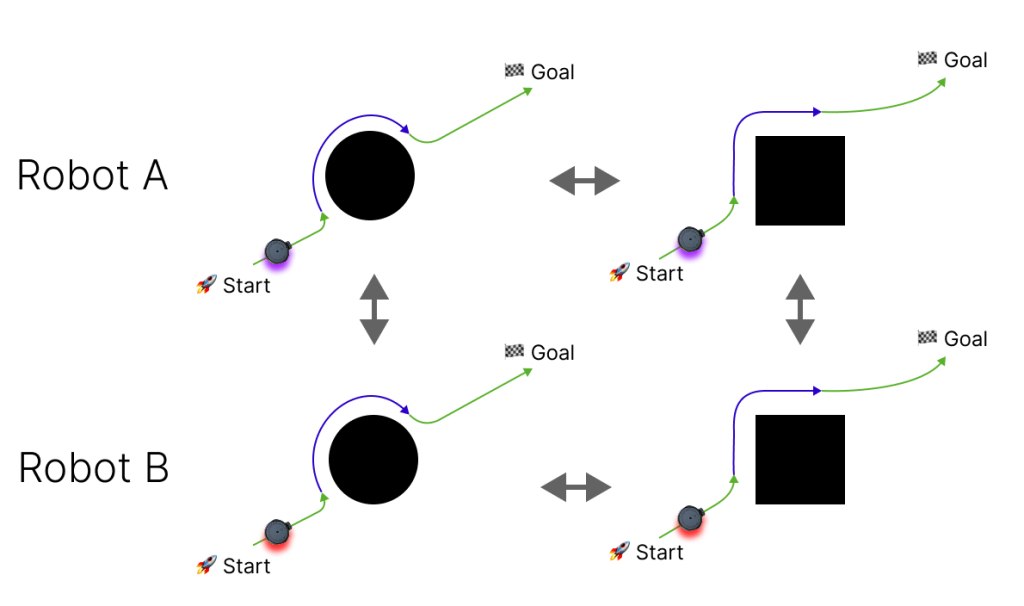
When a robot learns to perform a task, it implicitly learns a set of constraints — rules governing what the task demands and what its own body allows. A key challenge in robotics is transferring this knowledge: if one robot has mastered a skill, can another robot with a different morphology benefit from that experience? The answer depends critically on which constraints are transferable and which are not. A task constraint — such as “the object must not fall” — applies regardless of which robot executes it. An embodiment constraint — such as a robot’s maximum joint velocity — is robot-specific and should not be transferred. Identifying this distinction automatically, from demonstration data alone, is an open and important problem in robot learning.
This project builds directly on recent LASA work on constraint learning from demonstrations [1, 2], which has shown that nonlinear constraint functions can be inferred from expert trajectories using positive-unlabeled learning. The new challenge is to go beyond learning constraints for a single robot and instead identify, across demonstrations from multiple robots, which constraints are universal and which are robot-specific.
Project Goals
The student will work in a 2D simulation with point-mass robots of different drive types (differential, omnidirectional, unicycle) navigating environments with varying obstacle shapes. The central question: given demonstrations from multiple robots performing the same task, can we automatically distinguish task-specific constraints (shared) from embodiment-specific constraints (unique to each robot)?
The project proceeds in three stages:
- Simulation setup: Implement a 2D environment and generate demonstration trajectories across robot types.
- Constraint learning: Apply and extend Baiyu’s constraint learning framework to segment trajectories and extract per-robot constraint functions.
- Transfer analysis: Develop a method to identify which constraints are shared (task-specific) versus unique (embodiment-specific) across demonstration sets. This is the core scientific contribution of the project.
Expected Outcome
Strong results are expected to lead to a publishable outcome, targeting top robotics venues such as ICRA, IROS, CoRL, or IEEE RA-L.
Candidate Requirements
Time Commitment
We expect a commitment of 20+ hours per week. This project is ideally suited for a Master’s Thesis or a Visiting Student Project.
For students with a strong relevant background, a Semester Project can be considered as well, provided a minimum commitment of 12 hours per week is maintained.
Must-have:
- Strong Python programming skills, familiarity with Git/GitHub
- Background in machine learning and/or robotics (e.g., relevant EPFL courses)
Nice-to-have (plus): knowledge and experience in
- Optimization, constrained learning, or imitation learning
- Robot control or motion planning
- Interest in the theoretical foundations of robot learning, not just implementation
Feel free to get in touch and discuss more details at [email protected]
References
[1] B. Peng and A. Billard, “Positive-Unlabeled Constraint Learning for Inferring Nonlinear Continuous Constraints Functions From Expert Demonstrations,” in IEEE Robotics and Automation Letters, vol. 10, no. 2, pp. 1593–1600, Feb. 2025, doi: 10.1109/LRA.2024.3522756.
[2] B. Peng and A. Billard, “Learning Constraint Network from Demonstrations via Positive-Unlabeled Learning with Memory Replay,” arXiv preprint arXiv:2407.16485, 2024.