
| Type | Master thesis (preferably) / Visiting student Project |
| Split | 60% Control, 20% Modeling, 20% Evaluation |
| Knowledge | Robot control; Python; Robotic |
| Subjects | Adaptive Control, Variable Stiffness, Embodied Intelligence, Humanoid Hands |
| Supervision | Irene Frizza |
| Published | 18.08.2026. |
| Availability | Available |
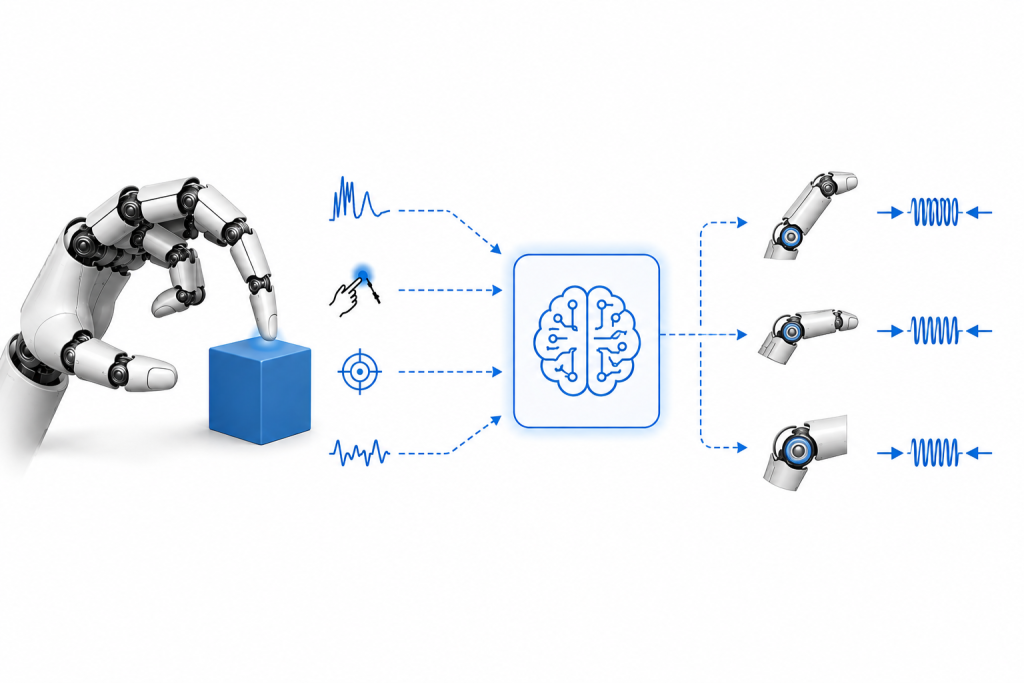
Giving robots the ability to physically adapt their bodies introduces a new challenge: how should a robot decide when and how to change its mechanical properties? For a humanoid hand, the appropriate stiffness may vary considerably depending on the task, contact conditions, external forces, and uncertainty. Selecting these properties online could allow the same hand to remain compliant during uncertain contact while becoming stiff when precise force transmission or robust interaction is required [1].
This project investigates adaptive stiffness control for humanoid hands, where directional stiffness becomes a controllable variable alongside robot motion. The goal is to identify which task and interaction information should drive physical adaptation and develop control strategies that select the appropriate stiffness online.
The project contributes toward embodiment-aware intelligence, where robots learn to regulate not only how they move, but also how their bodies physically respond to the world.
Project Goals
The project aims to investigate when and how a humanoid hand joint should adapt its directional stiffness during physical interaction. The goal is to develop a control strategy that selects the desired stiffness according to the task, contact conditions, and external disturbances.
The project proceeds in two stages:
- Adaptive stiffness control: What information does a robot need to adapt its physical behavior effectively? Identify the task and interaction variables that are most relevant for selecting the desired directional stiffness, and develop a model-based controller that adapts stiffness online. When this relationship cannot be effectively captured by an explicit model, investigate learning-based approaches to infer appropriate stiffness strategies from interaction data.
- Simulation and evaluation: Implement an idealized variable-stiffness humanoid finger or hand in MuJoCo and evaluate the proposed controller under changing tasks, contact conditions, and external disturbances. Compare adaptive stiffness control against fixed-stiffness strategies in terms of interaction performance and robustness.
The resulting framework will provide a foundation for embodiment-aware control and learning in humanoid hands, where robots can actively regulate not only their motion, but also their physical behavior during interaction.
Expected Outcome
Strong results are expected to lead to a publishable outcome, targeting top robotics venues such as ICRA, IROS, or IEEE RA-L.
Candidate Requirements
Time Commitment:
We expect a commitment of 20+ hours per week. This project is ideally suited for a Master’s Thesis.
Must-have:
- Strong Python programming skills.
- Strong background in robotics and/or control.
- Interest in robot simulation, control, and embodied intelligence.
Nice-to-have:
- Experience with MuJoCo.
- Familiarity with compliant control, variable stiffness, or contact-rich manipulation.
- Knowledge of robot learning or machine learning.
Feel free to get in touch and discuss more details at [email protected].
References
[1] I. Frizza, H. Kaminaga, K. Ayusawa, P. Fraisse, and G. Venture, “A Study on the Benefits of Using Variable Stiffness Feet for Humanoid Walking on Rough Terrains,” 2022 IEEE-RAS 21st International Conference on Humanoid Robots (Humanoids), pp. 427–434, 2022.