
| Type | Master thesis (preferably) / Visiting student Project |
| Split | 40% Mechanical Design & Modeling, 40% Prototyping & Integration, 20% Experiments |
| Knowledge | Mechanical design; CAD; mechanics and dynamics; |
| Subjects | Robotics, Machine Learning, Dynamic Manipulation |
| Supervision | Irene Frizza |
| Published | 18.08.2026. |
| Availability | Available |
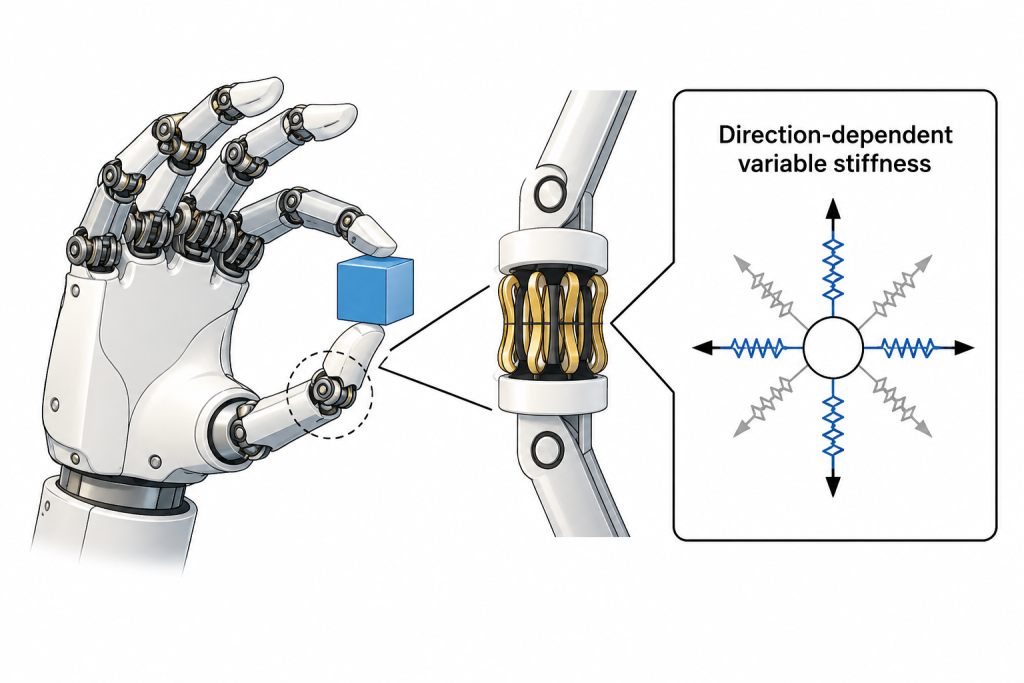
Robots are becoming increasingly capable of adapting their perception, planning, and control, yet their physical embodiment remains largely fixed. This limitation is particularly relevant for humanoid robots, whose hands must interact with diverse objects and environments while handling delicate contacts, large interaction forces, and unexpected disturbances. Recent work has shown how physically adaptive compliance and stiffness can improve a robot’s ability to interact with its environment [1,2].
This project explores mechanical intelligence through direction-dependent variable stiffness: robotic joints that can physically adapt their mechanical response along different directions. The goal is to develop and characterize a variable-stiffness joint for adaptive humanoid hands, combining mechanical design, hardware integration, and experimental testing.
The resulting joint will provide a physical foundation for adaptive humanoid hands capable of changing their mechanical behavior according to the task, enabling future research on embodiment-aware control and learning.
Project Goals
The project aims to develop a direction-dependent variable-stiffness joint for adaptive humanoid hands. Starting from an existing mechanical concept, the student will work on the design and realization of a functional joint prototype and investigate its mechanical behavior.
The project proceeds in two stages:
- Mechanical design: Refine the CAD and mechanical implementation of the variable- stiffness joint, focusing on the compliant and stiffness-adjustment mechanisms.
- Prototype development and testing: Assemble and integrate the joint into a functional prototype and perform experimental tests to evaluate its mechanical behavior under different stiffness configurations and loading directions.
The resulting prototype will provide a hardware platform for adaptive humanoid hands and future research on stiffness control and embodiment-aware manipulation.
Expected Outcome
Strong results are expected to lead to a publishable outcome, targeting top robotics venues such as ICRA, IROS, or IEEE RA-L.
Candidate Requirements
Time Commitment:
We expect a commitment of 20+ hours per week. This project is ideally suited for a Master’s Thesis.
Must-have:
- Background in mechanical engineering, mechanics, and/or robotics.
- Experience with CAD and mechanical design.
- Interest in robot hardware.
Nice-to-have:
- Knowledge of compliant mechanisms, variable-stiffness systems, or mechanics of materials.
- Experience with mechanical prototyping, assembly, or fabrication.
Feel free to get in touch and discuss more details at [email protected].
References
[1] I. Frizza, H. Kaminaga, P. Fraisse, and G. Venture, “Design and Validation of a Soft Pneumatic Submodule for Adaptive Humanoid Foot Compliance,” Machines, vol. 13, no. 12, 1142, 2025.
[2] I. Frizza, H. Kaminaga, P. Fraisse, and G. Venture, “Compliant Pneumatic Feet with Real-Time Stiffness Adaptation for Humanoid Locomotion,” Advanced Robotics Research, 2026.