
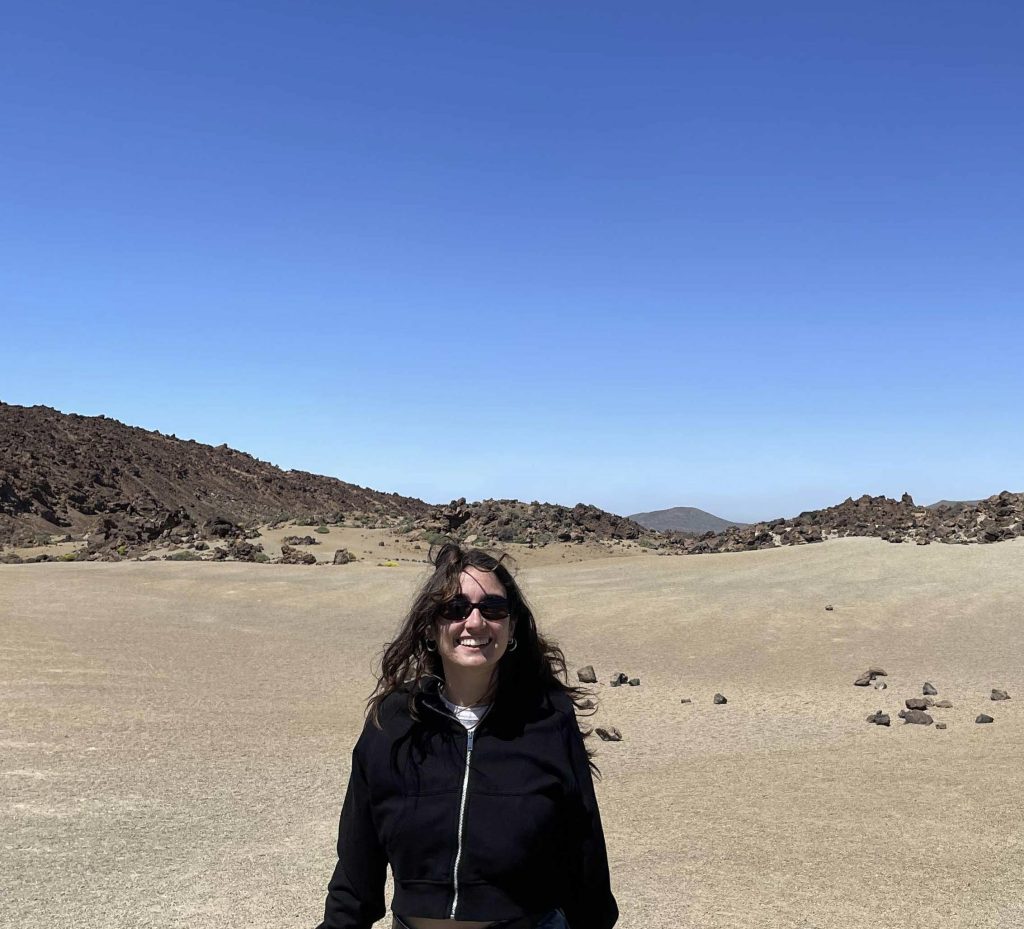
Can you say a few words about yourself
I was born and raised in Athens, Greece. From a very young age, I remember being fascinated by science and how the world works. This curiosity led me to study Applied Mathematics and Physical Sciences at the National Technical University of Athens (NTUA). My thesis focused on the study of aerosols and their impact on climate change. I am currently preparing to defend my PhD at the Laser Remote Sensing Unit of NTUA.
Did you choose your profession or did it choose you?
I was always attracted to science and curious about how the world works, but I never imagined my path would take this direction. As a child, I loved watching documentaries about climate change and was fascinated by everything related to it. During my Bachelor’s studies, I had the chance to meet Prof. Alexandros Papayannis and attend his classes. Hearing about the different ways we can study and understand the environment made me realize that this is what I wanted to do. So, I believe it was a bit of both, I chose my profession, but it also chose me. When it came time to select my diploma thesis topic, I instinctively knew that atmospheric science was the right path for me. It’s a combination of scientific depth and real-world impact confirmed that this was it.
What attracted you to join LAPI?
During the CleanCloud – CHOPIN Campaign I had the change to meet and work with Prof. Athanasios Nenes. He was always very inclusive so even before I officially joined LAPI, it already felt like I was part of it. Beyond that, I was drawn to the amazing people and the impressive science they produce.
Can you speak about the projects you are currently working on and other ones in the past?
I mainly study atmospheric aerosols. During my undergraduate studies, I worked on identifying different aerosol types, such as biomass burning smoke, dust, and sea spray, and retrieve their optical and microphysical properties. In my PhD research, I continued this work with a focus on pollen and other fluorescent particles, studying how they can be distinguished from non-fluorescent aerosols. I have also investigated the impacts of wildfires on climate. Currently, my research focuses on how humidity affects fluorescent and non-fluorescent particles, as well as on developing methods to identify different
pollen species, which is a particularly challenging task since their differences are often very small.
What have been some of your biggest successes?
One of my biggest successes is being part of research that contributes to understanding the atmosphere and helps inform and improve local environmental policies. I feel proud knowing that my work, even in a small way, can have a positive impact on society and the environment. Beyond specific results, I also consider a success the opportunity to collaborate with inspiring scientists, learn from them, and grow both professionally and personally through this journey.
You split your time between teaching and research. How do you view these two roles?
Currently I only spend time in the research.
What do you enjoy to do, outside of science and research?
In my free time, I really enjoy traveling. Even a short day trip is enough for me to walk, hike, and reset my mind. I also love spending time with my friends and family, especially over a nice coffee or meal.
Where is the most interesting place you’ve been?
This is a very hard question to answer. I’ve always believed that it’s not just the places you visit, but the people you share them with. Even the most “boring” place can become the most interesting with good company. But if I had to choose one, it would be my favorite place in the world, Ikaria, a Greek island in the Aegean Sea where I spend my summers. It has a warm and friendly atmosphere where everyone feels connected through dance and music, and suddenly no one is a stranger. I love this unique spirit, as well as the island’s stunning natural environment with its steep hills, dramatic cliffs, and fascinating rock formations.
A free thought for the end?
Be calm and leave stress behind. It’s okay to take things step by step and trust that everything will come together in time. And if it doesn’t, take a deep breath because tomorrow is a new day, and you can always try again.