

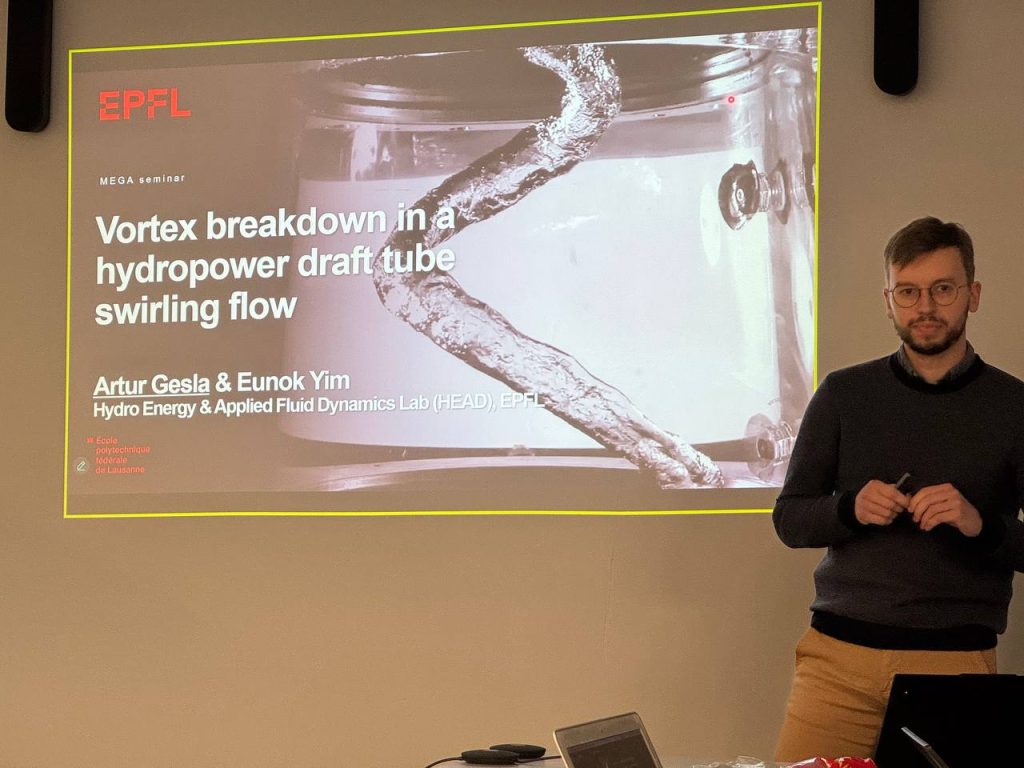
MEchanics GAthering –MEGA- Seminar: Vortex breakdown in a hydropower draft tube swirling flow
Abstact: In this talk we will explore a vortex breakdown mechanism in the industrial flow inside a Francis hydropower turbine. Vortex breakdown is a sudden change in a swirling flow structure when varying a flow control parameter. It can manifest as the formation of an axisymmetric recirculation bubble or single- and double-helical structures in the flow. Such a helical structure is present in the Francis turbine flow in the form of a vortex rope. Depending on the flow parameters, the formation of the vortex rope can follow a simple supercritical Hopf scenario, in which the base flow loses linear stability to monofrequency oscillatory dynamics, or a much more complex one, in which the base flow solution branch is characterised by multiple folds leading to saddle-node bifurcations, hysteresis loops, and the system transiently visiting the unstable solutions of the Navier–Stokes equations. We will show that the results of simplified laminar simulations can capture closely the spatial structure and the frequency of the experimentally observed turbulent vortex rope. Investigating the influence of turbulence on the rope dynamics and on the proposed bifurcation scenario will be identified as a main outlook of the present work.

MEchanics GAthering –MEGA- Seminar: What Rocket Turbopumps and Rabbits Have in Common: Logistic Dynamics in Inducer Cavitation Instabilities
Abstract: Cavitation instabilities in liquid rocket turbopump inducers—especially local types—have long been a persistent challenge, manifesting in various forms depending on the operating conditions. Despite extensive studies, their physical mechanisms have remained elusive. In this talk, the blade-to-blade interaction, which is the effect of one blade’s cavity on the flow field encountered by the following blade, is newly proposed as a unified physical mechansim underlying these various instabilities. Examination of the flow field under these instabilities reveals that this interaction exhibits nonlinear behavior analogous to the logistic map popularized by Robert May’s demographic model. Such nonlinearity leads to bifurcations in the cavity response, where local interactions among adjacent blades evolve into annulus-wide instability patterns. Further analysis shows that the emergence and transition of these instability modes can be interpreted within the same framework that governs bifurcation in the logistic map, providing an example of the physical and (Mitchell Feigenbaum’s) mathematical universality of nonlinear dynamical system.
