
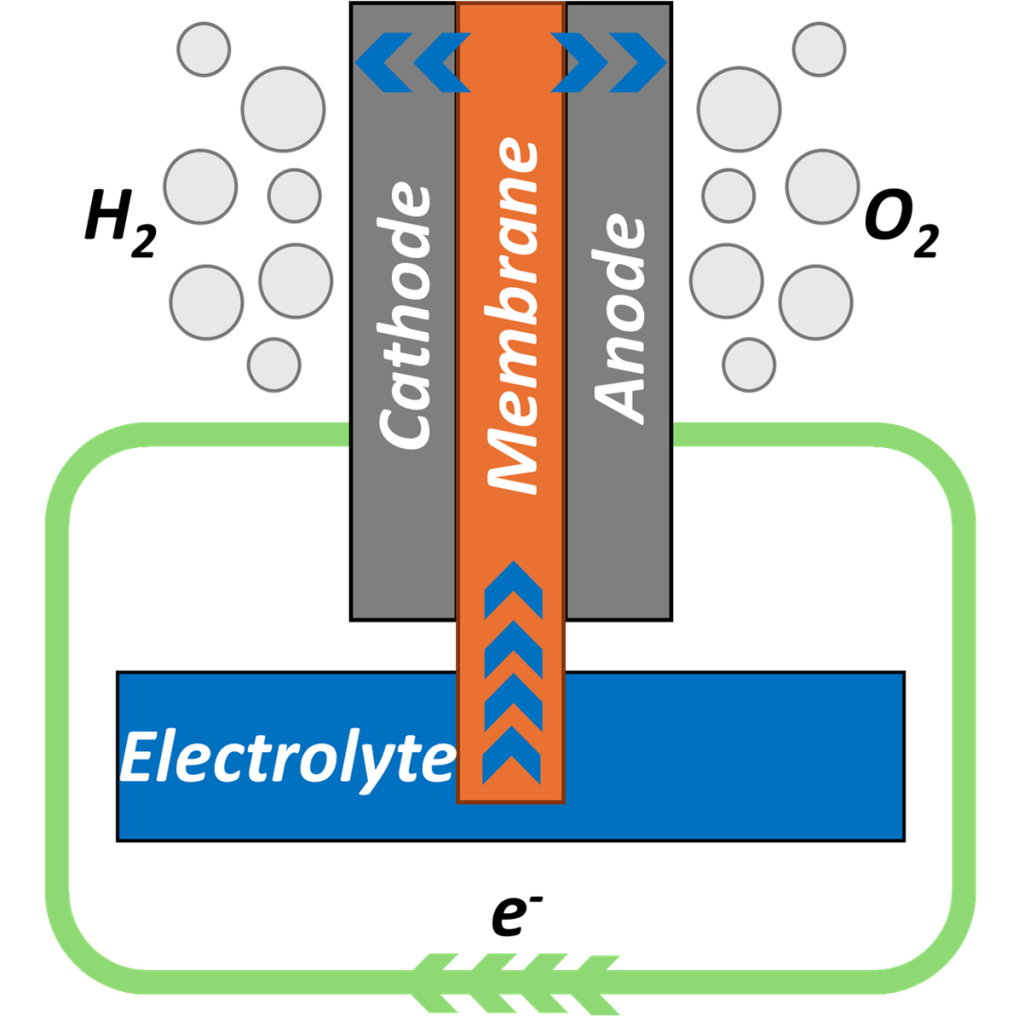
Context and challenge: Electrochemical water splitting is a key pathway for converting electrical energy into chemical energy, playing a key role in clean energy technologies and the large-scale production of green hydrogen. However, operation at high current densities/high reaction rates comes with high losses due to bubbles covering the electrode surfaces.
Approach and objective: Design and optimize a bubble-free capillarity-driven flow cell for electrolysis. Investigate the effect of utilizing various electrodes and membranes with different geometries and materials on energy efficiency and maximum current density.
If you plan to do a semester/thesis project on this:
What we expect:
Basic knowledge of fluid mechanics, thermodynamics, and mechanical design. Experience with electrochemistry, material synthesis, and/or COMSOL modeling will be an advantage.
What you will learn:
– Set up an electrochemical cell with various configurations.
– Characterize electrolysis cells with different techniques
– Synthesize and characterize electrodes for water splitting
Contact: Farkhondeh Khodabandeh ([email protected])