
Master & SIE Projects
CRYOS
First simulations with the new community snow model (“Helmut”)
Contact (supervisor) :
Professor Michael Lehning : [email protected]
Description:
- Helmut will be the future French/Swiss flagship land surface model and is currently developed between CEN (MeteoFrance) and SLF Davos. The numerical core has been developed and the work will be to execute first model simulations and compare to the state of the art model SNOWPACK. Work will be at SLF Davos.
Modeling blowing snow events in the Arctic
Contact (supervisor) :
Dr. Samuele Viaro : [email protected]
Description:
- The Arctic is experiencing an accelerated warming with respect to global mean and lower latitudes. Surface temperatures in the Arctic are a direct consequence of the surface radiation balance, which is modulated by clouds and aerosol dynamics. The sublimation of salty blowing snow particles (BSP) is an important source of sea salt aerosol (SSA), one of the most abundant natural aerosols globally.
- An accurate prediction of SSA in numerical models therefore requires capturing the dynamics of BSP, including their transport and interaction with cloud microphysics. This research employs the numerical model CRYOWRF, which includes prognostic blowing-snow equations coupled with the advanced land-surface snow model SNOWPACK, to investigate how BSP are transported and how they influence the highly nonlinear cloud microphysics. Numerical results will be validated using data from the MOSAiC expedition, which demonstrated that BSP can reach cloud levels and therefore potentially interact with cloud microphysics.
- This master project benefits from the expertise of two EPFL labs: CRYOS in numerical modeling and EERL in field measurements. The objectives are:
• Detailed literature review
• Set up initial and boundary conditions for CRYOWRF for different blowing snow events
• Run simulations with sensitivity analyses
• Compare numerical results with observations

Development of an LLM companion to a geophysical model for a novel developer/user interface
Contact (supervisor) :
Dr. Dylan Reynolds : [email protected]
Description:
- Documentation of geophysical models is often lacking, with model updates outpacing the speed of documentation updates, or legacy code remaining undocumented. In this thesis, the ability of a Generative AI to automatically translate code changes into documentation changes will be explored.
- The student will train an existing large language model (LLM) on the code base of the atmospheric model HICAR to serve as an assistant to both model users and developers. This LLM can then answer questions about model use or structure using natural language, improving the user/developer experience. Ultimately the student will test the accuracy of the LLM relative to a human and existing, generalized agentic AI coding assistants.
- This work will explore a novel method of code documentation which promises to free up developer time and provide users with more up-to-date information. The possibility of gathering additional model training data from model-user interactions may also be explored if time permits.
- This thesis topic is flexible in its implementation, and motivated students are encouraged to come to the project with their own ideas.
Monin-Obukhov theory and surface exchange
Contact (supervisor) :
Professor Michael Lehning : [email protected]
Description:
The turbulent fluxes of sensible and latent heat between the surface of the Earth and the Atmosphere are main contributors to the total energy and mass balance and determine boundary layer dynamics and surface properties for diverse land covers from vegetation to snow and ice.
Based on the recent observation that current models heavily underestimate latent heat fluxes, this master thesis investigates the hypothesis whether radiation penetration into the snow can explain this. The figure shows a temperature profile, for which penetration of shortwave radiation into the snow causes the maximum temperature to be below the snow surface. In this case, most water vapor will be produced at the depth of the maximum temperature and the vapor gradient based on the (lower) surface temperature will be underestimated. The master thesis will explore this mechanism using a combination of numerical modelling and data analysis. Own measurements of temperature profiles in the snow will validate the modelling efforts. Modelling will be done with SNOWPACK and with OpenFOAM, trying to explicitly capture vapor transport through the snow – atmosphere interface.

Towards an Arctic Wind Atlas for Greenland and Svalbard based on machine-learning bias-correction of climate model reanalysis (CARRA)
Contact (supervisor) :
Brandon van Schaik : [email protected]
Description:
High-latitude regions such as Greenland and Svalbard are characterized by complex orography, strong surface heterogeneity, and persistent stable boundary layers most of the year, which challenge the accurate representation of near-surface winds in atmospheric reanalyses of our climate models. While Copernicus Arctic Regional Reanalysis (CARRA) provides high-resolution wind fields (2.5km) over the Arctic, systematic biases remain, particularly in regions affected by the mountains and extreme wind events.
This project aims to develop an Arctic Wind Atlas for Greenland (and possibly Svalbard, Northern Scandinavia and Novaya Zemlya) based on CARRA reanalysis data, using machine-learning-based bias correction methods. You will be able to work on long-term CARRA wind statistics with available in situ observations (e.g. automatic weather stations) to quantify and correct systematic biases in near-surface wind speed and direction. Following the methodology of our recent Antarctic Wind Atlas study, statistical or machine learning approaches will be applied using time-invariant predictors describing sub-grid-scale orography and surface characteristics.
The project focuses on deriving spatially continuous, bias-corrected probability distributions of the wind and associated wind energy metrics across Greenland and Svalbard. Extreme wind regimes, including downslope wind systems such as Piteraq events, may be briefly examined as part of the broader wind climate.
The project is suited for an advanced Semester project or a Master’s thesis. At the end of your project, you will have gained skills in analysing Arctic climate data, statistical and machine learning methods, and the construction and plotting of regional wind atlases. Your results may contribute to future scientific publications which is relevant to both the scientific and engineering communities.

Parameterizing snow density with atmospheric variables
Contact (supervisor) :
Dr. Samuele Viaro : [email protected]
Description:
- Snow density influences both mechanical and thermal characteristics of the snowpack which are key components in many applications, including avalanche warning. The current snow density parameterization in the 1D numerical model SNOWPACK relies on meteorological input variables close to the surface [1] but it was recently shown to underestimate new snow density under warm conditions, while overestimating it under colder, windy events [2].
- To improve the fresh snow density parameterization in SNOWPACK, meteorological conditions of the upper atmosphere could be included in the parameterization through the use of the CRYOWRF model [3], which couples the atmospheric model WRF with SNOWPACK as land surface model. Initial results [4] show a possible trend between maximum supersaturation, found high in the atmosphere, and fresh snow density (figure 1).
- This master project involves investigating additional measurement data, running CRYOWRF simulations to prove the trend observed and potentially finding additional variables that could be included in the novel parameterization of fresh snow density in SNOWPACK.
References :
[1] M. Lehning, P. Bartelt, B. Brown, and C. Fierz, “A physical SNOWPACK model for the swiss avalanche warning: Part iii: Meteorological forcing, thin layer formation and evaluation,” Cold Regions Science and Technology, vol. 35, no. 3, pp. 169–184, 2002.
[2] L. Gaillard, “Validation of SNOWPACK modelled densities using SnowMicroPen data,” EPFL Master thesis, 2025.
[3] V. Sharma, F. Gerber, and M. Lehning, “Introducing cryowrf v1. 0: multiscale atmospheric flow simulations with advanced snow cover modelling,” Geoscientific Model Development, vol. 16, no. 2, pp. 719–749, 2023.
[4] L. Accossato, “Insights for an improved snow density parameterization including upper atmosphere parameters,” EPFL Semester project, 2026.

WSL institute for Snow and Avalanche Research SLF, in Davos
Master’s internships at SLF
Spatial interpolation of Automatic Weather Station (AWS) data, (Despiking): Internship Despiking
Contact:
Dr. Mathias Bavay : [email protected]
081 41 70 265
Master’s thesis at SLF
Studying the atmospheric circulation and their related snow effects using observational methods at SLF Davos
Contact:
Dr. Sergi Gonzalez Herrero : [email protected]
Description:
-
The tasks consist on deploying a LIDAR system in the Flüela valley during winter and use the data of the new Tschuggen station to study the effects of mesoscale circulations (katabatic winds, rotors, etc.) on the snow in an Alpine Valley.
Introducing a new snow model into the weather and climate model ICON
Contact (supervisors) :
Dr. Nander Wever : [email protected]
Professor Michael Lehning : [email protected]
Description:
- The work conducts validation studies with the new simplified snow model NIX as part of the TERRA land surface scheme in ICON. The task consists in simulating snow cover dynamics over the Alps and validating against observations.
Effects of extreme heatwaves on the Antarctic snow and firn
Contact:
Dr. Sergi Gonzalez Herrero : [email protected]
Description:
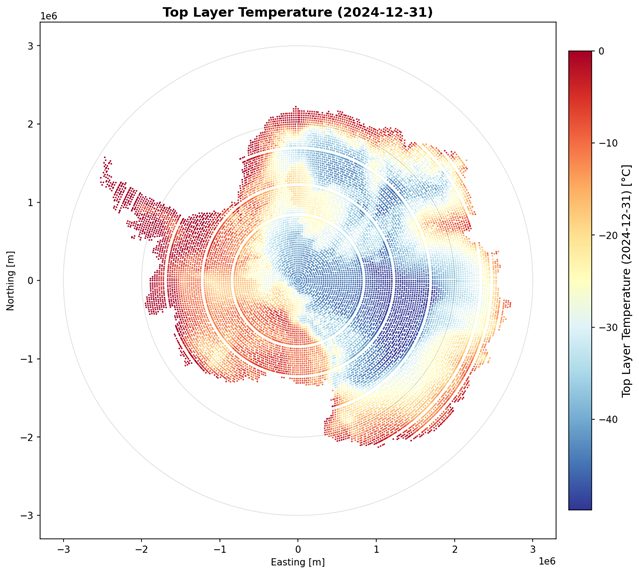
Extreme atmospheric heatwaves in Antarctica are known to be exacerbated by climate change. This rise concerns on the implications that these extreme events have for cryosphere stability. Our initial modelling results of selected case study also suggest that these heatwaves have important implications on the snow and firn, including enhanced melt, changes in densification processes and alterations of surface energy balance. The project will systematically investigate these processes at large scales.
The tasks will consist in:
- Define and track extreme heatwaves across the Antarctic continent, by developing objective detection criteria and applying them to atmospheric reanalysis to characterize their spatial and temporal distribution.
- Assess their impacts on snow and firn by using long-term, distributed simulation with SNOWPACK across Antarctica in order to quantify changes in melt occurrence, refreezing, firn structure and related processes under extreme temperature conditions.
Studying the heat flux representation by different reanalysis and climate models.
Contact:
Dr. Sergi Gonzalez Herrero : [email protected]
Description:
-
The tasks will be compiling heat fluxes by different datasets in Antarctica and analyze them to study the uncertainty of reanalysis and climate models in Antarctica. Also set simulations with CRYOWRF to understand the importance of grid resolution.
Simulation of drifting snow and its impact on snow stratigraphy in a physics-based snowpack model
Contact :
Dr. Nander Wever : [email protected]
Description:
- Snow transport by wind is a key process in snow-covered regions, significantly influencing local snow distribution and stratigraphy. In Antarctica, high wind speeds result in frequent drifting snow events that strongly impact the local surface mass balance and contribute to large-scale redistribution of snow. In alpine regions, wind-driven snow transport leads to the formation of wind slabs, which can cause unstable snowpacks and contribute to avalanche risks.
- The aim of this thesis is to validate recent improvements in a physics-based snowpack model for simulating drifting snow conditions. Model output of drifting snow mass fluxes will be compared against field measurements of drifting snow. Additionally, the study will assess how the simulated snow transport affects the resulting snow stratigraphy. These results will provide insights in the information delivered by snowpack models regarding the presence of drifting snow, and the properties of formed wind slabs, enhancing our understanding of the surface processes and improve model tools used for avalanche forecasting.