
Talking about radiation/particle detection modules based on scintillating crystals, one serious issue consists in light extraction. The modules, as shown in the picture, are composed by a photosensor, capable to detect light, coupled with a block of material (organic or inorganic) that has the property to convert an incoming high-energy radiation in optical photons through a process called scintillation. The Optical photons generated tend to stay inside the block because of its higher index of refraction respect to the surrounding environment.
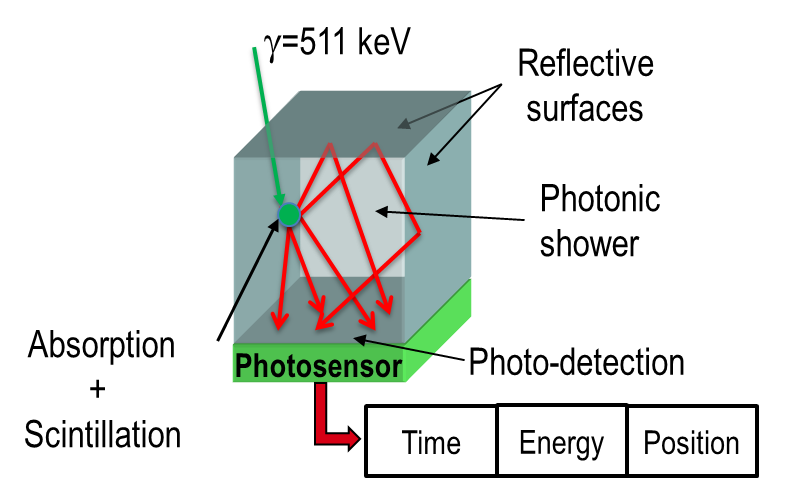
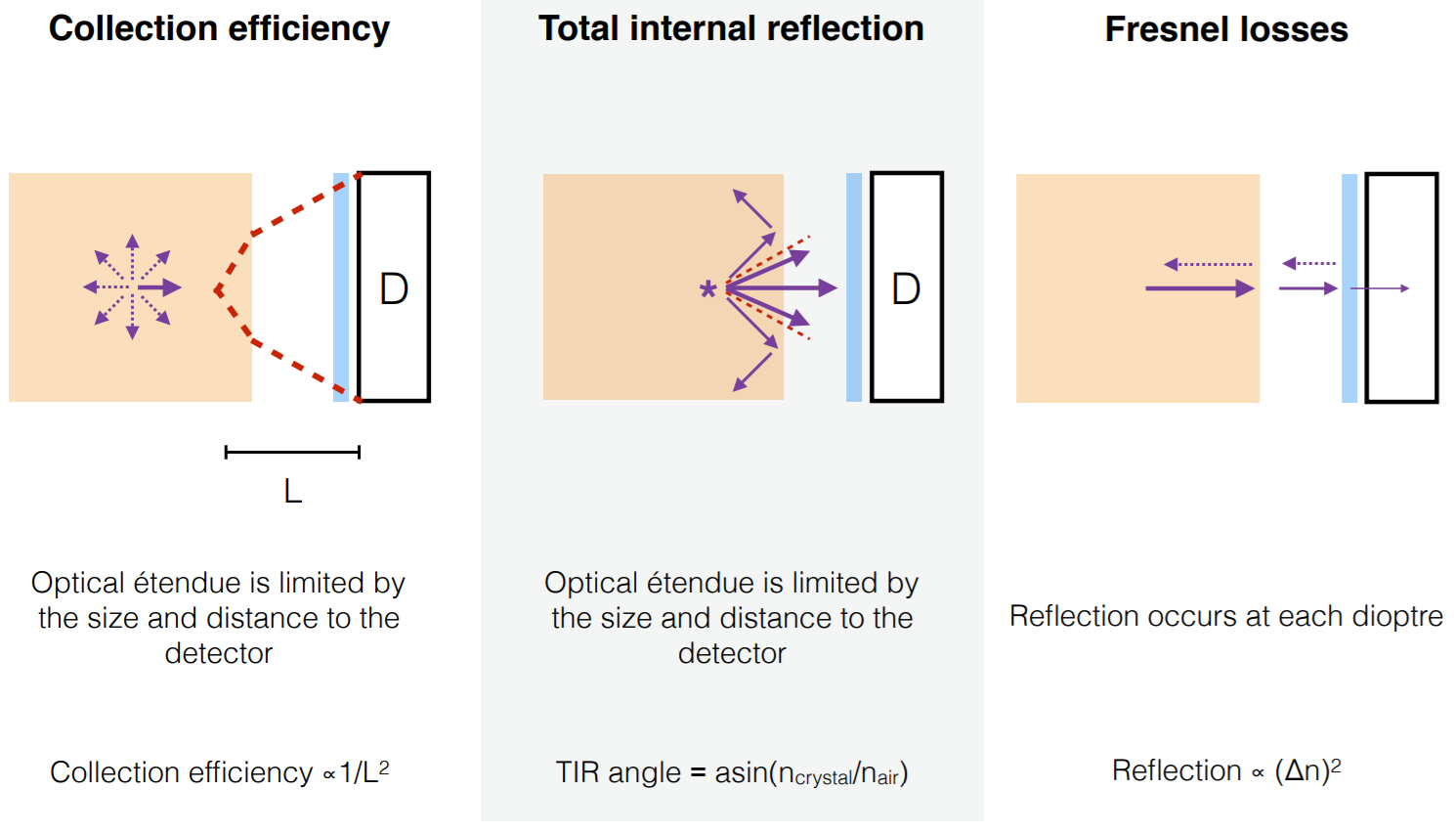
This not optimal interface with the photosensor causes a not negligible loss of light, caused by reflections and internal absorption.
The aim of this research is to investigate several way to optimize the coupling, to reduce the losses and to extract light at the first interaction with the surface. This enables better timing resolution for the system.
Applications
- Medical imaging
- Radiation and Particle Detection
- Fast light detection devices
Relevant publication
F. Gramuglia, et al. “Towards 10ps SPTR and Ultra-Low DCR in SiPMs Through the Combination of Microlenses and Photonic Crystals” IEEE Nuclear Science Symposium and Medical Imaging Conference (NSS/MIC), 2017