
lunch&LEARN

Why lunch&LEARN?
At the Center LEARN we have the mission to develop evidence-based educational practices and support innovative teaching and learning.
In order to capture and showcase some interesting examples, we have set up a series of lunch&LEARN sessions which portray projects from the community and their respective teaching and learning experiences.
The aim of lunch&LEARN sessions is to gather an audience interested in novel and effective learning and teaching approaches, and create a rich discussion around successful paradigms based on evidence.
As an informal event, lunch&LEARN allows participants to have their meals while gaining new insights about interesting pedagogical approaches, opening possibilities for knowledge sharing and further collaborations.
Our guests encompass a range of innovative teachers from EPFL as well as researchers from labs working on learning (CHILI, REACT, MOBOTS, ML4ED), service units (CEDE, CAPE), and educators with new visions for education at EPFL.
This event is open to EPFL teachers and teaching assistants interested in innovative teaching and learning and, regardless of whether you are curious or doubtful, active participation in lunch&LEARN discussions is very welcomed!
If you’d like to give a talk or have any ideas, suggestions or questions regarding lunch&LEARN sessions, contact us on [email protected]
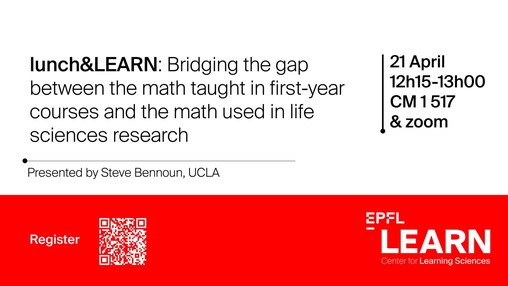
lunch&LEARN: Bridging the gap between the math taught in first-year courses and the math used in life sciences research
Speaker: Steve Bennoun
Location: CM 1 517 & Online
Category: Conferences – Seminars
Target audience: Informed public
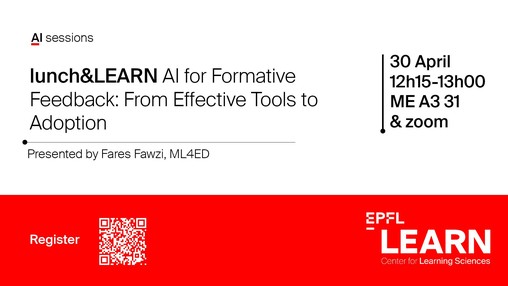
lunch&LEARN: AI for formative feedback. From effective tools to adoption
Speaker: Fares Fawzi, Machine Learning for Education Laboratory
Location: ME A3 31 & Online
Category: Conferences – Seminars
Target audience: Informed public
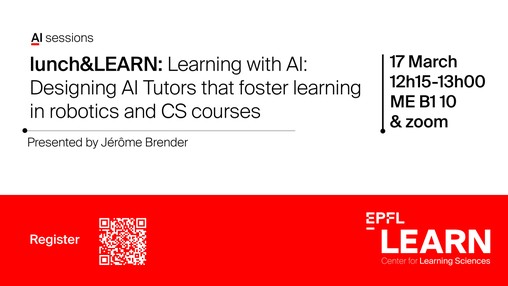
lunch&LEARN: Learning with AI: Designing AI Tutors that foster learning in robotics and CS courses
Speaker: Jérôme Brender
Location: ME B1 10 & Online
Category: Conferences – Seminars
Target audience: Informed public
Sessions in 2025


More past sessions
- Investigating the use of oral exams in large-enrollment engineering courses with Curt Schurgers
- Exploring the Impact of ChatGPT in Robotics Courses: Does It Really Help Students to Learn? with Jérôme Brender
- Randomized experiments to evaluate learning technologies with Maria Paula Cacault
- An Automatic Grading System for Large Classes with Matt Bovel and Benoit Morawiec
- An exploratory analysis of student behavior, performance and evaluation in hybrid and blended first year bachelor calculus course with Manuela Pineros-Rodriguez,Annechien Sarah Helsdingen
- AI Unmasked: How Transparency Shapes Student Trust in AI Feedback with Tatjana Nazaretsky
- Lessons learned from the first edition of a large second-year course in software construction with Shardul Chiplunkar
- The new and improved “No-Significant-Difference-Phenomenon” with Gerd Kortemeyer
- Improving retention of non-traditional STEM students at EPFL with Simone Deparis
- 3T PLAY: designing an activity to teach transversal skills with tangible objects with Nicola Winzenried, Siara Isaac
- Introducing digital education at scale: EPFL’s contribution to the EduNum project with Francesco Mondada
- Unveiling the dynamic journey of ETH’s Project-Based Learning for electrical engineering at the D-ITET Center with Michele Magno, Victoria Abou-Khalil
- Interaction between Moral Reasoning and Imagination: Critical Perspectives and Pedagogical Implications with Yousef Jalali
- Piazza as a service tool for asynchronous learning: preliminary results with Patrick Jermann
- Preparing to learn linear algebra with Vera Baumgartner (ETH Zürich)
- Using web-based computational chemistry software to teach first-year students with Luc Patiny
- Emotional experiences in the first year at university: empirical findings and implications with Alexandra Niculescu
- Climate and Sustainability Action Week with Michka Melo, Nicola Banwell and Eric Domon
- Transversal skills: where we are and where we are going with Kathryn Hess, Helena Kovacs and Julien Delisle
- Developing expertise: practical approach to teaching in hands-on settings with Siara Isaac and Roland Tormey
- Computational thinking assessment with Marc Lafuente
- How can we make and use educational videos in higher education? with Annechien Helsdingen, Matthew Goodman and Patrick Jermann
- Which professional skills do students learn in engineering team-based projects? with Cyril Picard, Cécile Hardebolle, Roland Tormey, Jürg Schiffmann
- Is it possible to teach a first year subject in a more inclusive way? Our experience in Linear Algebra with Simone Deparis, Roland Tormey, Himanshu Verma, Cécile Hardebolle
- Teaching under lockdown: what we know and what it means with Helena Kovacs
- Teaching online laboratories with Christophe Salzmann, Denis Gillet
- On motivation
Caroline Pulfrey
Session recording, slides and questionnaire
- EPFL Graph Search
Francisco Pinto, Patrick Jermann
- Transferable skills in student engineering projects
Ivan Istomin
- Scaffolding engineering students’ thinking from paper-based exercises to open-ended projects: towards epistemic sophistication
Siara Isaac
- Investigating collaboration as a process with theory-driven learning analytics
Carmel Kent, Mutlu Cukurova (UCL)
- Configuration of learning and teaching spaces
Isabelle Lermigeaux-Sarrade
- Discovery of EdTech Startups and the Swiss EdTech Collider, featuring Calerga, Isyflow and Classtime
Roman Brügger, Guillaume Zufferey, Yves Piguet, Jan Rihak
- Human resilience against automation, robotics and artificial intelligence: how to predict and improve it
Rafael Lalive (UNIL), Nicola Nosengo
- Design, implementation and evaluation of the Flipped Classroom model in a mandatory Linear Algebra course
Simone Deparis, Cécile Hardebolle, Roland Tormey, Himanshu Verma
- Maker education in higher education: what’s possible?
Paulo Blikstein (Columbia University)
- Active learning: from concepts to blended implementation with open access platform
Denis Gillet, Juan Carlos Farah
- Teaching programming to large classes with Jupyter Notebooks
Mauro Cherubini, Thibault Estier (UNIL)
- Improgineering
Simon Henein, Susanne Martin
- Developing a questionnaire to assess interdisciplinary project management skills
Marc Laperrouza, Roland Tormey
- FROG for classroom orchestration
Stian Haklev