
-… — .-.. -. is how we first meet the romantic interest in Ella Cheever Thayer’s 1880 novel Wired Love: A Romance of Dots and Dashes. “Just a noise,” claims our lead Nattie, a telegraphist who comes to rely on that noise for daily comfort. We read. She hears. With a moment, Thayer has demonstrated what is special about the game of love.
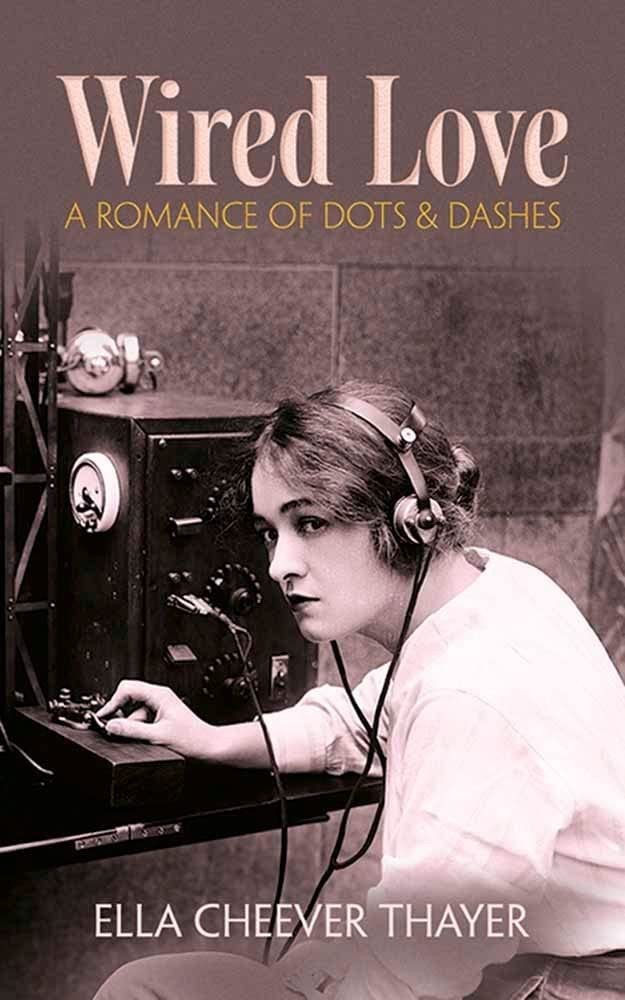
How Thayer presents the full picture of this love is special, too. Nattie and the mysterious operator’s romance blossoms through constant conversation via telegraph, to the enjoyment and chagrin of other operators on the same line. That telegraph operators shared lines, or that operators could hear messages not sent to their office, isn’t something a modern reader would know. But Thayer dispatches such telegraphy tidbits with grace: in a story of “John is dead beat; home at three” being received as “John is dead, be at home at three”; in foregrounding the romantic implications of every telegraphist possessing their own style of sending Morse; in ensuring “somebody always ‘calls’ [Nattie] in the middle of every entertaining chapter!” The result is an outdated tool brought to life. Thayer, a former telegraphist herself who dedicates a concerning number of words to the foolishness of Nattie’s customers, writes for the ignorant of 1880 and the ignorant of today.
Of course, she owes something to today’s world for steeping us in the very culture she describes. It is not quite as peculiar for us to read of telegraphists sending one another “H a!” as it might’ve been to Thayer’s initial readers. Virtual connection as the antidote to Nattie’s bucolic ennui mimics the promise of the internet today, real or imagined. Even Thayer’s effort to cast Nattie as “one of the ordinary human beings we meet every day,” rather than “one of those impossible, angelic young ladies of whom we read,” matches the perspective driving more modern content.
It has our humor, too. Asked not to poke fun at Nattie’s error in transcribing “horse” as “hearse” by sending morbid words, her mysterious suitor decides, “the undertaking will not be difficult.” Wit in the dialogue gives way to Seinfeldian tragicomedy when the love between characters makes itself known. Regardless of form, Thayer’s easy humor separates her from the stuffy, difficult writing of lesser contemporaries. Her novel’s teaser impossibly rings true some 140 years later: “‘the old, old story,’ – in a new, new way.”
The novel’s age shows in dialogue nonetheless, though it is more an engine for curiosity than sour taste: “red-haired” is exclusively used as a synonym for revolting, for example. Some EPFL students might be delighted by the characters’ habit of slipping French phrases into conversation – an old class-conscious habit that I can assure you Americans no longer maintain. For these accessible insights into small history, we thank Thayer for a novel unambitious in length and plotting, content to organize a friend group sized ultimately at six within the confines of a residential building or telegraph office so they might fall and fail in love.
Like Friends, I now realize. By its end, this book becomes a Gilded Era precursor to the television show Friends.
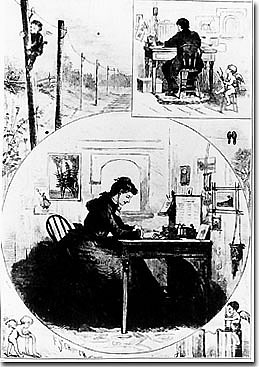
Which must be why it couldn’t maintain my interest (before PLUME receives any hate mail, I should note that opinions on the hit show Friends in this piece are entirely my own). After Thayer all but abandons the telegraph as a framing device for courtship, the novel slips into the mundane, with one-note male characters, a contrived end-of-the-second-act low point for our two romantic leads, and a neat string of romantic confessions. All the familiar trappings of an undercooked romantic comedy or, dare I say, comfort television which has outstayed its welcome.
It is the few startling moments when Thayer culminates a character’s arc by explicitly laying out the novel’s message that a reader in their late 20s realizes he or she is not the intended audience. Even so, a shy, bookish, teenaged girl who yearns for grander things undergoing a journey into self-confidence can be a joy with Thayer’s humor behind the wheel. And if you cannot stay beyond the telegraph for Quimby – perennially friend-zoned Quimby, Ralph “a little more or less of misery does not matter” Quimby, a caricature of nerves whose quest for love ends with a supremely appropriate omen for anyone who was ever a Quimby in a past life – then you can at least stay until the moment our two leads truly meet. Those lovely pages will have you grinning ear to ear.
Part of me believes the ending belongs to this moment. Perhaps we shouldn’t let it. Perhaps we deserve to endure Thayer relegating the telegraph and making way for Friends. After all, we relegated the telegraph’s cultural achievements long ago. We consider it a relic that says nothing of who we are today. We are wrong. Look no further than Wired Love to see it in plain enough English: internet friends, chat rooms, imagined faces to distant names, the attractive, sometimes false promise that the device at our fingertips can save us from plain old life. So what if our young telegraphist doesn’t have any honest lessons to learn about efforts and compromise in romance? So what if an earnest but flawed young adult plot supplants the main draw? There’s no doubt about it: this is a cute little object of history. Spare a few hours to enjoy how far we haven’t come.
Ella Cheever Thayer’s Wired Love: A Romance of Dots and Dashes can be read for free at Project Gutenberg.