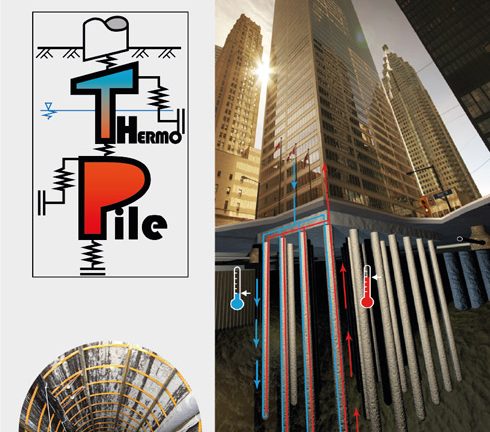
Energy Geostructures

Redefining Infrastructure: Energy Geostructures for a Sustainable Future
At the Laboratory of Soil Mechanics (LMS), we are reshaping how society interacts with the ground beneath us. Energy geostructures—innovative systems that combine structural foundations with geothermal energy harvesting—represent a bold step toward sustainable, resilient cities.
These multipurpose elements—such as building foundations, retaining walls, and tunnels—not only provide structural support but also serve as renewable energy exchangers. By tapping into the Earth’s constant subsurface temperature, they provide efficient heating and cooling for buildings, drastically reducing emissions and energy costs.
Engineering the Transition
Under the leadership of Prof. Lyesse Laloui, LMS laid the scientific foundation for energy geostructures nearly three decades ago. Today, we continue to lead the field through:
- Fundamental Research: Exploring the coupled thermal, hydraulic, and mechanical behavior of energy geostructures under real-world conditions.
- Design Tools and Technologies: Developing pioneering solutions like Thermopile software for system optimization, and launching spin-offs like Enerdrape and Geoeg to bring innovation to market.
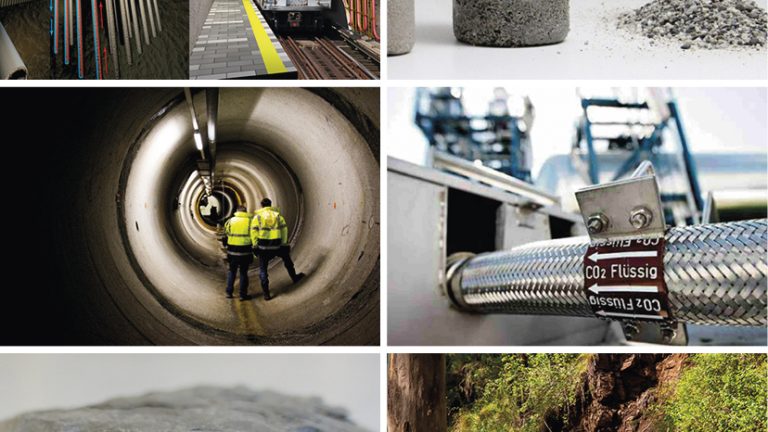
- Applied Impact: Partnering with industry to deploy solutions in complex environments—from underground carparks to data centers—turning passive infrastructure into active energy systems.
Why It Matters
Energy geostructures are a cornerstone of climate-resilient infrastructure. They integrate seamlessly into the urban landscape, require no additional land use, and enable a clean energy transition—supporting the world’s path to carbon neutrality.
At LMS, we’re not just imagining the energy systems of tomorrow. We’re building them—beneath our feet.
Research Group for Energy Geostructures:
Professors

Post-doctoral researchers

Ph.D. Candidates
Ph.D. Projects
Supervisors: Lyesse Laloui, Dimitrios Terzis, Elena Ravera
To former projects and publications
2025
-
Evaluating the geothermal potential of a metro station considering its airflow conditions. S. E. ten Bosch, E. Ravera, M. Tobler, M. Bettelini, L. Laloui. Tunnelling and Underground Space Technology, 163 (2025)
- Evaluating the geothermal potential of a metro station considering its airflow conditions. S. E. ten Bosch, E. Ravera, M. Tobler, M. Bettelini, L. Laloui. Tunnelling and Underground Space Technology, 163 (2025)
2024
- Assessing and exploiting the interaction between ventilation and geothermal systems in an underground data centre. S. E. ten Bosch; E. Ravera; M. Tobler; M. Bettelini. Tunnelling and Underground Space Technology, 144 (2024)
- Performance of complex energy geostructures. Ravera, E., Rotta Loria, A. F. & Laloui, L. Geomechanics for Energy and the Environment, 100536 (2024)
- Performance of energy piles foundation in hot-dominated climate: A case study in Dubai. Ten Bosch, S., Ravera, E., & Laloui, L. Renewable Energy, 220, 119632 (2024)
2023
-
Heriot-Watt University’s Centre of Excellence in Smart Construction Research Bulletin April 2023 – Issuu. Laloui, L., Ravera, E., Mabrouk, A.B, Rotta Loria, A., Ten Bosch, S. Heriot-Watt Centre of Excellence in Smart Construction, Research Bulletin, 7 April 2023.
- Thermo-hydro-mechanical behavior of energy barrettes: Field experiments and numerical simulations. Rotta Loria, A. F., Ravera, E., & Laloui, L. Geomechanics For Energy And The Environment, 34, 100451 (2023)
2022
- Failure mechanism of fine-grained soil-structure interface for energy piles. Ravera, E., & Laloui, L. Soils and Foundations, 62(3), 101152.
- Analysis of barrette foundations subjected to mechanical and thermal loads. Rotta Loria, A. F., Richard, N., & Laloui, L. Geomechanics for Energy and the Environment, 100333.
- Thermal interactions among vertical geothermal borehole fields. Cassina, L., Laloui, L., & Rotta Loria, A. F. Renewable Energy.
- Experimental analysis of a thermoactive underground railway station. Zannin, J., Ferrari, A., Kazerani, T., Koliji, A., & Laloui, L. Geomechanics for Energy and the Environment, 29, 100275.
2021
- Microstructure observations in compacted clays subjected to thermal loading. Houhou, R., Sutman, M., Sadek, S., & Laloui, L., Engineering Geology, 287, 105928.
- Thermal stress analysis of energy piles. Garbellini, C., & Laloui, L., Géotechnique, 71(3), 260-271.
- Experimental investigation of energy piles: From laboratory to field testing. Laloui, L., & Sutman, M., Geomechanics for Energy and the Environment, 27, 100214.
- Hydrothermal interactions in energy walls. Zannin, J., Ferrari, A., Pousse, M., & Laloui, L., Underground Space, 6(2), 173-184.
- Experimental analysis of a thermoactive underground railway station. Zannin, J., Ferrari, A., Kazerani, T., Koliji, A., & Laloui, L., Geomechanics for Energy and the Environment, 29, 100275.
- Experimental and numerical investigation of the thermo-mechanical behaviour of an energy sheet pile wall. Adinolfi, M., Loria, A. F. R., Laloui, L., & Aversa, S., Geomechanics for Energy and the Environment, 25, 100208.
2020
- Cyclic thermomechanical response of fine-grained soil-concrete interface for energy piles applications. Ravera, E., Sutman, M., & Laloui, L., Canadian Geotechnical Journal.
- Early-stage thermal performance design of thermo-active walls implemented in underground infrastructures. Zannin, J., Ferrari, A., Larrey-Lassalle, P., & Laloui, L., Geomechanics for Energy and the Environment, 100218.
- Extension of Winkler’s solution to non-isothermal conditions for capturing the behaviour of plane geostructures subjected to thermal and mechanical actions. Zannin, J., Loria, A. F. R., Llabjani, Q., & Laloui, L., Computers and Geotechnics 128, 103618.
- Equivalent pier analysis of full-scale pile groups subjected to mechanical and thermal loads. A.F.R. Loria, J.V.C. Oltra, L. Laloui, Computers and Geotechnics 120, 103410.
- Hydrothermal interactions in energy walls. J. Zannin, A. Ferrari, M. Pousse, L. Laloui, Underground Space.
- The role of thermal loads in the performance-based design of energy piles. A.F.R. Loria, M. Bocco, C. Garbellini, A. Muttoni, L. Laloui, Geomechanics for Energy and the Environment 21, 100153, DOI: 10.1016/j.gete.2019.100153.
- Long-term performance and life cycle assessment of energy piles in three different climatic conditions. M. Sutman, G. Speranza, A. Ferrari, P. Larrey-Lassalle, L. Laloui, Renewable Energy 146, 1177-1191, DOI: 10.1016/j.renene.2019.07.035.
- Performance of Energy Piles Considering Reinforced Concrete Non-Linearity. C. Garbellini, L. Laloui, Journal of Geotechnical and Geoenvironmental Engineering, DOI: 10.1061/9780784482780.005.
- Load transfer method for energy piles in a group with pile–soil–slab–pile interaction. Elena Ravera, Melis Sutman, Lyesse Laloui, Journal of Geotechnical and Geoenvironmental Engineering, doi.org/10.1061/(ASCE)GT.1943-5606.0002258
2019
- Thermal stress analysis of energy piles. C. Garbellini, L. Laloui,Géotechnique, 1-12, DOI: 10.1680/jgeot.19.p.208.
- Analysis of the interaction factor method for energy pile groups with slab. Elena Ravera, Melis Sutman, Lyesse Laloui, Computers and Geotechnics, doi.org/10.1016/j.compgeo.2019.103294
-
Energy performance and economic feasibility of energy segmental linings for subway tunnels. Benoît Cousin, Alessandro F.Rotta Loria, Andrew Bourget, Fabrice Rognon, Lyesse Laloui, Tunnelling and Underground Space Technology DOI: 10.1016/j.tust.2019.102997, 2019
- Numerical investigation of the convection heat transfer driven by airflows in underground tunnels. Peltier, M., Rotta Loria, A.F., Lepage, L., Garin, E. and Laloui, L. Applied Thermal Engineering, 2019
- Three-dimensional finite element analysis of piled rafts with energy piles. Garbellini, C. and Laloui, L. Computers and Geotechnics, 2019
2018
- Cyclic Load–Transfer Approach for the Analysis of Energy Piles. Sutman, M., Olgun, G. and Laloui, L, Journal of Geotechnical and Geoenvironmental Engineering, DOI: 10.1061/(ASCE)GT.1943-5606.0001992, 2018
- Group action effects caused by various operating energy piles. Rotta Loria, A.F., Laloui, L, Géotechnique, DOI: 10.1680/jgeot.17.P.213, 2018
- Analysis of the vertical displacement of energy pile groups. Rotta Loria, A.F., Vadrot, A. and Laloui, L,Geomechanics for Energy and the Environment, DOI: 10.1016/j.gete.2018.04.001, 2018
2017
- Effect of non-linear soil deformation on the interaction among energy piles. Rotta Loria, A.F., Vadrot, A. and Laloui, L, Computers and Geotechnics. DOI: 10.1016/j.compgeo.2016.12.015, 2017
- The equivalent pier method for energy pile groups. Rotta Loria, A.F., and Laloui, L, Géotechnique, DOI: 10.1680/jgeot.16.P.139, 2017
- Thermally induced group effects among energy pile. Rotta Loria, A.F., and Laloui, L, Géotechnique, DOI: 10.1680/jgeot.16.P.039, 2017 https://doi.org/10.1016/j.tust.2019.102997
2016
- The interaction factor method for energy pile groups. Rotta Loria, A.F., and Laloui, L, Computers and Geotechnics, 2016
- Numerical study of the response of a group of energy piles under different combinations of thermo-mechanical loads. Di Donna, A., Rotta Loria, A.F., and Laloui, L., Computers and Geotechnics, 2016
2015
- Experimental investigations of the soil-concrete interface: physical mechanisms, cyclic mobilisation and behaviour at different temperatures. Di Donna, A., Ferrari, A., and Laloui, L., Canadian Geotechnical Journal, 2015
- Predicting the axial capacity of piles in sand. Rotta Loria, A. F., Orellana, F., Minardi, A., Fürbringer, J. M., and Laloui, L., Computers and Geotechnics, 2015
Books:

Analysis and Design of Energy Geostructures,1st Edition: Theoretical Essentials and Practical Application
Analysis and Design of Energy Geostructures gathers in a unified framework the theoretical and experimental competence available on energy geostructures: innovative multifunctional earth-contact structures that can provide renewable energy supply and structural support to any built environment. The book covers the broad, interdisciplinary and integrated knowledge required to address the analysis and design of energy geostructures from energy, geotechnical and structural perspectives.
Academic Press
1st November 2019
Hardcover ISBN: 9780128206232
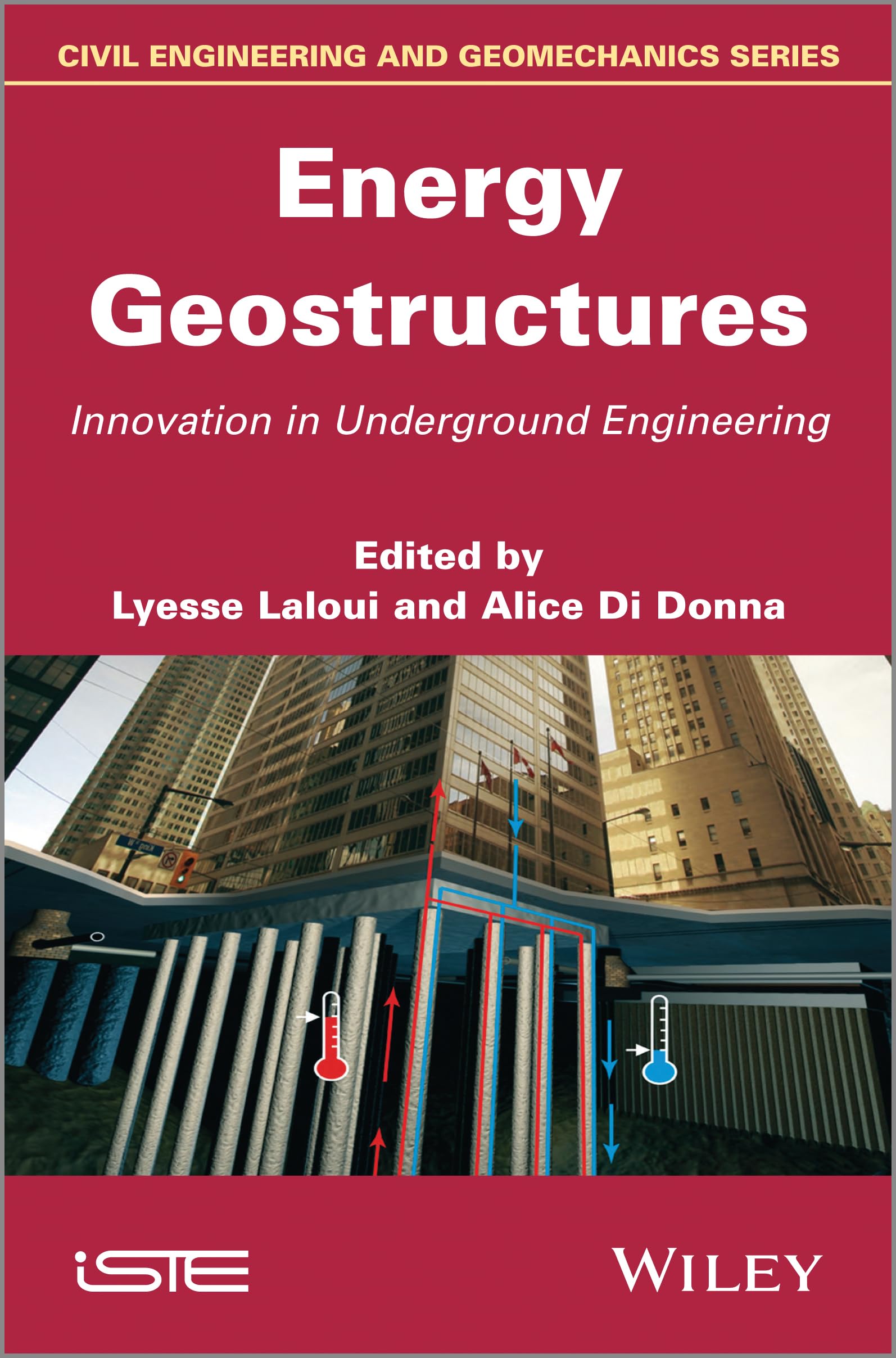
Energy Geostructures
This book explores energy geostructures—an innovative technology that combines structural support with geothermal energy exchange for heating and cooling buildings. By integrating renewable energy into foundations, these systems offer a sustainable alternative to conventional infrastructure. The book is structured in three parts: experimental modeling, numerical simulation, and engineering practice. It presents state-of-the-art research, current design methodologies, and real-world applications contributed by leading experts. A final case study illustrates the implementation of these systems, providing engineers and researchers with essential insights into this rapidly evolving field.
Wiley-ISTE
2016
Hardcover ISBN: 9781118761762
Courses
Curious to deepen your expertise in sustainable infrastructure? The Energy Geostructures: Analysis and Design course, taught at EPFL by leading experts in the field, offers a unique opportunity to explore the principles, modelling, and practical implementation of this innovative technology.
Whether you’re a practicing engineer, researcher, or student, this intensive course bridges theory and application—empowering you to design geostructures that harness the Earth’s energy for a more sustainable built environment.

Media:
2023-2025




2022
Published in 24 Heures on 19 May 2022.
Published at EPFL on 02 June 2022.
Published at EPFL on 03 May 2022.
Published at EPFL on 29 November 2021.
Published at EPFL on 07 October 2021.
Published at EPFL on 05 May 2021.
Published at EPFL on 25 February 2021.
Published at EPFL on 22 January 2021.
2020
Published at EPFL on 23 November 2020.
Published at EPFL on 24 September 2020.
Published at EPFL on 07 October 2020.
Published at EPFL on 15 July 2020.
2018
Published in Madrid Subterra on 07 November 2018.
Published in TRACES 21 / 2018: Géothermie on 07 November 2018.
Published in the ‘’24 heures’’ on 10 January 2018.
2015
Published in « Terre&Nature » on 21 May 2015.
2014
Published in the »24 heures » on 29 March 2014.
2013
Published in Deep Foundations on March/April 2013
2012
Published in La Regione Ticino on 02 February 2012.
2011
Published in Le Moniteur du BTP on 16 December 2011.
Published in the Ee-news on 1 July 2011.
Published in the EPFL news on 25 May 2011.
Tech – Transfer

ENERDRAPE
We developed the first geo-thermal panel that efficiently captures both geothermal and waster heat in existing indoor environments located in the underground and transfers it for renewable heating and cooling to buildings. Unlike conventional geothermal systems, the technology developed relies on a non-invasive installation, allowing the use of shallow geothermal energy in existing buildings. The modular geo-thermal panels are meant to be installed in existing underground indoor environments such as underground parking, underground transportation hubs, tunnels etc. With the modular geo-thermal panels we facilitate access to renewable shallow geothermal energy to existing buildings while reducing capital investments, operation costs and CO2 emissions.