
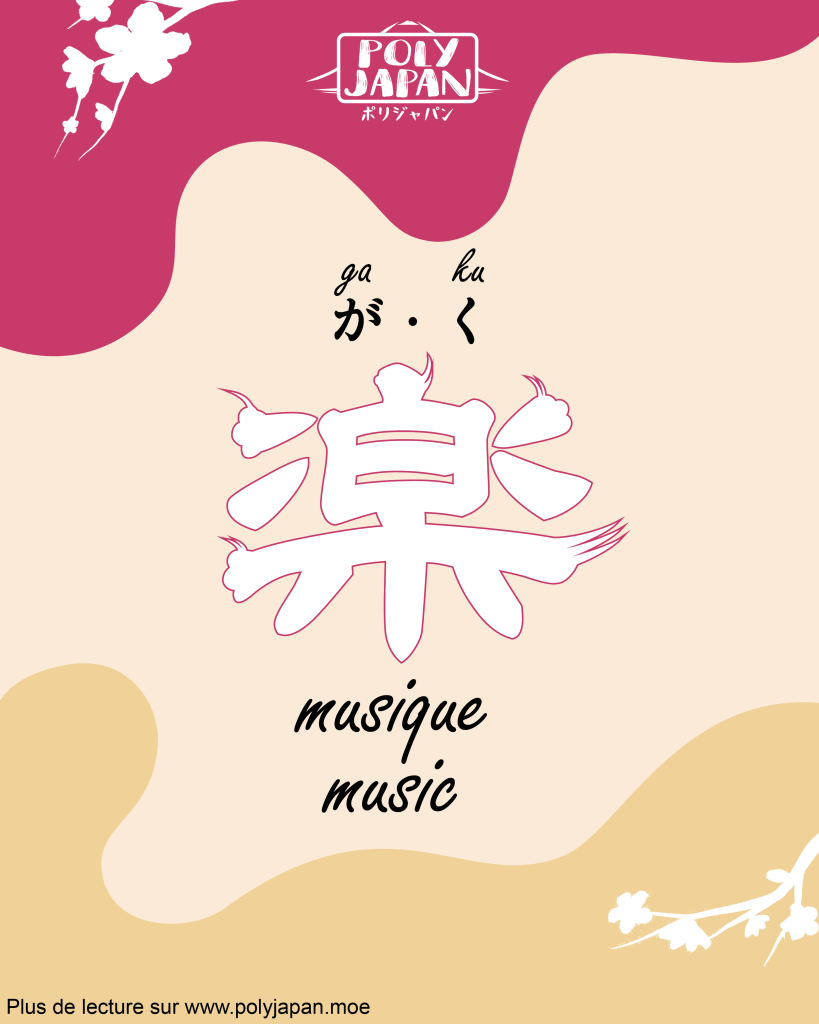
Cette semaine, amusons-nous à étudier le kanji 楽 (gaku), lié au monde de la musique et à tout ce qui est agréable !
Dans le mot 音楽 (ongaku, musique), 楽 est utilisé aux côtés de 音 (on, le son) : la musique est donc tout simplement un son agréable ! Et pour beaucoup de mots musicaux, c’est bel et bien 楽 qui est utilisé et non le kanji du son. Il est ainsi combiné au kanji de l’ustensile 器 pour désigner les instruments 楽器 (gakki), et au kanji du groupe 団 pour désigner un orchestre (楽団, gakudan). Pour ces derniers, on trouve toutefois aussi l’anglicisme オーケストラ (ookesutora).
Pour ce qui est du champ lexical de l’agréable, 楽 se pronounce plus souvent “raku” (et, tout seul, signifie “relaxation”) ou encore “tano(shii)” (楽しい , amusant). Certaines formes d’art l’utilisent, comme le 文楽 (bunraku, phrase + agréable), le théâtre de marionnettes japonais.
Enfin, il existe un kanji dérivé de 楽 : 薬 (médicament, drogue), composé de 楽 … et du radical “herbe” !
—
This week, let’s have some fun learning the kanji 楽 (gaku), which is related to the world of music and everything that’s enjoyable!
In the word 音楽 (“ongaku”, music), 楽 is used alongside 音 (“on”, sound): music is simply a pleasant sound! And for many music-related words, it’s indeed 楽 that’s used and not the kanji for “sound.” It’s combined with the kanji for “utensil” (器) to refer to musical instruments (楽器, gakki), and with the kanji for “group” (団) to refer to an orchestra (楽団, gakudan). For the latter, however, the English loan word オーケストラ (ookesutora) is also used.
When it comes to the lexical field of enjoyability, 楽 is more often pronounced “raku” (which on its own can mean “relaxation”) or “tano(shii)” (楽しい, fun). Certain art forms use it, such as 文楽 (“bunraku”, literature + enjoyment), the Japanese puppet theater.
Finally, there exists a kanji derived from 楽: 薬 (medicine, drug), composed of 楽 … and the “grass” radical!