
Nicola Braghieri and Filippo Cattapan “The Composite Presence Of Public Space from the Scena Comica to Collage City: Virtual Urban Representations as Visual Disciplinary Tools,” Septembre 2022.
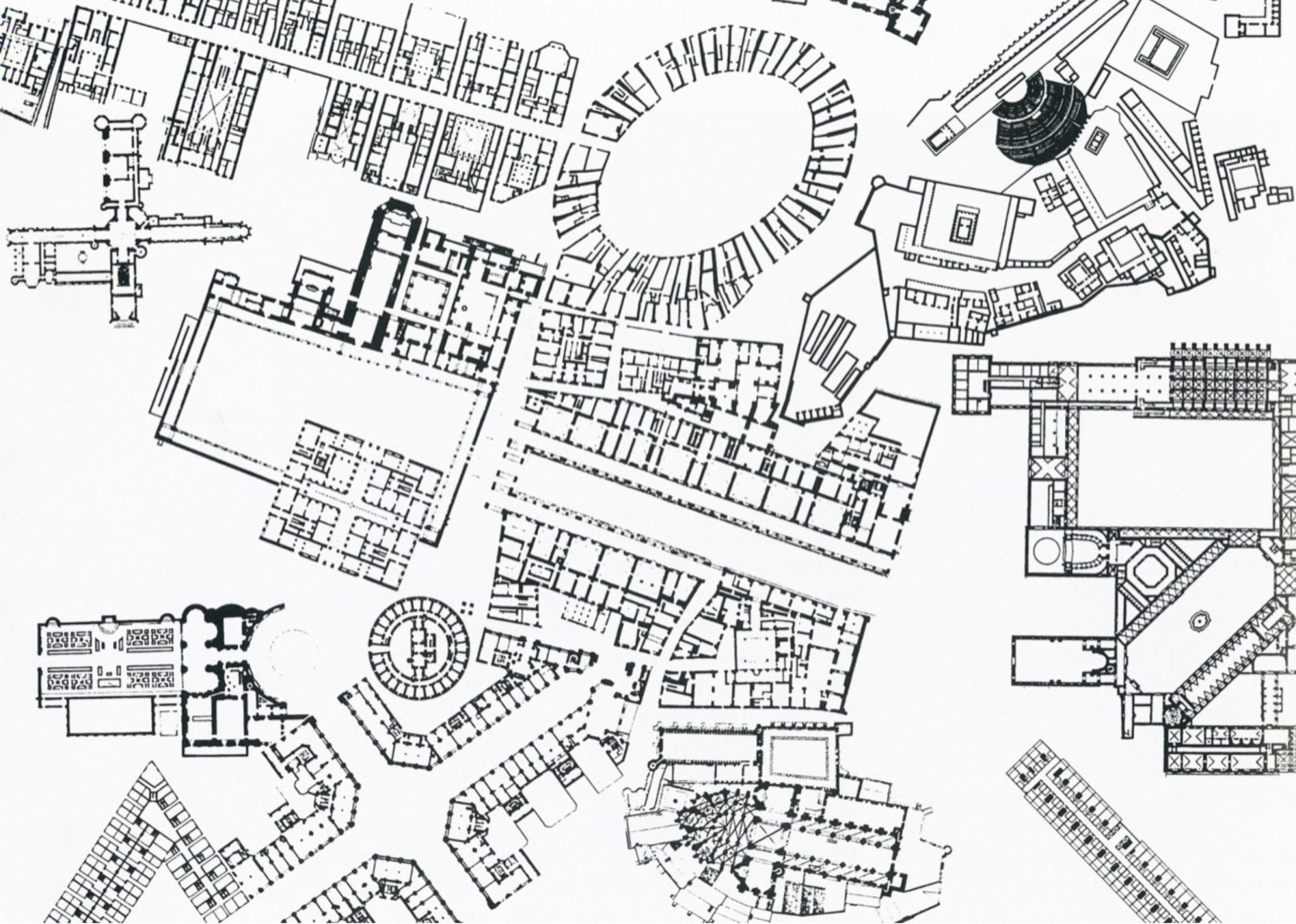
The essay traces the concept of the « composite city » as a recurring visual and disciplinary paradigm in Western architectural culture, from the theatrical scenography of the Italian Renaissance to Rowe and Koetter’s Collage City (1978). The composite city is defined not as an ideal city but as a fictional urban construct assembled from multiple heterogeneous fragments — spatially, geographically, and chronologically — producing a synchronic dimension in which the linear notion of space and time is suspended.
The authors argue that such images functioned not merely as urban representations but as operative disciplinary tools transmitting architectural knowledge in a tacit and visual manner. The composite city is understood as an archetype of a universal attitude towards the city and discipline — a design approach but also a psychological disposition towards reality and the world — in which images were and still are operational tools with which to think, re-think, and transmit disciplinary content.
The essay moves through key historical moments: Serlio’s Scena Comica, the ideal city panels of Urbino, Berlin, and Baltimore, Alberti’s renovatio urbis, Canaletto’s Capricci, and the Strada Novissima at the 1980 Venice Biennale. The composite city ultimately operates as a cognitive paradigm of disciplinary thought — a structurally visual paradigm founded on the mediation of images, their collection by affinity and analogy, and their assemblage in the form of fragments, situated on the boundary between reality and ideality, theory and practice.