
Sustainable Labs

Reducing the footprint of research
Scientific research is at the core of EPFL’s mission. But cutting-edge research also comes with a significant environmental footprint. Laboratories consume large amounts of energy, generate substantial quantities of plastic, chemical, and biological waste, and contribute considerably to greenhouse gas emissions.
At EPFL, we are committed to understanding and reducing this impact. Through the development of new assessment methods, innovative research practices, and pilot initiatives across laboratories, we support researchers in measuring and improving the environmental performance of their work. Our goal is to enable scientific excellence while advancing more sustainable laboratory operations: reducing emissions, optimizing resource use, and fostering a culture of collective responsibility without compromising research quality.
The Green Labs initiative is part of EPFL’s Climate & Sustainability Strategy 2030, which aims to reduce GreenHouse Gas emissions by an average of 40% from 2006/2019 levels and reach climate neutrality by 2040. Research activities are a key lever in reaching this goal.

The Sustainable Labs initiative guided by clear and ambitious vision:
“All EPFL laboratories conduct environmentally and socially responsible research without compromising the research quality. Laboratory practices are especially aligned with planetary boundaries.”
The implementation of this vision across EPFL laboratories is structured around four key steps:

Evaluate:
- To assess the environmental and social impacts associated with research laboratories, we empower labs in conducting an environmental footprint assessment using the EPFL CO₂ Calculator at either the laboratory or project level, in accordance with the GHG Protocol methodology.
Plan:
- Based on this carbon footprint assessment, we support labs to develop an action plan and strategy with the research team to reduce the environmental and social impacts associated with research labs. It is key to prioritize actions by identifying those that have a high impact reduction and high feasibility.
Transform:
- Labs should implement their action plan that involves changes in lab operations, procurement, waste management, stakeholder engagement and communication.
Educate:
- Educating the EPFL community is a key enabler to raise awareness or promote sustainability practices through interventions in Bachelor, Master or Doctoral courses, development of specific sustainability programs and organization of events (Green Academy, Plastic collage, conferences). We actively participate in and promote national and international green laboratory initiatives and networks.
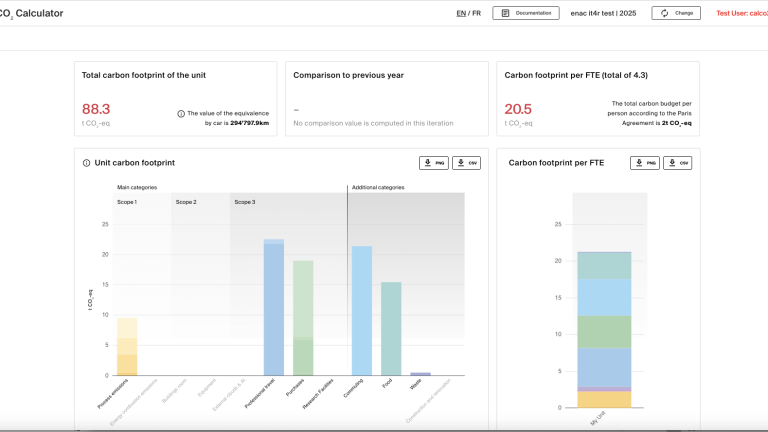
The EPFL CO₂ Calculator is an innovative tool developed to support research laboratories in understanding and reducing their environmental impact. It provides a rigorous and practical framework to assess emissions linked to research activities such as energy consumption, travel, equipment uses, and procurement.
The CO₂ Calculator is designed to support laboratories and EPFL leadership in:
- Understanding their specific carbon footprint, adapted to different research domains,
- Identifying targeted and effective actions to reduce emissions,
- Visualizing the relative contribution of different emission sources,
- Providing a clear and detailed overview of laboratory-level emissions.
EPFL CO₂ Calculator
Learn more about the CO₂ calculator.
Building more sustainable laboratories at EPFL requires a collective and coordinated effort. Because research activities and infrastructures vary significantly across faculties and laboratories, meaningful change depends on practical actions adapted to each research environment.
Whether you are a researcher, lecturer, engineer, technician, or administrative staff member, you can help reduce the environmental footprint of research through everyday decisions and laboratory practices.
Here are a few examples of individual actions that can make a difference:
- Name a sustainability coordinator within your laboratory,
- Evaluate your laboratory’s environmental impact using the carbon emissions calculator,
- Extend the lifespan of research equipment through maintenance and repair,
- Encourage equipment sharing and reuse between laboratories,
- Assess actual needs before purchasing new equipment,
- Switch instruments and devices to standby or energy-saving mode when not in use,
- Keep fume hood sashes closed to reduce energy consumption,
- Optimize refrigerator and freezer use by sharing storage space and regularly defrosting units,
- Reduce plastic, chemical, and biological waste whenever possible.
Each faculty is also developing approaches tailored to its specific research activities and operational needs. In several faculties, dedicated Sustainability Managers support laboratories in implementing sustainable research practices and identifying improvement opportunities.
| School/Entity | More Informations | Contact |
| Life Science School (SV) | https://www.epfl.ch/schools/sv/school-of-life-sciences/about-us/sv-sustainability-office/sv-green-labs-corner/ | Mai-Phuong Dinh |
| Engineering School (STI) | https://sti.epfl.ch/sti-green-labs-eng/ | Anna Kounina Massé |
| Basic Science (SB) | https://www.epfl.ch/schools/sb/ | Tomoko Muranaka |
| School of Computer and Communication Sciences (IC) | There is no Sustainability manager at this school | Bryan Bourrat |
| School of Architecture, Civil and Environmental Engineering (ENAC) | There is no Sustainability manager at this school | Bryan Bourrat |
| CMi | Cyrille Hibert | |
| Research Facilities | Bryan Bourrat |